
What Is Bore and How Does It Work?
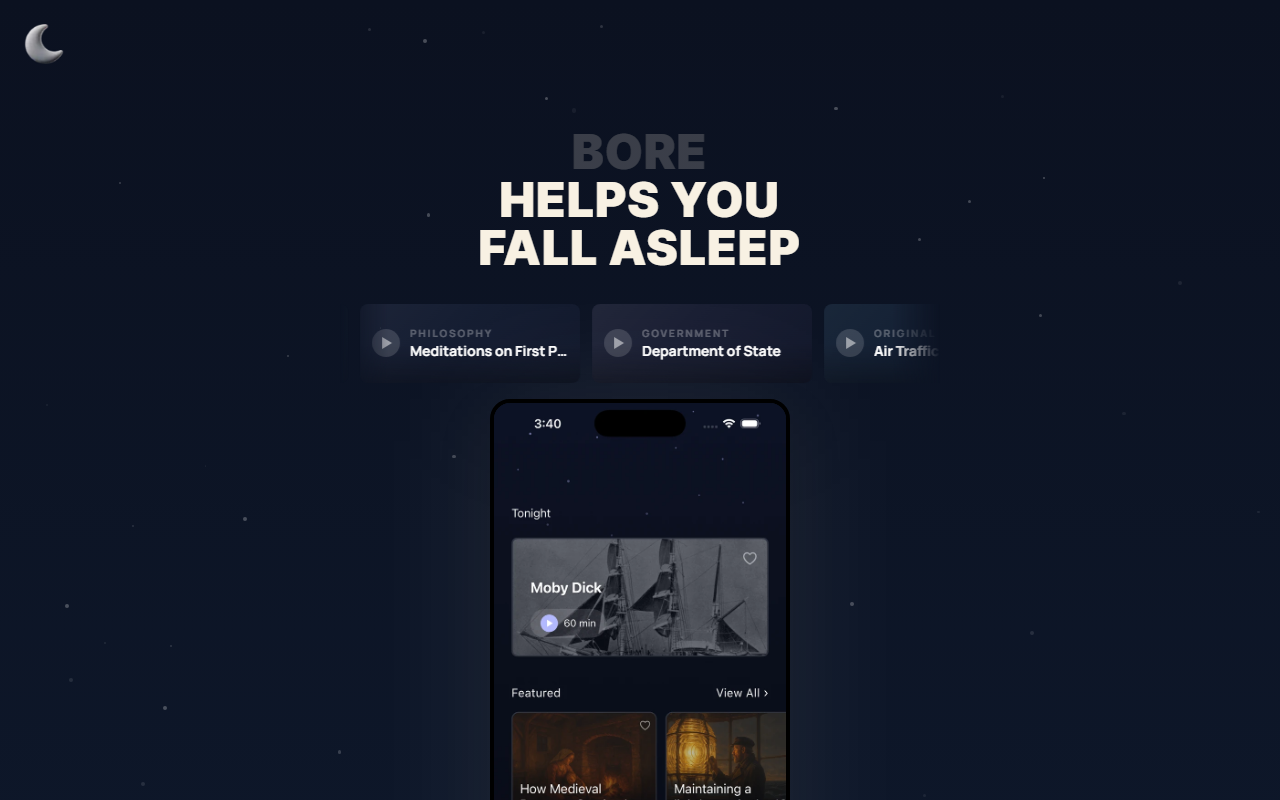
Upon visiting historysleep.com, you're greeted by a stark, minimalist interface. No flashy graphics, no onboarding wizard—just a grid of audio cards with titles like "Maintaining a Lighthouse in the 1800s" and "How Medieval Peasants Survived Winter". The tagline "Bore helps you fall asleep" is both honest and clever. The tool curates long-form, dry content—government hearings, classic novels read aloud, medieval history—delivered in a flat, monotone AI voice designed to lull you into drowsiness. There's a single audio player at the bottom showing elapsed time and a playback slider. No playlists, no user profiles, no interactive features. It's almost aggressively simple.
When I tested the free tier, I selected "Department of State Hearing." The AI voice spoke at a measured, droning pace, with no emotional inflection. The content itself was intentionally tedious: bureaucratic proceedings interspersed with pauses. Within four minutes, my eyelids grew heavy—which is exactly the point. The app is available via a QR code for iOS, but there's no web player for extended sessions. The whole experience is streamlined and frictionless, but also feels remarkably underbuilt compared to most modern audio tools.
Interface, Audio Quality, and Onboarding
The dashboard shows a scrollable list of about 20 audio titles, grouped loosely by categories like GOVERNMENT, CLASSIC, MEDIEVAL, and CRAFTS & TRADES. Each entry links to a 10-second preview? The player shows "0s / 10s" which seems like a placeholder—or the free version only offers 10-second samples. This is confusing. The actual audio runs longer (I heard several minutes), but the timer doesn't update accurately. That oversight aside, the audio quality is decent: clean, with no background noise, but the AI voice lacks the warmth of a human narrator. It's deliberately monotonous, but some may find it grating rather than soothing.
Onboarding is virtually nonexistent. You land on the page, pick an audio, and press play. There's no signup required for the web version, though the iOS app likely demands an account. A testimonial from "Drew P." reads: "Unhooks my brain." Another user, "pequickster," says "Finally stopped YouTube scrolling." These indicate the tool's core value proposition: replacing mindless content consumption with purposefully boring audio that encourages sleep. However, the lack of clear pricing or subscription information on the main site is a red flag. Scanning the QR code leads to the app store, where pricing may be listed. Based on the website alone, pricing is not publicly listed, which limits transparency.
Strengths, Limitations, and How It Compares
Bore's strength lies in its focused premise. Most sleep apps (like Calm or Headspace) offer guided meditations or ambient sounds that can become stimulating. Bore flips the script: it uses dry, academic narration to decouple your brain from active thought. The niche content—government hearings, lighthouse maintenance guides—ensures you don't get intellectually hooked. It's a clever psychological trick that leverages boredom as a sleep aid. Additionally, the tool is entirely free on the web, which is a barrier-free entry for anyone curious.
However, the limitations are significant. The audio library is tiny (maybe 20-30 pieces), and there's no new content added frequently. The web interface feels unfinished—the timer bug is a minor but annoying flaw. There's no cross-device syncing, offline downloads, or sleep timer feature. Unlike audiobook services like Audible or sleep-focused apps like Slumber, Bore lacks depth and configurability. It's best suited for people who desperately need a non-stimulating wind-down routine and can tolerate monotony. Not recommended for those who prefer variety, background music, or human narration.
Who Should Use Bore?
Bore is ideal for individuals who struggle with racing thoughts at bedtime and find that typical sleep aids—white noise, ASMR, or even audiobooks—keep them alert. It's also a great option for minimalists who want one-purpose tools. If you're a history buff or enjoy obscure trivia, the content might even become a cozy ritual. Conversely, if you need rich soundscapes, storytelling, or customization, look elsewhere. The app is still in its early stages (no funding information available) and feels like a passion project. That honesty is refreshing, but it also means users should expect rough edges.
After spending half an hour falling asleep to Moby Dick read like a congressional transcript, I'm convinced Bore has a real, narrow use case. It won't replace your next-generation sleep tracker, but it might replace your late-night YouTube spiral. Give it a try if you're tired of being kept awake by content that's too interesting.
Visit Bore at https://historysleep.com/ to explore it yourself.













Comments