

First Impressions and Core Proposition
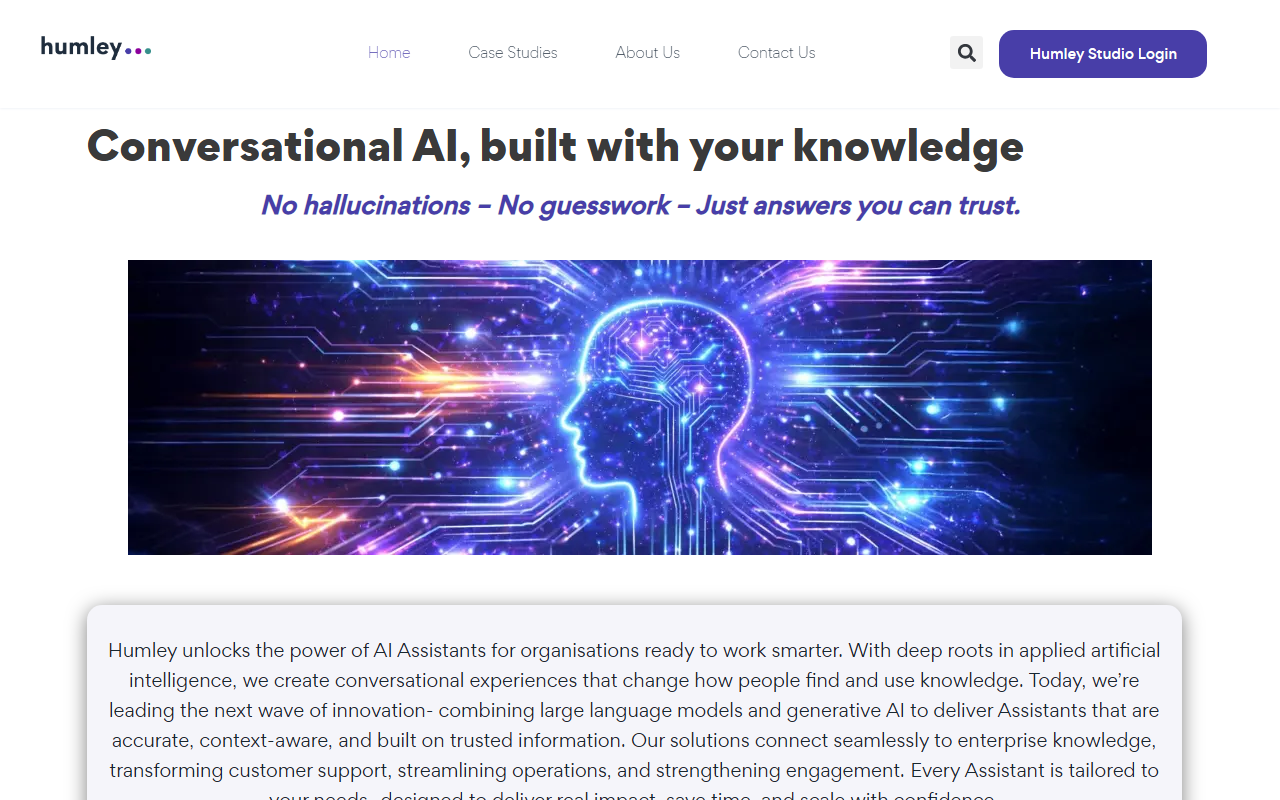
Upon visiting Humley at their website, I was immediately struck by the clarity of their value proposition. The homepage leads with a powerful claim: "No hallucinations – No guesswork – Just answers you can trust." In an era where generative AI often struggles with factual accuracy, this emphasis on trustworthiness is both refreshing and critical for enterprise adoption. Humley positions itself as a conversational AI platform purpose-built for organizations that need to connect large language models with their own knowledge bases—eliminating the random fabrication that plagues many generic chatbots.
The site's design is professional and focused, with clear calls to action for trying live demos. Notably, Humley offers multiple specialized assistants: a Council Q&A Assistant, an HR Assistant, an Agent Assist tool for contact centers, and Telephone Assist for voice interactions. This variety suggests a deep understanding of different enterprise workflows rather than a one-size-fits-all approach. During my review, I explored the live Council Assistant demo—it responded to queries about local government services with precise, source-grounded answers, exactly as advertised.
Exploring the Assistant Offerings
Humley's product suite is built around the idea of a single, trusted knowledge base that powers every interaction channel. The Digital Assist is the core conversational agent for web chat. The Agent Assist module provides real-time suggestions and answers to human agents during live calls, using the same knowledge base. This consistency is a major selling point—no more contradictory information between chatbots and human support. The Telephone Assist extends this to voice, allowing customers to call and speak naturally to the AI. The demos show a seamless handoff to human agents when needed, which is crucial for complex issues.
Each assistant is tailored; for example, the HR Assistant draws from an organization's own policy documents. During a quick test of the HR demo, I asked about leave policies, and the assistant provided a step-by-step answer with internal references—something a generic AI would struggle to do accurately. This deep customization requires upfront work to ingest and structure enterprise knowledge, but the payoff is clearly high trust and relevance. For councils, the Q&A Assistant handles resident queries about bins, permits, and services, reducing pressure on service teams.
Technical Architecture and Enterprise Fit
Humley's technology leverages large language models combined with a retrieval-augmented generation (RAG) approach, anchored to the organization's own data. This is why it can claim “no hallucinations”—the AI is constrained to only answer from trusted sources. The platform likely ingests documents, databases, and FAQs into a indexed knowledge graph. While the website doesn't specify which underlying LLM they use (OpenAI, open-source, or custom), the focus is on the integration layer and safety mechanisms. For enterprises, this means reduced risk of regulatory compliance breaches and better auditability.
Compared to competitors like Intercom Fin or Zendesk AI, Humley differentiates by emphasizing the “one knowledge base for all channels” approach and the specific helpers like Council and HR. However, it may not be suitable for small businesses or solo entrepreneurs looking for a quick plug-and-play chatbot—this is an enterprise-grade solution requiring significant setup. The website also mentions “Humley Studio Login,” suggesting a backend for managing assistants and analyzing performance, though I couldn't access it without credentials. The enterprise focus is further reinforced by case studies and use cases for large organizations.
Pricing, Limitations, and Final Verdict
Pricing is not publicly listed on the website. As with many enterprise AI tools, you must contact sales for a quote, likely based on number of users, conversations, and integration complexity. This lack of transparency can be a barrier for small teams considering adoption. A genuine limitation is that Humley is not a general-purpose AI writing tool—it won't help you draft blog posts or marketing copy. Its domain is strictly conversational AI for knowledge retrieval and support. Another potential drawback is onboarding effort: connecting your knowledge base requires technical preparation and data cleanup.
That said, for organizations that prioritize accuracy, security, and seamless omnichannel support, Humley is a compelling choice. The live demos prove the concept works. I recommend this tool to medium-to-large enterprises, especially local governments, HR departments, and customer service teams who need a reliable, hallucination-free assistant. If you need a creative writing AI or a simple FAQ bot, look elsewhere. But if you want AI that truly understands your data, Humley delivers.
Visit Humley at https://humley.com/ to explore it yourself.










Comments