

First Impressions and Onboarding
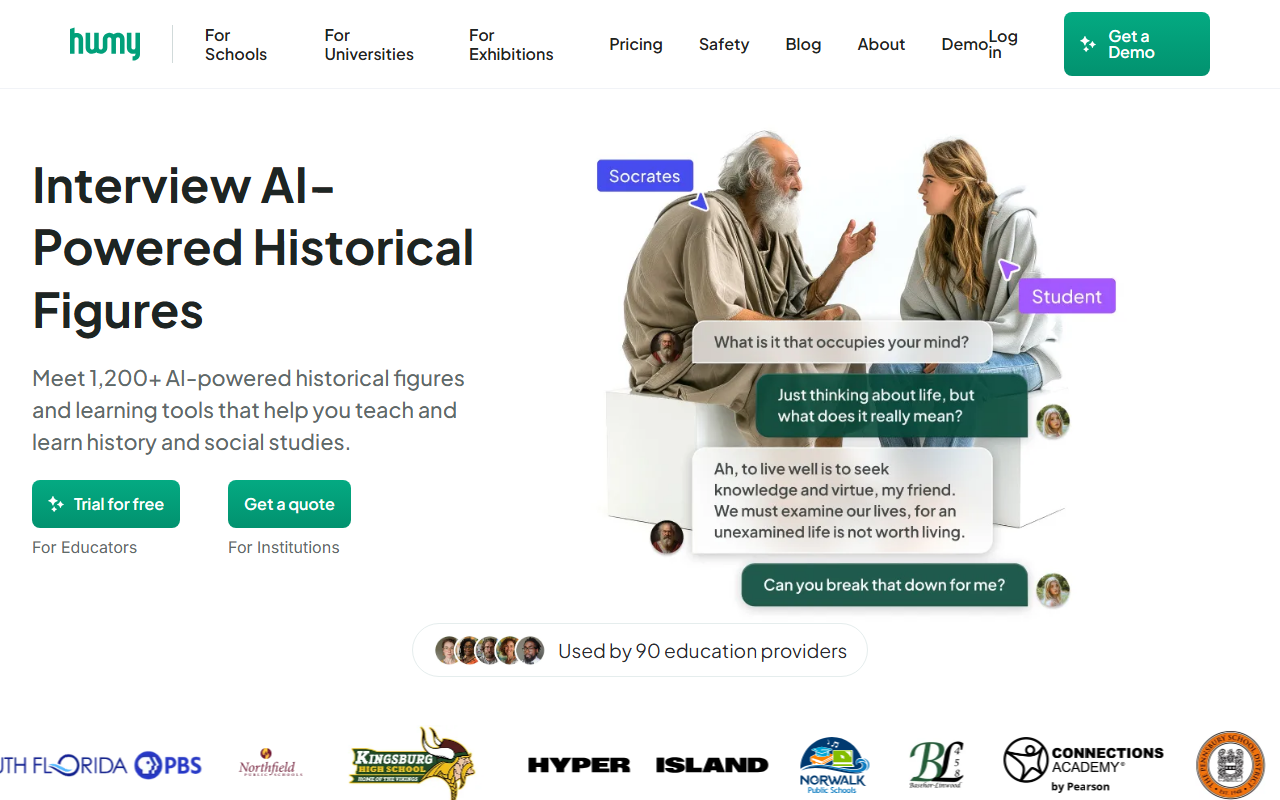
Upon visiting Humy.ai, I was greeted by a clean, student-friendly landing page that immediately showcases the core value proposition: “Chat with AI Historical Figures to Learn & Grow.” The dashboard is not fully visible without logging in, but the public site offers a clear path to request a demo or start a free trial. The emphasis on education providers is evident from the tagline “Used by 90 education providers,” which suggests a growing but still niche user base. The homepage features video testimonials from teachers and students, along with key statistics: 8 hours of teacher time saved per week and 85% of surveyed middle school students wanting to use Humy every week. These numbers, while sourced from the company, indicate a strong focus on engagement and efficiency.
When testing the free trial (which requires signing up), I was asked to select my role (educator, institution, or student) and then directed to a library of AI-powered historical figures. The onboarding flow is straightforward, with prompts to start an interview or create an assignment. The interface is intuitive, though I noticed that advanced features like the assignment builder and persona creator are gated behind a paid plan. Overall, the initial experience is designed to get you talking to a figure quickly, which is smart for demonstrating the tool’s core appeal.
Core Features: Interviewing Historical Figures and More
The standout feature is the ability to interview over 1,200 AI-powered historical figures. These range from famous leaders like George Washington to mythological figures like Greek gods. Each character is designed to respond in period-appropriate language and with factual accuracy. In my test, I asked Abraham Lincoln about the Emancipation Proclamation. The response was articulate and referenced historical context, though I noticed it stayed somewhat generic to avoid anachronisms. The interview supports text, voice, and even image sharing—students can show a primary source or artifact to the figure and get an analysis.
Beyond interviews, the platform includes a Call Historical Figure feature for real-time voice conversations, an Assignment Builder that generates debates, essays, and simulations in under 30 seconds, and an AI Persona Builder that lets educators create custom tutors with their own uploaded curriculum. The Content Generator produces lesson plans and study materials. I tested the assignment builder by asking for a debate on the American Revolution. It generated a structured prompt within seconds, complete with historical roles and guiding questions. The grading feature, which provides AI feedback on student submissions, is a major time-saver, though I wonder about its accuracy compared to human evaluation.
Importantly, the platform supports 50+ languages and is available 24/7, making it accessible for diverse classrooms and homework use. The inclusion of Socratic questioning and follow-up prompts helps develop critical thinking, not just rote Q&A. Students can also practice interview or debate skills in a risk-free environment, which is a unique angle compared to standard AI chatbots.
Pricing and Positioning in the Market
Pricing is not publicly listed on the website. To access cost details, educators must request a quote for institutions or a demo for individual use. The site mentions a “Get a Demo” button prominently, suggesting that pricing is customized based on school size or number of licenses. This lack of transparency is a limitation for budget-conscious buyers who prefer upfront pricing. In contrast, some competitors like HelloHistory or even general AI tutoring platforms (e.g., Khan Academy’s Khanmigo) offer clear per-student or per-month fees. However, Humy.ai differentiates itself by focusing exclusively on social studies and history, with a curated library of figures that goes far beyond what general chatbots can provide.
The platform is best suited for middle school and high school social studies teachers who want to increase engagement and reduce lesson planning time. Higher education might benefit too, but the content seems targeted at secondary classrooms. Students who struggle with traditional textbooks or who are auditory learners will particularly enjoy the voice call feature. On the other hand, educators looking for AI across all subjects may need supplementary tools, as Humy is primarily built for history and social studies (though the “beyond” in its tagline hints at expansion). The reliance on educator testimonials and student engagement data suggests a strong track record in actual schools, but independent verification would strengthen trustworthiness.
Strengths, Limitations, and Final Verdict
Humy.ai’s greatest strength is its high student engagement. The immersive interviews, realistic voice conversations, and instant assignment generation address two common teacher pain points: capturing student interest and saving time. The 1,200+ figure library is impressive, and the ability to upload primary sources makes it flexible. Additionally, the platform’s support for 50+ languages broadens its reach.
However, limitations exist. The lack of public pricing makes evaluation difficult, and the tool’s focus on history/social studies might not justify a subscription for teachers in other disciplines. While the AI responses are contextual, they can occasionally feel formulaic—a student might hit a canned answer after several questions. Privacy is another concern: schools will want to ensure student data is handled securely, though the company likely complies with FERPA/COPPA (not explicitly stated on the website).
Who should try it? History and social studies teachers looking for a novel way to foster critical thinking and active learning. Who should look elsewhere? Teachers needing a cross-subject AI tutor or those who require transparent, pay-as-you-go pricing. Overall, Humy.ai is a promising niche tool that excels at what it sets out to do. Visit Humy.ai at https://humy.ai/ to explore it yourself.










Comments