

First Impressions: A Policy‑Focused One‑Day Conference
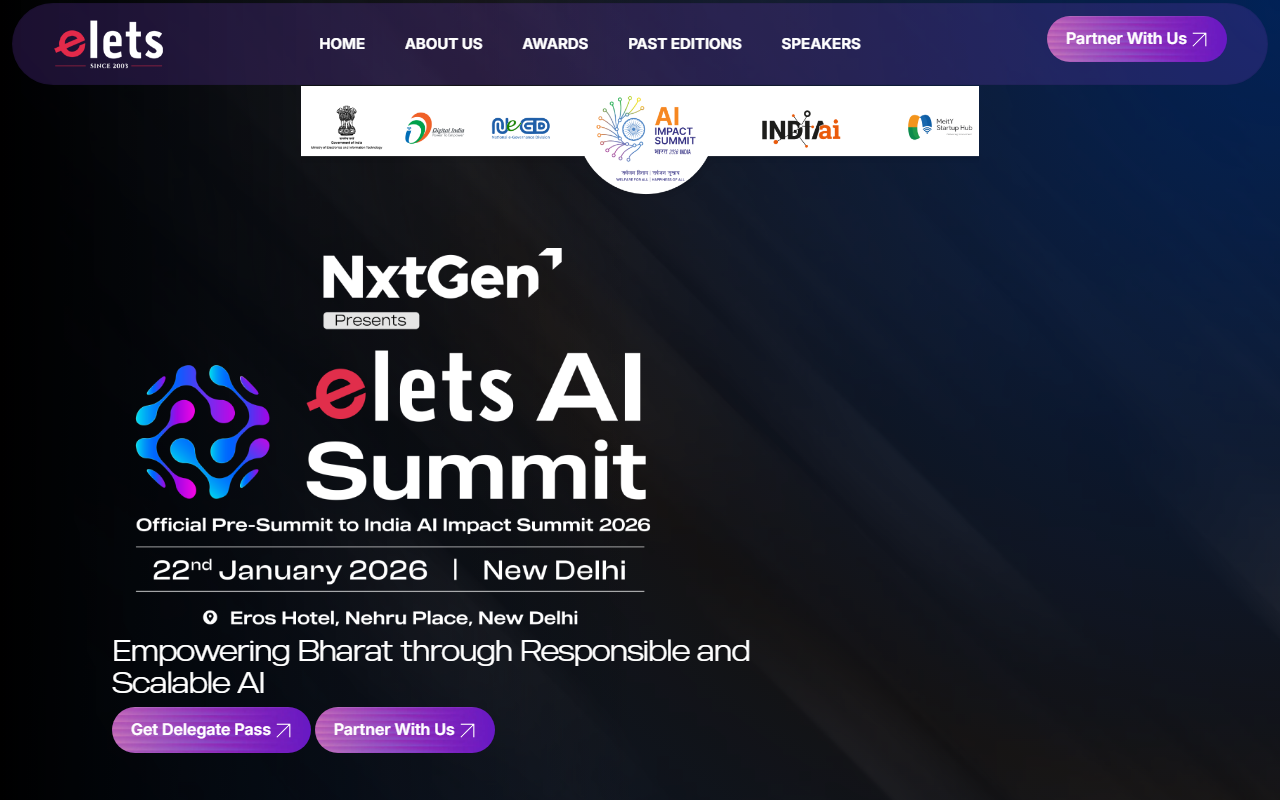
Upon visiting the India AI Summit website, the first thing I noticed is a clean, professional landing page that wastes no time in stating its purpose: “Empowering Bharat through Responsible and Scalable AI.” The layout is straightforward—hero section with dates (22 January 2026), venue (Eros Hotel, New Delhi), and key metrics: 20+ partners, 350+ participants, and 60+ speakers. Below that, the site briefly describes the event as a national flagship platform for dialogue, innovation, and policy exchange. There is no dashboard or interactive tool; this is a conference announcement site for a single‑day event. The navigation is minimal, offering “Get Delegate Pass” and “Partner With Us” calls‑to‑action, but no ticket prices are visible on the homepage. The content clearly targets government leaders, enterprise executives, and technology partners rather than individual learners or practitioners.
Focus Areas and Audience: Where the Summit Digs In
The conference lists nine distinct focus areas, each tied to a specific AI application: Energy & Power (outage prediction, loss reduction), Urban Infra & Smart Cities (smart traffic, water intelligence), Healthcare (faster diagnosis, clinical AI), Agriculture (precision farming, yield prediction), Manufacturing (predictive maintenance, zero downtime), BFSI (fraud analytics), Mobility & Transportation (route optimisation, fleet intelligence), and Information Technology (AI architectures, data infrastructure). These are not vague categories; they reflect real‑world problems that Indian government departments and public‑sector enterprises face. The summit appears designed to bridge the gap between policy and implementation by bringing together decision‑makers from ministries, public sector units, and tech providers. Unlike learning platforms such as Coursera or DeepLearning.AI, this is not a place to acquire hands‑on coding skills. Instead, it offers high‑level strategy sessions, startup showcases, and policy dialogues. For context, alternatives like the NVIDIA GTC or AI Summit London cover similar ground but are larger in scale and often include more technical workshops. The India AI Summit clearly positions itself as a domestic policy‑action hub rather than a global tech conference.
Speakers and Value Proposition: Government Heavyweights Take the Stage
What sets this summit apart is the speaker lineup. The website lists over 30 government officials, including senior IAS officers, secretaries from ministries like Home Affairs, Health, Defence, and Commerce, as well as representatives from NITI Aayog, MeitY, DRDO, and the World Bank. Notable names include Meeta R Lochan (Secretary, NCBC), Dr. Rajendra Kumar (Secretary, Ministry of Home Affairs), and Kavita Bhatia (Scientist ‘G’ at MeitY and COO IndiaAI Mission). This concentration of high‑level policymakers means the summit is arguably unmatched in providing direct access to the architects of India’s AI strategy. For any company or organisation looking to understand, influence, or align with India’s AI regulatory and implementation roadmap, this event offers a unique networking opportunity. The focus on “Responsible AI” also suggests that ethical considerations and governance will be central topics—timely given global discussions around AI safety. However, the website does not publish a detailed agenda, workshop descriptions, or any recorded past sessions. As a first‑time visitor, I could not gauge the depth of content beyond the speaker titles. This lack of transparency may be a drawback for those deciding whether to travel or invest in a delegate pass.
Pricing and Verdict: Who Should Attend—and Who Should Skip
Pricing is not publicly listed on the website. The “Get Delegate Pass” button leads to a form that likely returns a quote or registration link, but no tiers are shown. Similarly, “Partner With Us” offers no upfront cost details for sponsorship or exhibition slots. This is common for high‑end B2B conferences, where prices are negotiated based on organisat>ion size and sponsorship level. For individuals hoping to attend as general delegates, the lack of transparent pricing may be frustrating. Strengths of the India AI Summit include its exclusive access to senior Indian government officials, a clear focus on responsible deployment across critical sectors, and a tightly packed one‑day format that respects busy schedules. Its limitations: no hands‑on learning, no published agenda depth, no virtual attendance option mentioned, and a very short event that may feel hurried for deep discussion. I would recommend this summit to senior executives in enterprises that work with Indian government departments, startups seeking policy visibility, and international organisations interested in India’s AI landscape. If you are a developer or student looking to learn AI skills, look elsewhere—this is a networking and policy event, not a training platform. Visit India AI Summit at https://indiaaisummit.in/ to explore it yourself.













Comments