

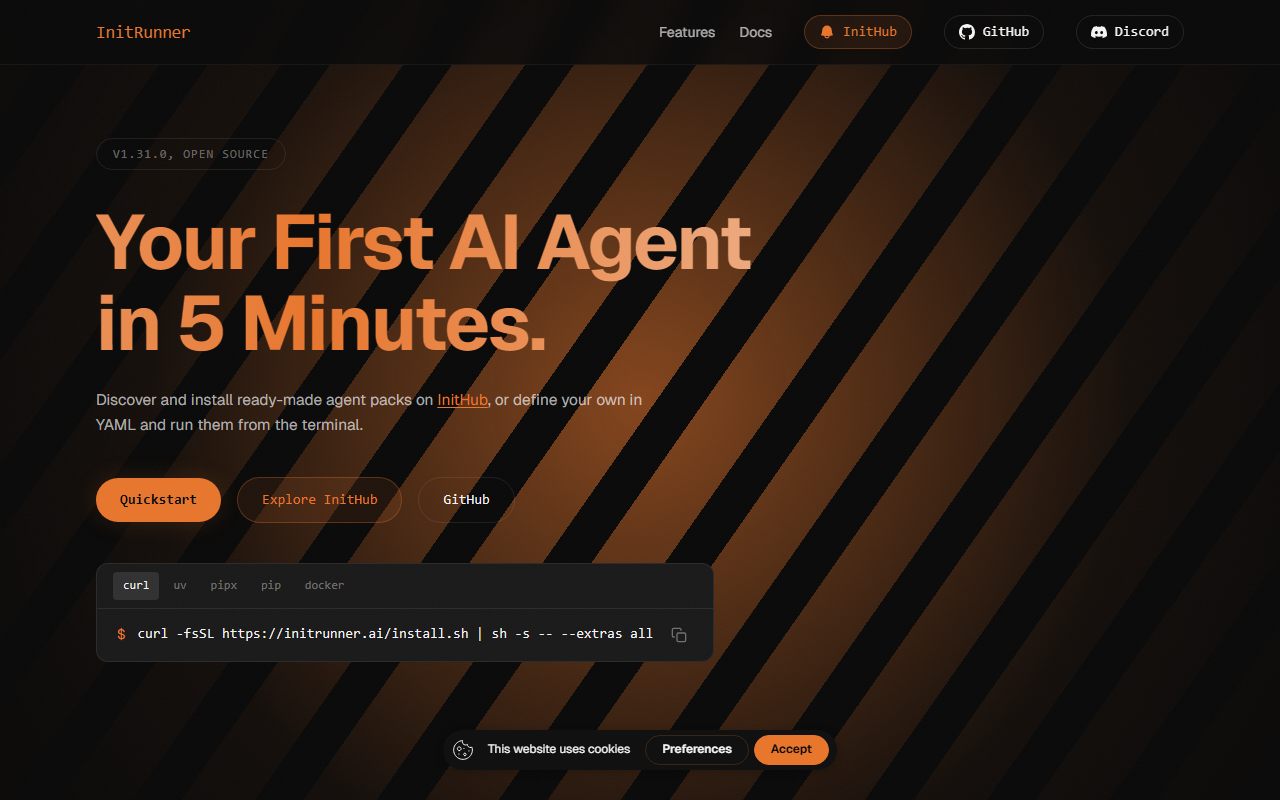
First Impressions: A Developer-First Agent Framework
Upon visiting InitRunner's website, the tagline "Your First AI Agent in 5 Minutes" immediately sets the tone. This is an open-source, MIT-licensed framework that prioritizes simplicity and control. The homepage showcases a curl command for installation, followed by a three-step setup (install, setup, run). The dashboard screenshot and terminal snippets give a clear sense of the CLI-driven workflow. As someone who has explored many agent frameworks, I appreciate the focus on YAML configurations rather than boilerplate code. The framework claims 4,700+ tests, 27 built-in tool types, and support for 12+ LLM providers, which suggests robust engineering. The quickstart invites you to run initrunner run without any config, then gradually customize with --ingest, --tool-profile, or Telegram/Discord options. The onboarding is clearly aimed at developers who are comfortable with terminal commands. The dashboard provides a visual overview of running agents, including logs and tool calls, which is a welcome addition for monitoring. Within minutes, I had a research agent running in autonomous mode, planning steps and tracking token usage—a remarkably smooth experience for a CLI tool.
Core Features: YAML-Driven Agents with Autonomous Execution
InitRunner's core innovation is its YAML-based agent definition. You define an agent's role, model, and tools in a single file. For example, a code reviewer agent uses kind: Agent, model.provider: openai, and tools like git and filesystem. Running initrunner run agent.yaml launches an interactive session. More impressively, the autonomous mode (--autopilot) lets agents plan and execute tasks independently. The terminal output shows a detailed plan-execute loop with budget tracking (iterations, tokens). The framework includes four reasoning strategies, budget-aware execution, and a built-in SQLite log for full auditability. I tested importing a PydanticAI agent using initrunner new --pydantic-ai agent.py, and the conversion was seamless. Additionally, the --serve flag turns any agent into an OpenAI-compatible API endpoint, enabling easy integration. The platform also supports triggers: cron, file watchers, webhooks, Telegram, and Discord. For developers who need to extend functionality, 27 built-in tool types and the ability to plug in Python functions provide flexibility. The guardrails block in YAML allows setting per-run token caps, session budgets, and daily limits, preventing runaway costs—a practical feature often missing in other frameworks.
Pricing and Market Position
InitRunner is open-source under the MIT license, so there is no licensing cost for self-hosting. The website does not list any paid tiers or cloud service; the entire workflow appears to be local. Pricing is not publicly listed beyond the MIT license; there is no mention of a hosted version, so users must self-host. This is a significant advantage for teams that want full control over data and costs. In terms of positioning, InitRunner competes with frameworks like LangChain and PydanticAI, but takes a distinctly different approach. Unlike LangChain's extensive abstraction layers, InitRunner reduces everything to YAML and CLI commands, making it quicker to start but less customizable for complex chains. Compared to PydanticAI, which is more Pythonic and type-safe, InitRunner is configuration-driven and language-agnostic. It is best suited for developers who want to rapidly prototype and deploy autonomous agents without wrestling with code. Teams already invested in LangChain may find InitRunner too minimalistic, while those new to AI agents will appreciate the low barrier to entry.
Strengths, Limitations, and Verdict
The strongest aspect of InitRunner is its simplicity: from zero to an autonomous agent in three commands. The YAML-first design makes agent configurations version-controllable and shareable via InitHub. The built-in autonomous mode with budget awareness prevents runaway costs. The support for 12+ LLM providers and the OpenAI-compatible API server add to its versatility. However, the framework has limitations. It is heavily CLI-centric, which can be intimidating for non-developers or teams expecting a visual drag-and-drop interface. The autonomous planning strategy, while effective, may struggle with highly complex multi-agent workflows that require fine-grained orchestration. Also, being open-source, support is community-driven, which may not suit enterprise deployments needing SLA guarantees. The lack of a visual agent builder may deter some, but the CLI is powerful. For individual developers or small teams building internal tools, automated research agents, or code review bots, InitRunner is an excellent choice. It delivers on its promise of getting an AI agent running in minutes, with full control and no vendor lock-in. I would recommend it to anyone comfortable with a terminal who wants to experiment with autonomous agents without diving into heavy frameworks.
Visit InitRunner at https://initrunner.ai/ to explore it yourself.













Comments