

First Impressions and Onboarding
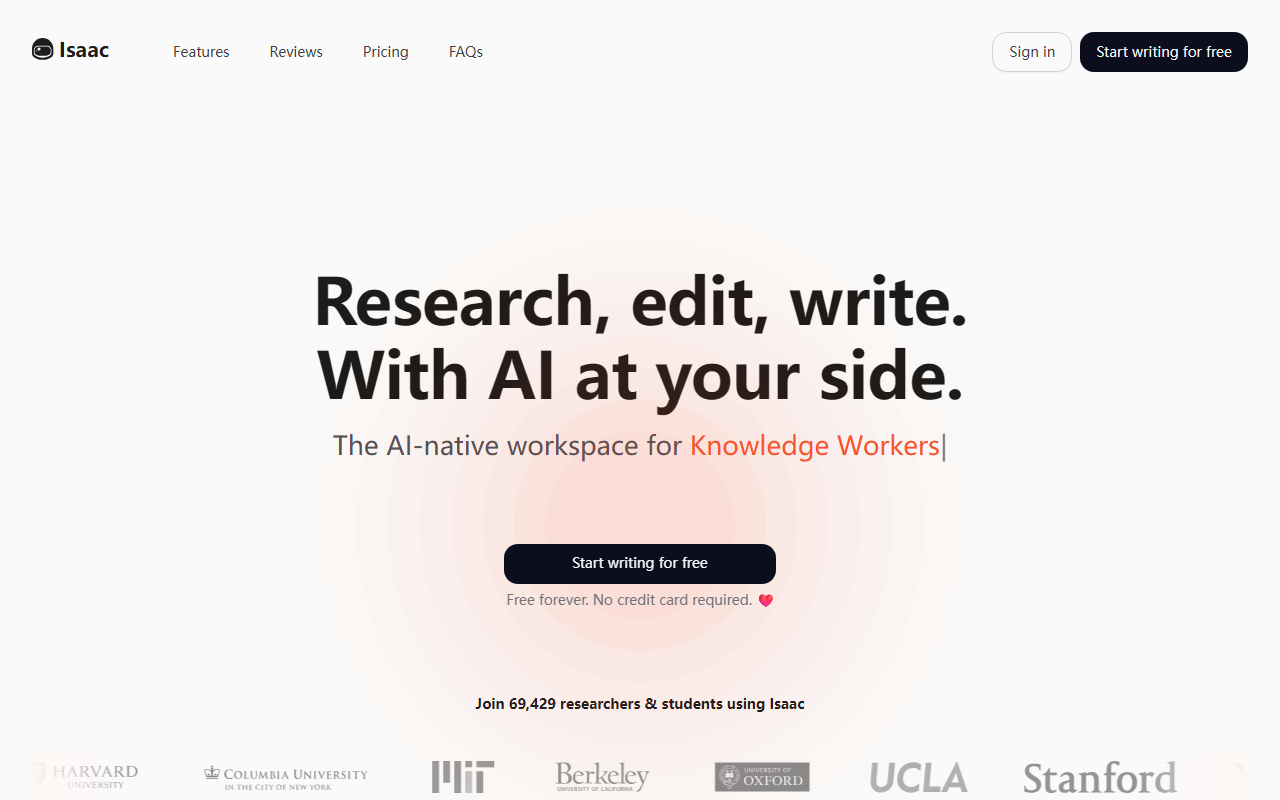
Upon visiting the Isaac website, I was greeted by a clean, modern landing page that clearly positions the tool as an "AI-powered research workspace for academic writing." The headline "Research, edit, write. With AI at your side." immediately communicates the core value proposition. The dashboard, accessed after a simple sign-up (no credit card required for the free tier), presents a straightforward layout: a document editor on the right, a sidebar with a reference list and document chat, and an AI assistant panel that can be summoned at any time. The onboarding flow is notably fast — I was able to start a new document within 30 seconds, as promised.
When testing the free tier, I noticed it provides 10 daily AI tokens. These tokens are consumed by actions like autocomplete, paraphrasing, and summarization. I found the autocomplete feature responsive and contextually relevant, often suggesting citations or clarifications based on the academic tone I was using. The document chat, where you upload a PDF and ask questions about its content, worked well with a sample research paper I uploaded. It correctly extracted key findings and answered follow-up queries without hallucinating obvious errors.
Core Features and Technical Details
Isaac integrates several steps of the academic writing workflow into one application. The integrated AI assistant functions similarly to a ChatGPT specifically finetuned for academic writing, but it operates within the editor. Key features include AI-supported writing (autocomplete, paraphrasing, summarizing), literature search (finding relevant papers inside Isaac), chat with documents, workflow automation (e.g., streamlining literature reviews), and reference management (saving and organizing documents in a reference list).
Under the hood, Isaac uses proprietary AI models trained on academic texts, though the exact model names are not publicly disclosed. The tool is available as a web application; there is no API mentioned on the site, and current mobile support is absent (though promised). It supports 16 languages, which is a significant advantage for non-native English speakers in academia. Data privacy is a strong point: the service is hosted on GDPR-compliant servers in the EU, and the team (German and US-based engineers with academic backgrounds) emphasizes that user data is 100% safe.
Pricing is transparently listed on the website. The Free plan costs $0 and includes 10 daily AI tokens, 100 MB file storage, AI-assisted writing, document chat, and literature search. The Basic plan is $8 per month (billed annually) and bumps tokens to 50 daily, storage to 1 GB, and adds file uploads in chat and first-draft generation. The Pro plan, priced at $16.66 per month (annual billing), offers unlimited AI and chat usage, unlimited file storage, premium AI models, and premium support. The site claims "no tricks," and the free plan is genuinely free forever without needing a credit card.
Strengths and Limitations
Isaac’s primary strength is its all-in-one design tailored specifically for academic writing. Unlike general-purpose AI writing tools like Grammarly or Jasper, Isaac incorporates literature search and document chat — features that directly support research workflows. For instance, you can search for related work, upload a PDF, and ask the AI to explain a methodology — all without leaving the editor. The reference management is basic but sufficient, allowing you to save papers and access them alongside your draft.
Another strength is the pricing. At $16.66 per month for unlimited tokens and storage, it is cheaper than many competitors like Notion AI (which requires a Notion paid plan) or Scite.ai (which offers more citation analytics but starts at $10/month for limited features). Isaac’s free tier is generous for light users, especially students writing occasional papers.
However, there are notable limitations. First, the tool is desktop-only; no mobile or tablet app exists, which can be inconvenient for researchers who like to review drafts on the go. Second, while the AI assistant is helpful, it occasionally produces generic suggestions that need significant tailoring for advanced graduate-level writing. I also found the literature search to be less comprehensive than dedicated tools like Google Scholar or Semantic Scholar — Isaac seems to index a limited set of open-access papers. Finally, the reliance on daily AI tokens (even on paid plans) may feel restrictive for power users who generate long documents daily, though the Pro plan removes this limit.
Who Should Use Isaac and Final Verdict
Isaac is best suited for undergraduate and graduate students, early-career researchers, and faculty who want a streamlined writing environment that reduces context-switching between a word processor, a literature manager, and an AI assistant. It is particularly valuable for those who write in multiple languages and need a GDPR-compliant tool. Conversely, seasoned researchers who rely on advanced reference managers like Zotero or EndNote may find Isaac’s reference features too basic. Similarly, if you need robust citation analytics or a large pre-trained library of full-text papers, you should consider alternatives like Scite or Connected Papers.
Overall, Isaac delivers on its promise of an AI-native academic workspace. Its integration of research and writing is well-executed, and the pricing is fair. The main trade-offs are the lack of mobile access and the token system on lower tiers. I recommend the free tier for students exploring AI-assisted writing; if you become a regular user, upgrade to Pro to unlock unlimited usage and premium models. Visit Isaac at https://isaaceditor.com/ to explore it yourself.











Comments