

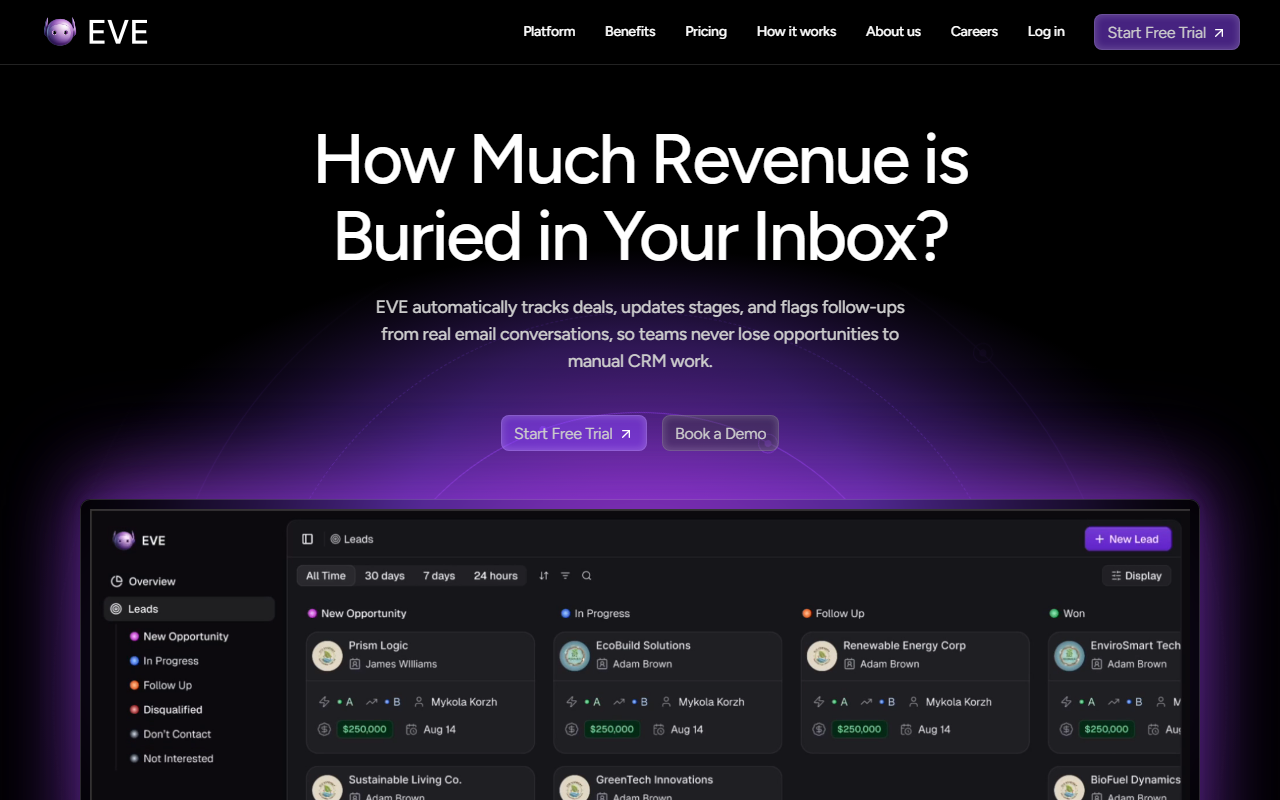
First Impressions: A Revenue Visibility Engine
Upon visiting the joineve.ai site, I was immediately struck by the bold promise: "Good deals go quiet every day. Eve makes sure yours don't." The landing page showcases a sleek, data-heavy dashboard simulation showing surfaced deals, live signals, and a timeline of actions. This is not another CRM plugin that merely logs activity. EVE positions itself as an autonomous teammate that connects to every channel where your revenue lives—email, CRM, calendar, social media, and even spreadsheets. In my exploration, the tone is aggressive but grounded in specific metrics: one case study cites $20.1M in pipeline uncovered from 97 qualified leads found in existing conversations. The demo clearly illustrates a side panel that surfaces deals like "Amanda Foster · Orbit $48K" with context such as "Product fit question · Went quiet 47d." This is exactly the kind of concrete workflow I look for—EVE doesn't just scan; it surfaces actionable deals with a one-click "Reactivate" button.
How EVE Works: Five Steps to Unlock Hidden Pipeline
EVE's workflow is broken into five clear steps on the website, and each step is illustrated with realistic interface mockups. Step one is connectivity: you plug into all your tools once, and EVE scans up to six months of history. In the demo, I observed a simulation of 1,247 threads scanned, $340K surfaced. Step two is identification: EVE finds every lead worth converting—including those that went quiet, got overlooked, or never received a follow-up. The system even highlights signals like a prospect who announced a Series B and revisited an old proposal. Step three is intelligence: EVE doesn't just draft a message; she decides what the deal needs—context, timing, and strategy—before you even approve it. Step four is execution: you review the recommendation, approve, adjust, or pass, and EVE handles delivery, follow-up scheduling, and tracking. Finally, step five is continuous monitoring: EVE tracks every signal—proposal opened, job change, reply received—and flags each one in real time. This is a stark contrast to tools like Outreach or Gong, which focus on cadence or conversation analysis. EVE is more of an autonomous revenue operations agent that recovers deals your team has already let slip.
Strengths, Limitations, and the Verdict
EVE's strongest selling point is its ability to aggregate fragmented communication data—email, Slack, CRM, LinkedIn—into a single, prioritized feed of buried opportunities. The case study from June Homes, where EVE surfaced $20.1M in pipeline from 97 qualified leads, is compelling. For teams using multiple tools, EVE eliminates the manual work of digging through inboxes and old threads. However, there are real limitations. Pricing is not publicly listed anywhere on the website, which makes it difficult to assess value for smaller teams. Additionally, EVE's effectiveness depends entirely on how well you can connect your tools—if your organization has strict permissions or uses obscure platforms, integration might be incomplete. The website also doesn't disclose which AI model powers the recommendations, raising questions about transparency. Unlike Gong, which provides deep conversation analytics for coaching, EVE is narrowly focused on pipeline recovery and deal reactivation. That makes it ideal for sales teams with high volumes of inbound leads and a backlog of dormant prospects, but less suited for companies that need full-suite sales engagement or coaching. In my assessment, EVE is best for mid-market B2B companies that feel they are leaving money on the table from past conversations. Early adopters should request a demo to get concrete pricing and integration details before committing.
Visit EVE at https://joineve.ai/ to explore it yourself.










Comments