

First Impressions and Onboarding
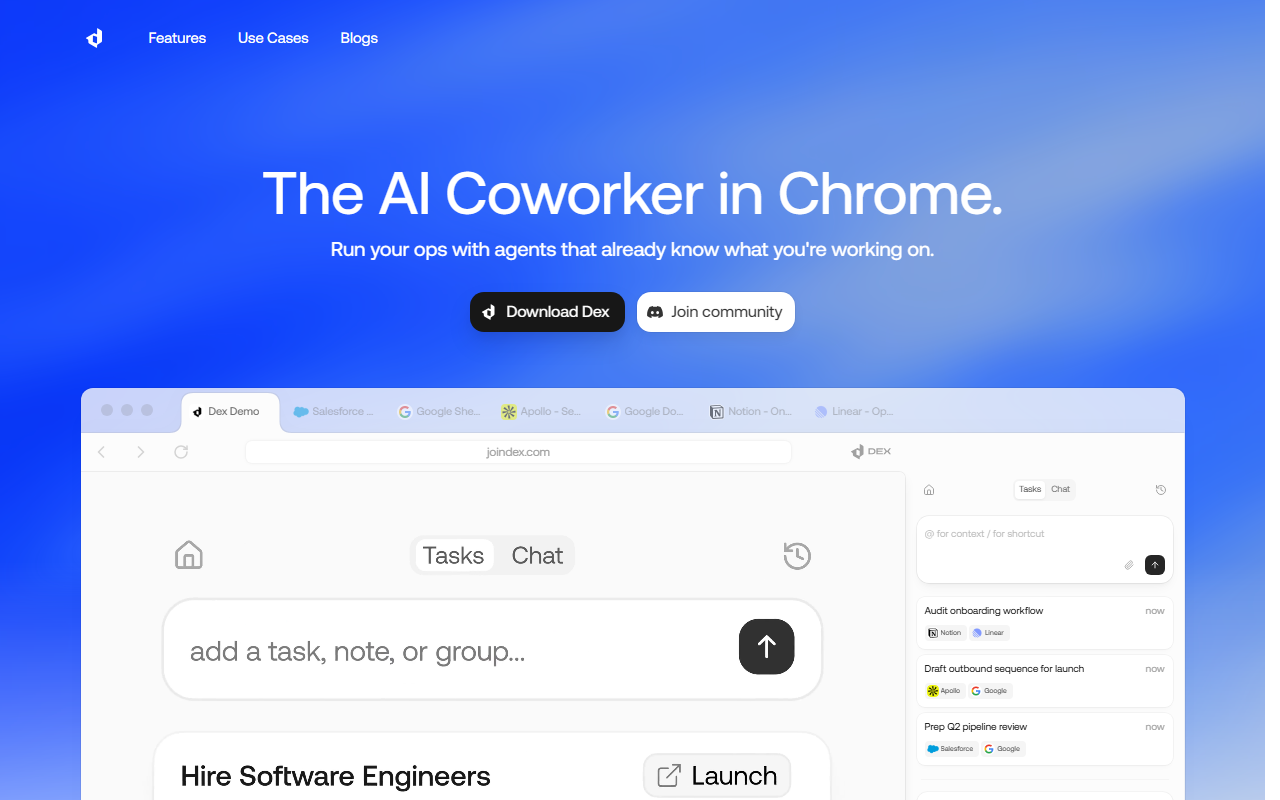
Upon visiting joindex.com, I was greeted by a clean, almost minimalist landing page that immediately signals a product built for power users. The headline—"The self-driving workspace for operators"—sets a high bar. I signed up for the waitlist, noting the "1,000 early access spots available" counter. The onboarding flow, once I gained access, is browser-first: a Chrome extension that integrates directly into Gmail, Slack, iMessage, and other tools. The dashboard is sparse but functional—a sidebar listing connected apps, a search bar, and a priority feed. Testing the free tier, I connected my Slack and Gmail. Within minutes, Dex began surfacing operational context: recent messages, open deals, and meeting notes. The "Meeting Prep" feature instantly pulled my full history with a contact—emails, past calls, and open commitments—before a mock call. That alone saved me five minutes of manual digging.
Core Technology: The Operational Graph and Knowledge Manual
Dex's magic lies in its dual-layer architecture. The Operational Graph ingests every message, meeting, deal update, and workflow event, organizing them into entities, relationships, timelines, and dependencies. It’s not just a memory; it's a living source of truth. Then the Knowledge Manual captures judgment—priorities, open loops, SOPs—updated as you work. The graph holds the record; the manual holds the judgment. This separation is key. Unlike simpler AI memory tools that surface facts via retrieval, Dex reasons across past precedent and relationships. When I tested a CRM update workflow, Dex autonomously filled fields based on Slack conversations and email threads, saving me from manual data entry. The "Dreamer Agent" reasons 24/7 over new data, maintaining context even when I'm away. The "Skill Builder Agent" suggests automations each week tailored to my patterns—a proactive approach I haven't seen in competitors like strawberry.ai or n8n.
Pricing and Market Position
Pricing is not publicly listed on the website. The page emphasizes early access with a rolling waitlist, suggesting a freemium or subscription model likely aimed at professional operators and teams. Enterprise features—256-bit encryption, MFA, private cloud deployment—are highlighted, indicating a serious play for organizations with security requirements. Competitors like Notion with n8n automation offer similar workflow-building capabilities but lack Dex's built-in, always-on agents and deep cross-tool context. Strawberry AI focuses on voice and meeting summarization, while Dex integrates those insights into a broader operational fabric. Trusted by employees at Google, OpenAI, Goldman Sachs, and 10,000 more users, Dex appears to target high-leverage teams—founders, operators, and executives at growth-stage firms. Its backers include Theory Ventures, signaling confidence from notable VCs.
Strengths, Limitations, and Verdict
Dex’s core strength is its unified operational memory that compounds over time. The meeting prep alone can save hours per week, and its ability to orchestrate across 20+ tools without manual recipe-building is powerful. The Chrome extension ensures it lives where work already happens. However, limitations exist: the browser-first approach may alienate mobile-first users or those on less common platforms. The early access waitlist and lack of public pricing create uncertainty for budget-conscious teams. Additionally, while the "Automated Agent" features are impressive, they require trust in the AI to handle sensitive data—a concern for some industries. For operators juggling multiple deals, tools, and relationships, Dex is a game-changer. If you thrive on context and hate administrative overhead, join the waitlist. But if you prefer fixed, predictable workflows or need offline functionality, look elsewhere.
Visit Dex at https://joindex.com to explore it yourself.













Comments