

The Rise and Farewell of Kite
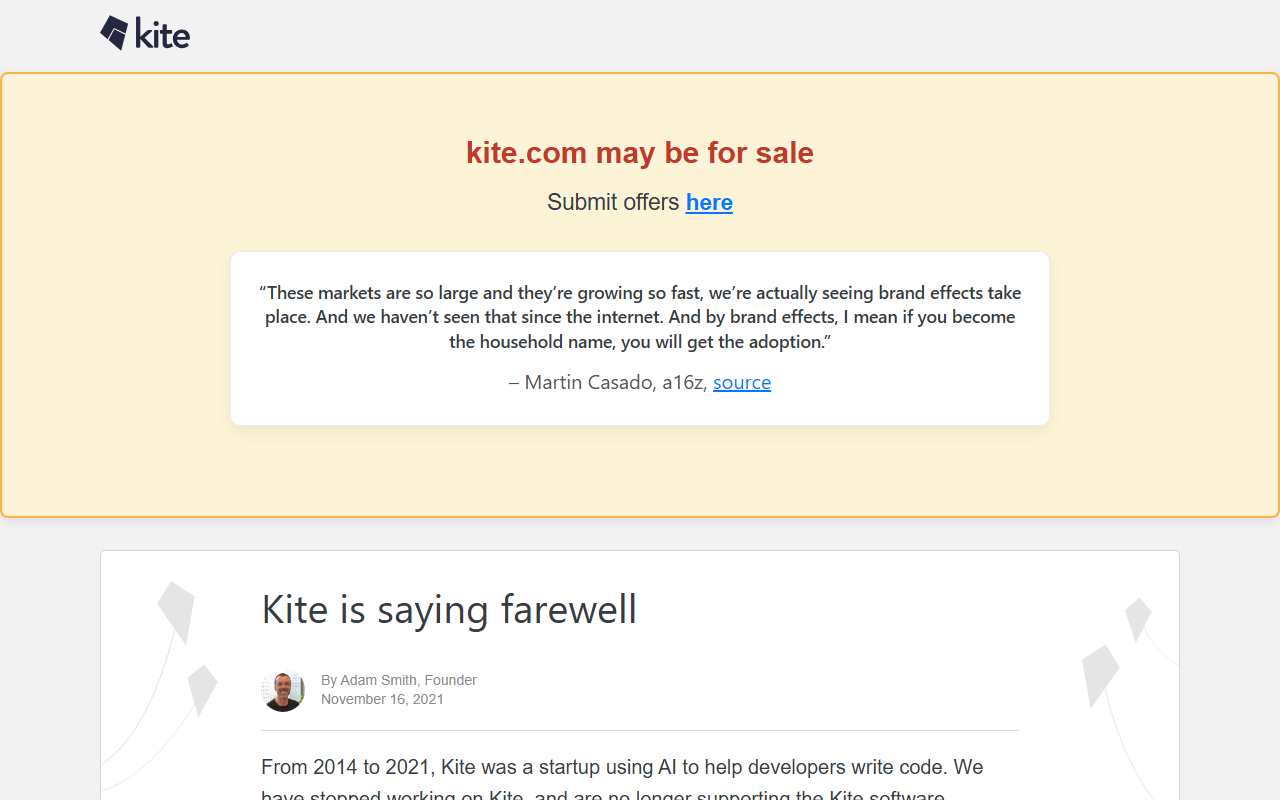
Upon visiting kite.com today, you are met with a stark farewell message. The site is now a for‑sale landing page, but the heart of the page is a detailed essay by founder Adam Smith, published November 16, 2021. Kite was a startup founded in 2014 that aimed to use artificial intelligence to help developers write code faster. It attracted significant venture backing, including from a16z, and grew a user base of 500,000 monthly‑active developers with almost zero marketing spend. Yet by late 2021, the company had stopped working on the product, and its software became unsupported. This review is a retrospective – Kite is no longer functional, but its story offers essential lessons for the current wave of AI‑assisted programming tools.
What I Observed from the Farewell Page
The farewell page is not a typical product homepage, but it is rich with information. It includes a quote from Martin Casado of a16z about brand effects in fast‑growing markets, and then a lengthy, transparent post‑mortem. As I scrolled through the text, I noticed Adam Smith’s candid assessment of why the business failed. He explained that the AI technology was “10+ years too early to market” – the state‑of‑the‑art machine learning models did not understand code structure, such as non‑local context. The page also notes that building a production‑quality code synthesis tool might cost over $100 million, and nobody had attempted that at the time. I found this level of honesty rare for a startup sunset announcement. It felt like reading an insider’s diary rather than a polished press release.
Technical and Business Lessons from Kite’s Failure
Kite’s core problem was a mismatch between technical ambition and market readiness. The tool aimed to provide 10× productivity improvements through AI‑autocompletion and code suggestions, but the models fell short. As Smith writes, “the largest issue is that state‑of‑the‑art models don’t understand the structure of code.” This is a crucial distinction from today’s tools like GitHub Copilot, which uses OpenAI’s Codex and has shown more promise, though still imperfect. From a business perspective, Kite’s product was free and widely adopted, but they could not convert users into paying customers. Smith’s diagnosis: individual developers rarely pay for tools; managers only pay for discrete new capabilities, and “making their developers 18% faster” did not resonate. Kite built team, product, and distribution in that order, but monetization never materialized. This sequencing – prioritizing engineering over revenue – is a stark lesson for AI startups targeting developers.
Market Context and Final Verdict
Kite was not the only AI coding assistant of its era. Competitors like TabNine (now part of Codeium) and later GitHub Copilot emerged with different approaches. TabNine used GPT‑2 models and offered a subscription model, while Copilot leveraged massive compute from Microsoft and OpenAI. Kite’s failure is a reminder that technology alone does not build a sustainable business. The tool was best suited for developers curious about AI‑assisted coding, but it ultimately became a historical artifact. Today, it is not functional, and I cannot recommend installing it. For those interested in the evolution of AI programming, Kite’s story is valuable: it shows how early pioneers struggled with model limitations and monetization, paving the way for current successes. If you want to use a working AI coding assistant, look at Copilot, Codeium, or Amazon CodeWhisperer instead. Visit kite.com to explore its farewell page yourself – a thoughtful document for anyone building developer tools.













Comments