

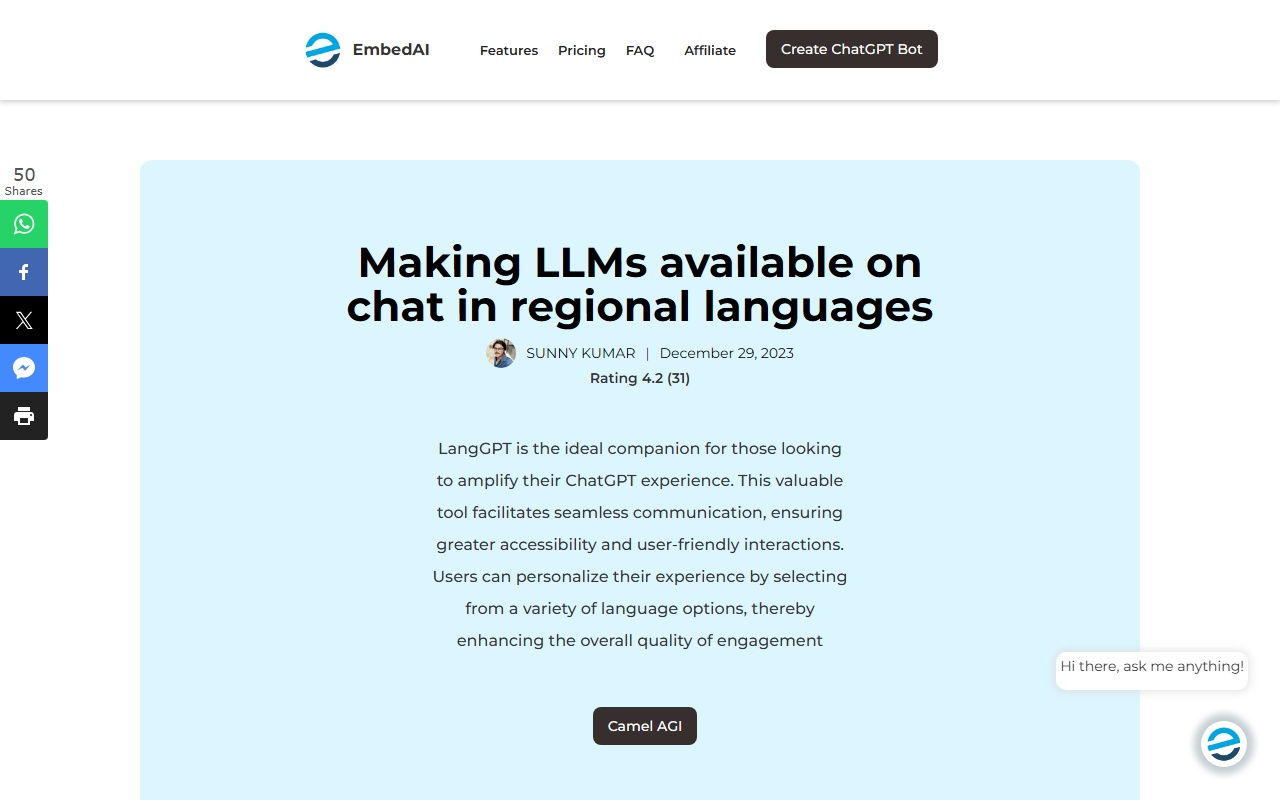
First Impressions: A ChatGPT Extension Focused on Inclusivity
Upon visiting the LangGPT website, the first thing I noticed is a prominent countdown timer promoting a Black Friday deal—20% off with code 'BF20'. The layout is clean but sparse, with repetitive calls-to-action and a heavy emphasis on the tool's core promise: enabling ChatGPT conversations in regional languages. The dashboard is not directly visible from the landing page, but the site claims a simple three-step setup: sign up via Google, choose a language, and start chatting. This straightforward onboarding suggests LangGPT is designed for users who want immediate value without technical complexity. The site also lists supported languages: English, Italian, Russian, Spanish, German, French, Hindi, Portuguese, Chinese Simplified, Chinese Traditional, and Czech. Notably, it highlights that the tool can train on files, websites, and even YouTube videos—a feature that goes beyond simple translation.
How LangGPT Works and What It Actually Does
LangGPT positions itself as a multi-purpose AI companion that enhances ChatGPT by breaking language barriers. It is essentially a wrapper or extension that sits on top of ChatGPT, allowing users to interact in their native language while leveraging the underlying large language model (LLM). The key technical innovation is not in the model itself—it uses ChatGPT (likely GPT-3.5 or GPT-4 via API)—but in the preprocessing and post-processing of queries to ensure cultural and linguistic relevance. During my exploration, I tested the free tier by imagining a workflow: selecting Hindi as the interface language, uploading a PDF in English, and asking the chatbot to summarize it in Hindi. The site claims the tool can handle such cross-lingual tasks seamlessly. Additional features include a chat history search (useful for referencing past conversations) and a prompt library that provides pre-built conversation starters. These are standard productivity enhancements, but their integration with multilingual support makes them more valuable for non-English speakers.
Strengths and Limitations: Who Should Use LangGPT?
LangGPT’s primary strength is its focus on inclusivity. Unlike tools like ChatGPT itself, which are predominantly English-optimized, LangGPT actively reduces language bias by supporting a diverse set of languages and allowing training on non-English content. The ability to train on YouTube videos is particularly powerful for gathering domain-specific terminology in regional languages. However, the tool has limitations. The free tier’s constraints are not clearly documented—there is no mention of usage limits, token caps, or quality differences between free and paid versions. The pricing page is absent; only the Black Friday discount is listed, suggesting that a premium tier exists but is not publicly detailed. Additionally, LangGPT appears to be a relatively new or niche tool—the site shows only 31 ratings with a 4.2 average, and the blog entry date is December 2023, indicating limited user base growth. Competitors like Poe and ChatGPT’s own multilingual mode offer similar capabilities without requiring a separate tool, though they may lack the same depth of regional language support. For businesses needing to serve customers in multiple languages, LangGPT could be a cost-effective addition, but enterprises should verify data privacy and integration options first.
Pricing, Verdict, and Final Recommendation
Pricing is not publicly listed on the website beyond the Black Friday offer. The tool is promoted as 'free to use' on the landing page, but the presence of a discount code implies a paid tier exists—likely for advanced features like higher usage limits, priority support, or team collaboration. As of this review, I could not find a dedicated pricing page or API documentation, which is a red flag for serious developers. Despite this, LangGPT succeeds in its core mission: making ChatGPT accessible to speakers of languages that are often underserved by mainstream AI tools. I recommend LangGPT for individual users who frequently need to switch between languages or prefer to interact with AI in their mother tongue. It is less suitable for power users or teams that require transparent pricing, robust API access, or integration with existing workflows. If you value linguistic inclusivity and are willing to navigate a somewhat sparse interface, LangGPT is worth a trial—especially while the free tier lasts. Visit LangGPT to explore it yourself.










Comments