

First Impressions: Onboarding and Interface
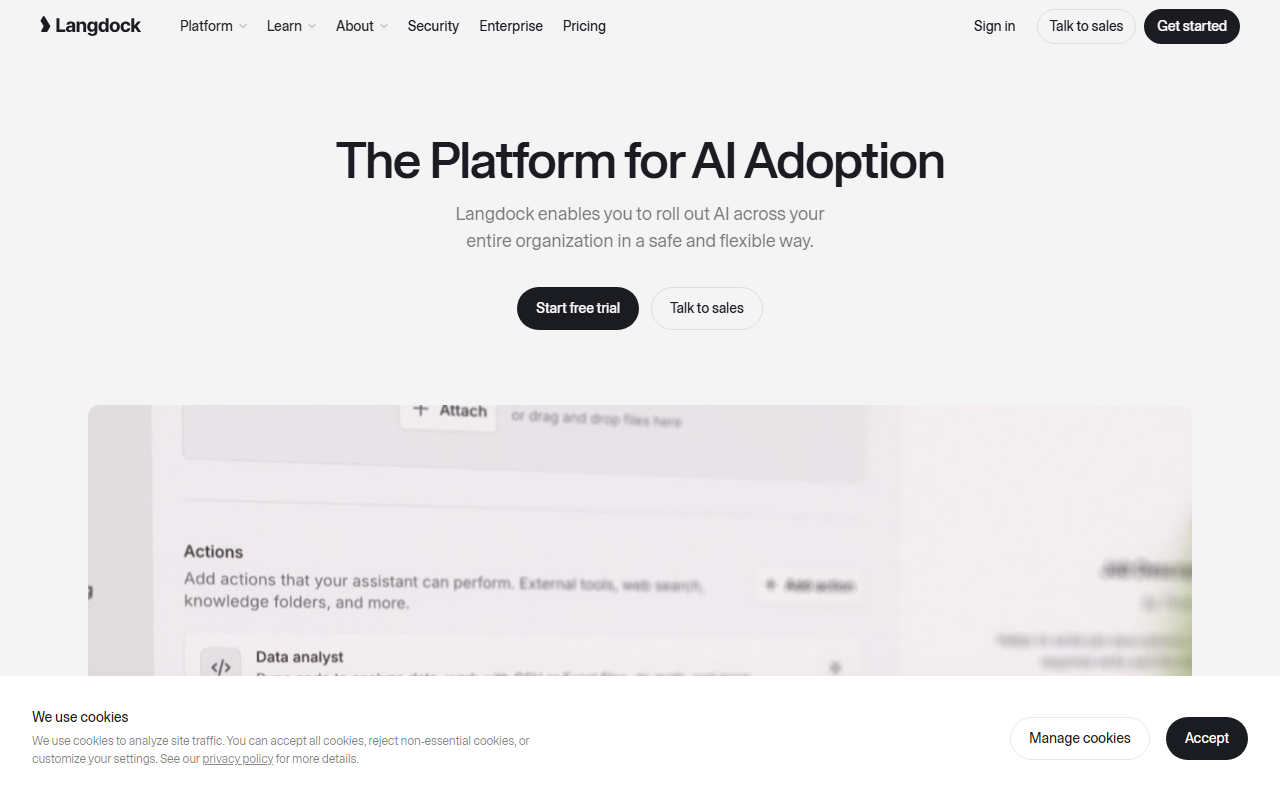
Upon visiting Langdock's website, the first thing that strikes me is the clear emphasis on enterprise-scale AI adoption. The homepage opens with a strong value proposition: roll out AI across your entire organization safely and flexibly. A short product tour (four minutes) is offered immediately, which I found helpful to understand the layout without signing up. The dashboard, as shown in the tour, is clean and modular. Users land on a central chat interface with model selection visible, alongside tabs for Workflows, Agents, and Integrations. Onboarding appears to be guided by an AI Adoption Handbook, reinforcing that this is not just a tool but a managed rollout service.
When I clicked through to the customer stories section, I noticed a reference to Merck, which reported over 33,000 monthly active users on Langdock. That number alone tells me the platform is built for serious scale. The interface language is consistent: it avoids jargon and focuses on actions like “start free trial” and “talk to sales.” Overall, the first impression is that Langdock prioritizes control and ease of use for non-technical users while offering depth for advanced teams.
Core Features: Chat, Workflows, Agents, and Integrations
Langdock positions itself as an “all-in-one platform to adopt AI as an organization.” The core feature set is divided into four areas: Chat, Workflows, Agents, and Integrations. The chat interface is model agnostic, meaning you can switch between leading models (such as GPT-4, Claude, or Llama) without vendor lock-in. During the product tour, I saw a demo where a user asked a business question and the system routed it to the best model based on cost and capability—a practical approach for enterprises monitoring expenses.
Workflows allow building AI automations without code. The example shown was an automated email summarizer that runs on incoming messages. Agents are described as “custom AI for recurring tasks,” which suggests you can train a dedicated assistant for processes like customer support triage or internal HR queries. Integrations connect with tools like Slack, Teams, Google Drive, and Confluence—common enterprise staples. There is also an API to hook into custom applications. Unlike some competitors (such as Microsoft Copilot, which is tightly bound to its ecosystem), Langdock emphasizes interoperability and open standards, a huge plus for heterogeneous IT environments.
Enterprise-Grade Security and Flexibility
Security and compliance are clearly Langdock’s differentiators. The platform is hosted in Europe (a boon for GDPR-heavy organizations) and offers deployment options ranging from cloud to on-premise. Custom deployment is available for organizations with 1,000+ seats, which signals that Langdock targets medium-to-large enterprises. Admin controls include central governance, branding customization, and cost management—features that IT departments require before allowing AI tools across the company.
I was impressed by the claim of “no vendor lock-in.” Many AI office platforms lock you into their model stack or ecosystem. Langdock’s model-agnostic approach, combined with open standards for custom tools and agents, addresses a real pain point. The website also mentions fully compliant infrastructure, though specific certifications (SOC 2, ISO 27001) are not listed—a minor transparency gap. Still, the testimonial from Merck’s Chief Data & AI Officer lends credibility: they use Langdock as their “company-wide AI companion” with tens of thousands of monthly active users in a controlled environment.
Pricing, Positioning, and Verdict
Pricing is not publicly listed on the website. The “Enterprise” pricing page likely requires contacting sales. This suggests Langdock operates on a per-seat or custom enterprise contract model. For organizations with fewer than 50 employees, this lack of transparency may be a barrier; smaller teams might prefer tools with transparent tiered pricing like Poe or Jasper. Langdock is best suited for companies with 200+ employees that need compliance, custom branding, and integration-heavy rollouts.
Strengths include model flexibility, strong security posture, and ready-made adoption resources. Limitations: the absence of public pricing makes initial evaluation harder, and the platform’s power is only fully realized with organizational buy-in—individual freelancers or tiny teams will find it overkill. If your company is serious about scaling AI safely across departments, Langdock deserves a serious look. Its focus on adoption, not just access, sets it apart from most competitors.
Visit Langdock at https://langdock.com to explore it yourself.













Comments