

What Is Language IO and How Does It Work?
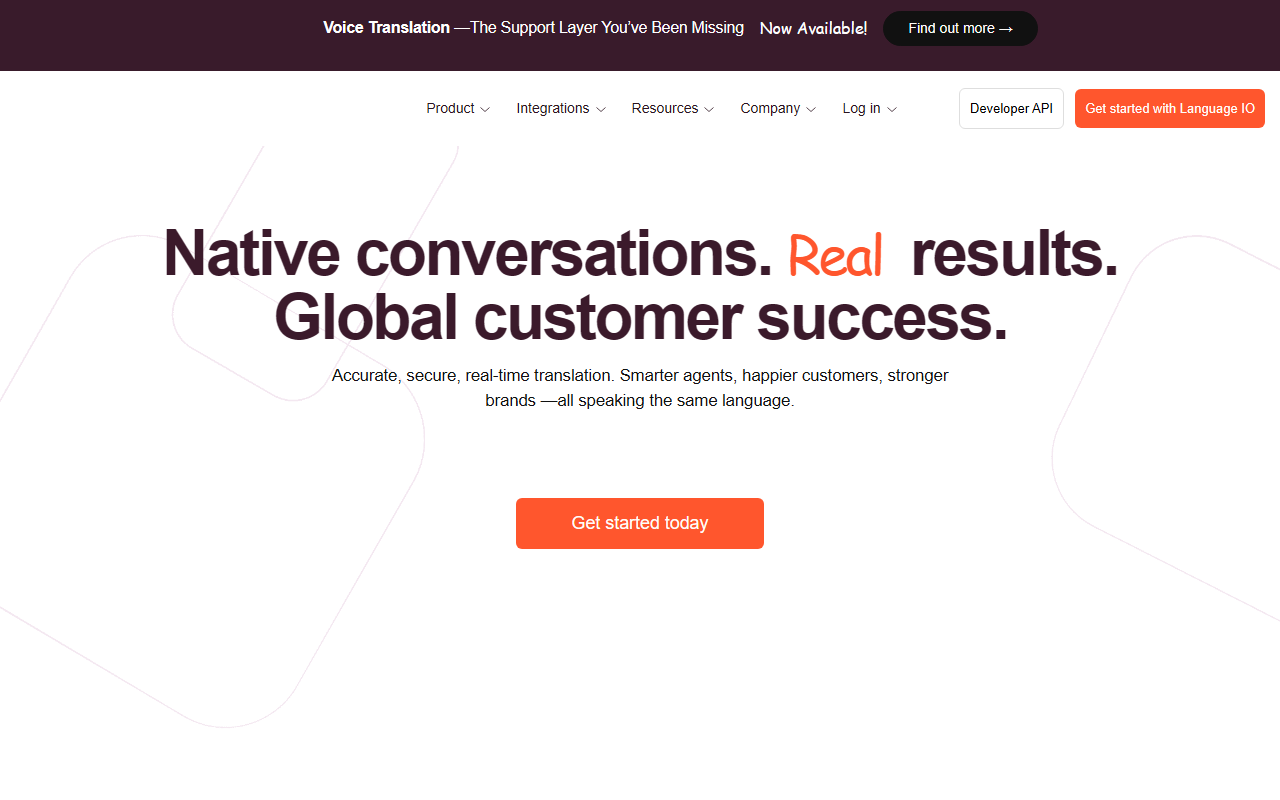
Upon visiting the Language IO website, the first thing that stood out was the clear enterprise focus. The homepage immediately pitches “multilingual customer support and translation tools” with a strong emphasis on integrating into existing CRM and helpdesk systems. Unlike generic machine translation services, Language IO positions itself as a support layer designed specifically for customer service teams. The platform uses AI to deliver real-time translations in over 150 languages, aiming to turn every agent into a global agent without adding headcount. The site highlights a philosophy called “Human + AI,” where translation handles the heavy lifting so agents can focus on empathy and relationship building.
When exploring the integrations page, I noticed direct connectors for Salesforce Service Cloud, Zendesk, Oracle Service Cloud, ServiceNow, and Intercom. There is also a Chrome extension for secure translations anywhere on the web and a Developer API for custom builds. The onboarding flow appears to be demo-driven rather than self-service; there is no “try for free” button, only a “Request a demo” call to action. This suggests a sales-led approach typical of enterprise software.
Key Features and Integrations
Language IO’s standout feature is its deep integration with major customer support platforms. For example, the Salesforce integration provides instant, secure translations directly within the CRM interface. The tool also boasts a new Voice Translation capability and a Lio Agent Assistant that promises “Fluent AI, Flawless Support.” The website includes an ROI Calculator and a guide titled “The Alignment Gap,” indicating a focus on proving business value.
During my review, I clicked through the resource section and found webinars, case studies, and success stories. The platform claims to be trusted by global enterprises and emphasizes security: “Security isn’t a feature, it’s our foundation.” This is a critical differentiator for industries like financial services and healthcare, where data compliance is non-negotiable. However, no specific certifications (like SOC 2 or HIPAA) were listed on the page I saw, though the language suggests enterprise-grade protection.
Pricing and Target Audience
Pricing is not publicly listed on the website. This is a common pattern for enterprise-focused tools, but it does make initial evaluation harder for smaller teams. You must book a demo or contact sales to get a quote. Given the integration depth and security emphasis, the cost is likely substantial and tailored to companies with dedicated support operations. The target audience is clearly large customer service teams in industries such as travel, gaming, retail, financial services, manufacturing, BPO, and entertainment. Competitors in this space include Unbabel and Smartling, but Language IO differentiates by focusing specifically on customer support workflows rather than general translation.
Small businesses or startups with basic multilingual needs might find the platform overkill or too expensive. A free or low-cost alternative like Google Translate’s API could suffice for simple use cases, but it lacks the context-aware, secure integrations that Language IO provides.
Final Verdict: Strengths, Limitations, and Recommendation
Language IO’s strengths are clear: deep integrations with leading support platforms, a strong security posture, and a focus on human-AI collaboration that yields accurate, culturally aware translations. The ability to serve customers natively without adding headcount is a compelling value proposition for scaling enterprises.
However, there are real limitations. The lack of transparent pricing and a self-service trial makes it difficult for smaller teams to evaluate the tool. Additionally, while the site promises high accuracy, I could not test the translation quality firsthand without a demo. The platform is also heavily dependent on existing CRM ecosystems; it won’t work as a standalone solution. Finally, the pricing model may be a barrier for organizations with tight budgets.
Who should try Language IO? Enterprise customer support leaders who rely on Salesforce, Zendesk, or ServiceNow and need secure, real-time translation across multiple languages will benefit most. If you’re a small business or need a simple, low-cost translation widget, look elsewhere. For those who qualify, I recommend booking a demo to assess accuracy and see how the platform integrates with your existing stack. Visit Language IO at https://languageio.com/ to explore it yourself.













Comments