

First Impressions and the Waitlist
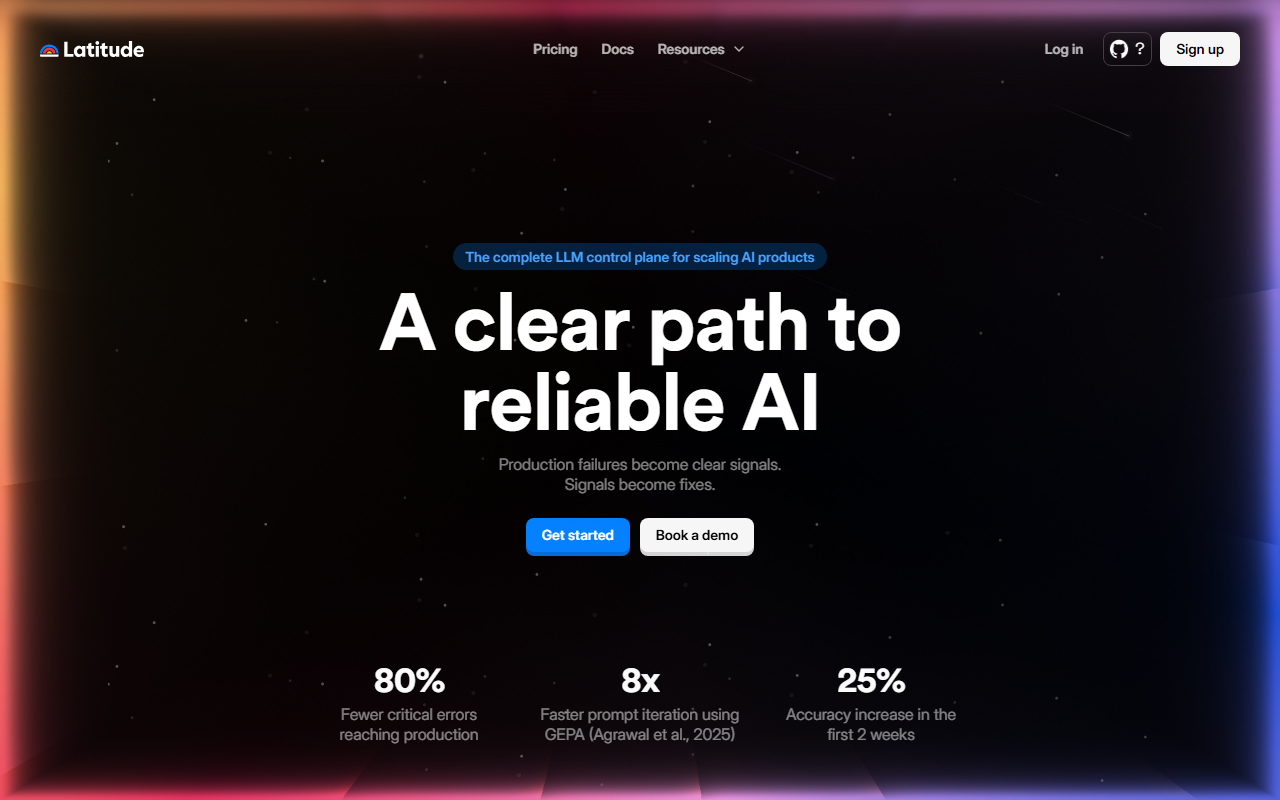
Upon visiting Latitude’s website, I was immediately struck by the clarity of its value proposition. The hero section declares it an “AI Agent Observability Platform” and leads with a call to join a waitlist for V2. This tells me the product is not yet fully open, but the team is already marketing its vision aggressively. The dashboard, which I cannot access directly, is teased through animated mockups showing traces, usage statistics, and failure discovery. The onboarding flow seems minimal at this stage—there is no self‑service signup; instead, interested teams fill a form to book a demo or join the waitlist. For a tool in the “Dev Framework” category, this early‑access approach suggests Latitude is targeting mature engineering teams willing to test a nascent solution. I appreciate that the site wastes no space on fluff; every section reinforces the core promise: turn production failures into clear signals.
Core Features and the Reliability Loop
Latitude’s main offering is what they call the “reliability loop,” a five‑step process designed to move from raw observability to automated fixes. The first step is observability: capturing real inputs, outputs, and context from live traffic. The site claims it supports “full traces” and “usage statistics,” which should give teams a comprehensive view of agent behaviour. Next comes annotations, where human judgment is applied to responses, turning subjective intent into a measurable signal. The third step, error analysis, automatically groups failures into recurring issues—a critical feature for teams dealing with voluminous logs. Automatic evals then convert those failure modes into ongoing tests that catch regressions before they hit users. Finally, a prompt manager and optimizer uses GEPA (Agrawal et al., 2025) to automatically test and iterate prompt variations against real evals. This is a notably advanced workflow for a tool that also provides a playground and A/B testing out of the box. The integrations list is impressive: it covers OpenAI, Anthropic, Azure, Google AI Platform, Amazon Bedrock, Cohere, Together AI, Vertex AI, Gemini, Groq, Mistral AI, Ollama, LiteLLM, Replicate, AWS SageMaker, and Hugging Face. That breadth suggests Latitude aims to be model‑agnostic, which is wise for agent‑heavy stacks.
Market Positioning and Competitive Context
Latitude is entering a space already populated by observability and evaluation platforms like LangSmith, Weights & Biases Prompts, and Arize AI. Where Latitude differentiates itself is in its explicit focus on closing the loop from failure to fix. Many tools stop at dashboards or basic evals; Latitude’s auto‑optimization using GEPA is a leap forward. However, the product is still in waitlist mode, which means it lacks the maturity of LangSmith’s public beta or Arize’s production‑ready traces. The claimed metrics—80% fewer critical errors, 8x faster prompt iteration, 25% accuracy increase in the first two weeks—are eye‑catching, but the site does not provide case studies or verifiable references. Keeping a healthy dose of skepticism, I would say the tool is best suited for teams building complex AI agents who already have observability in place but want a unified way to triage and improve reliability. Smaller teams or those just starting with LLM apps may find the loop too opinionated or the waitlist a blocker.
Verdict and Recommendations
Latitude’s genuine strength lies in its comprehensive, closed‑loop approach: observability plus human feedback plus automated evals plus prompt optimisation. The reliance on GEPA (a technique published in 2025) shows the team is investing in research‑backed methods. On the flip side, the product is not yet publicly accessible—you must join a waitlist, and pricing is not listed anywhere on the website. This makes it impossible to evaluate cost‑effectiveness or try the tool hands‑on. The lack of a free tier or live demo also limits my ability to test response quality. For now, I recommend Latitude to engineering leaders at mid‑to‑large AI companies who are willing to invest time in an early‑stage platform for a potential productivity boost in prompt iteration and failure detection. Everyone else should wait for a public launch or explore mature alternatives. Visit Latitude at https://latitude.so/ to explore it yourself.













Comments