

First Impressions and Onboarding
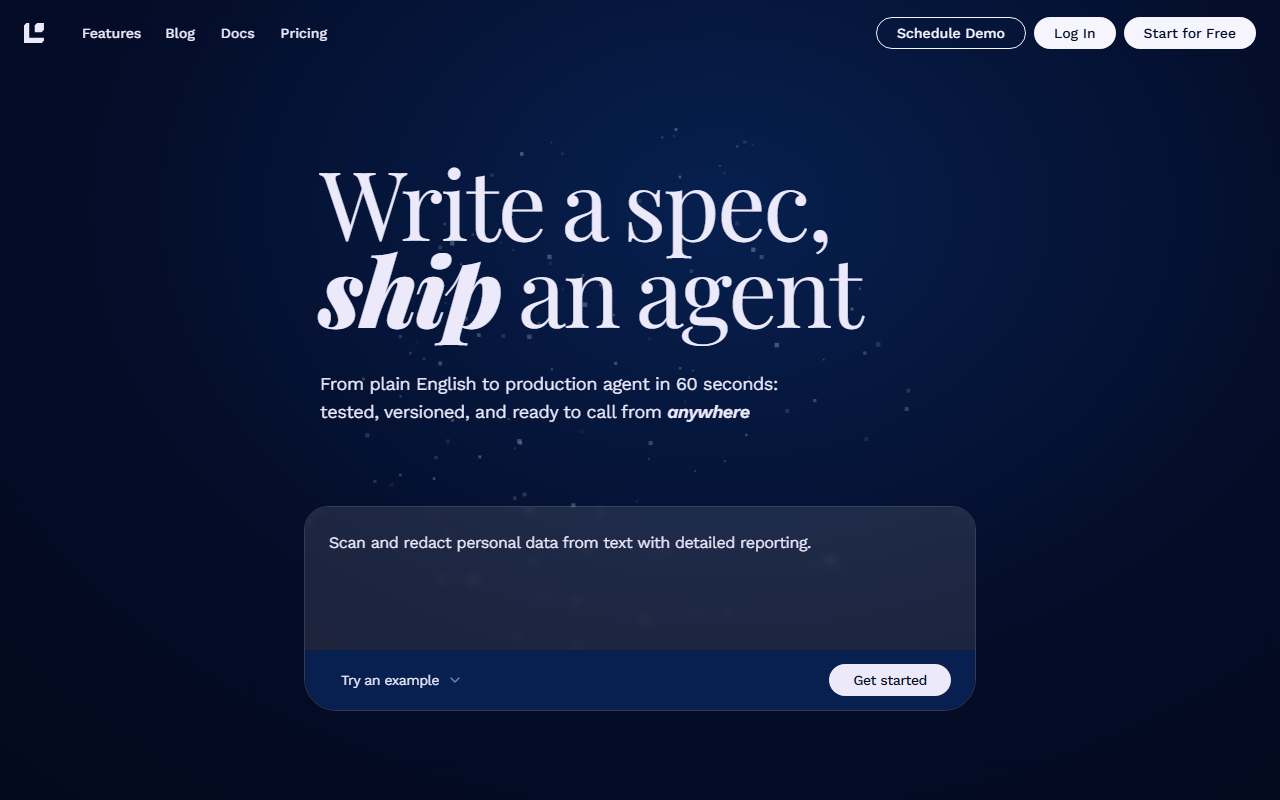
Upon visiting logic.inc, the landing page immediately communicates its core value proposition: write a spec, ship an agent. The dashboard, after signing up, presents a clean editor where you can define agent behavior, inputs, and outputs using natural language. The onboarding flow walks you through creating a first spec from a template—such as a PII Redactor or Resume Screener—which I found intuitive even without prior AI agent experience. The promise of going from plain English to a production agent in 60 seconds seems ambitious, but testing the PII Redactor template actually delivered a working endpoint in under two minutes. The interface avoids clutter: no SDKs or framework dependencies are required. The spec is simply a structured document with sections for instructions, input schema, and test cases.
Core Workflow: From Spec to Deployed Agent
The platform’s strength lies in its closed-loop workflow. Write a spec, define expected outputs in the built-in test harness, and Logic automatically validates every change on save. When I edited the spec for an Invoice & PO Data Extractor, adding a requirement to extract line-item totals, the tool flagged a regression in one of the existing test cases and pointed me to the exact line. This test-first approach eliminates the need for separate tools like Braintrust or Promptfoo. Versioning is another standout feature: each spec change creates a versioned snapshot with a git-like diff. I could revert to an earlier version instantly, and pin stable versions for API calls. Non-technical team members can edit specs through approval workflows without touching the deployment pipeline. Deployment is equally frictionless: saving the spec generates a strictly typed REST API with automatically generated documentation and a shareable web UI. I tested the auto-generated form for the Contract Clause Analyzer and the inputs matched my schema exactly. The platform also offers an MCP server for integration with Claude, Cursor, and ChatGPT, and batch CSV processing for bulk operations. Model routing happens behind the scenes: Logic selects the best provider (OpenAI, Anthropic, Google, or Perplexity) based on task complexity and cost, with automatic failover. In my tests, a simple entity extraction task used a faster model, while a complex contract analysis routed to a frontier model. Observability is comprehensive: every API call logs inputs, outputs, model reasoning, and latency. When a resume screener returned unexpected results, I traced the error to a vague spec instruction—the logs made debugging trivial compared to traditional manual logging setups.
Key Differentiators and Limitations
Unlike Vellum or LangChain, which still require heavy configuration and prompt engineering, Logic abstractes away all that complexity. It replaces prompt management, evaluation frameworks, and custom deployment pipelines with a single spec file. The built-in model routing and caching also reduce both cost and latency. However, the tool has genuine limitations. Customizability is constrained: you cannot inject custom Python scripts or advanced logic into the agent. The spec language, while powerful, may not handle deeply conditional workflows or multi-step reasoning chains that require external API calls. Another limitation is the lack of publicly listed pricing—teams must contact sales, which makes budget planning difficult for smaller projects. Additionally, the documentation for writing custom specs is somewhat sparse beyond the template examples; I had to experiment to understand the full syntax for defining complex output structures. Also, while the tool claims to support agents “from plain English,” creating robust specs for non-trivial tasks still requires careful structuring and testing—it’s not magic.
Who Should Use Logic?
Logic is best suited for product teams and internal tool builders who need to ship reliable, document-grounded agents quickly without hiring a team of prompt engineers. It excels at tasks like data extraction, content moderation, and triage classification where deterministic behavior and easy testing are critical. It is less ideal for researchers or developers who require low-level control over model selection, prompt formatting, or custom integration logic. For those teams, LangChain or a custom stack with frameworks like Braintrust might be a better fit. Overall, Logic delivers on its promise of speed and simplicity. If you’re tired of managing evaluation scripts, versioning nightmares, and multi-provider routing, this platform will save you weeks of engineering time. Visit logic.inc to explore it yourself.










Comments