

First Impressions and Core Offering
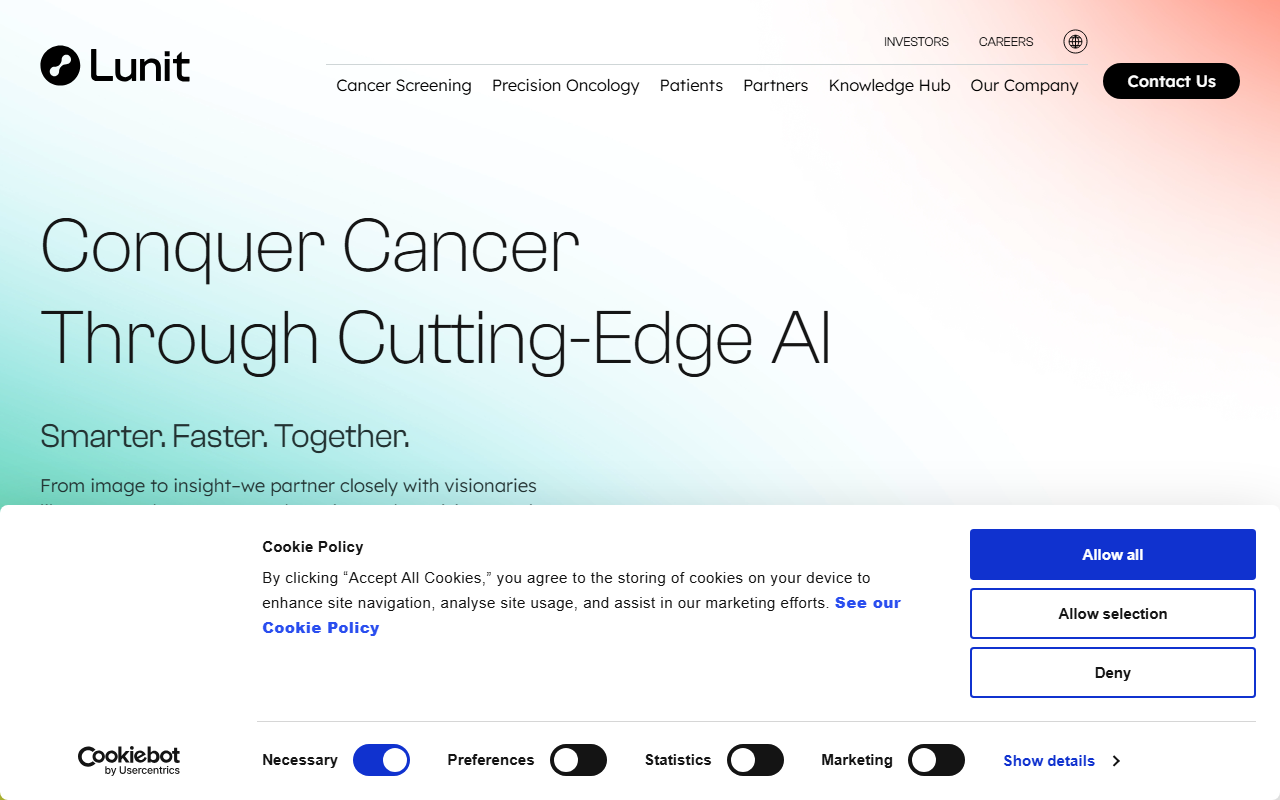
Upon visiting Lunit’s website, the messaging is clear: this is a mission-driven medical AI company focused entirely on cancer care. The landing page showcases three big numbers — over 10,000 customer sites, 65+ countries, and 700+ publications — immediately establishing credibility. The navigation splits into two main pillars: Cancer Screening and Precision Oncology. Unlike general-purpose image AI training platforms, Lunit is a specialized, end‑to‑end ecosystem for radiology and pathology. The free tier does not exist; the site pushes visitors to “Speak with a Specialist” for access, indicating an enterprise‑only sales model.
Products and Workflow
Lunit’s screening products include Lunit INSIGHT MMG (2D mammography), Lunit INSIGHT DBT (3D tomosynthesis), and Lunit INSIGHT CXR (chest X‑ray). On the precision oncology side, Lunit SCOPE IO performs tumor microenvironment analysis, while the IHC Suite quantifies biomarkers such as HER2 and PD‑L1. There is also a genotype prediction tool (SCOPE GP). All these tools are trained on diverse global datasets and designed to integrate with existing PACS (Picture Archiving and Communication Systems) and laboratory workflows. The website mentions a modular platform that connects multimodal data, but no API documentation or model training interface is visible — Lunit provides pre‑trained models, not a platform for users to train their own models.
Strengths and Limitations
Lunit’s strengths lie in its clinical validation and scale. With 700+ publications and partnerships with over 100 organizations including biopharma companies, the AI has real‑world evidence behind it. The dual focus on screening and treatment planning makes it a comprehensive solution for cancer care pathways. However, the tool is not for everyone. It is not a general‑purpose image model training tool; its scope is strictly oncology. Pricing is not publicly listed, and the sales‑led approach may be prohibitive for small clinics or research groups. Additionally, the website lacks technical details about model architectures, making independent verification of the AI’s underlying technology difficult. Competitors like PathAI and Paige.AI offer similar pathology‑focused tools, while ScreenPoint Medical competes in breast screening. Lunit differentiates by covering both radiology and pathology under one roof.
Target Audience and Final Verdict
Lunit is best suited for large hospitals, radiology networks, and biopharma companies conducting clinical trials that require validated, regulatory‑ready AI. Research labs or startups looking for a customizable model training platform should look elsewhere. If you work in oncology and need a reliable, evidence‑based AI assistant for screening or biomarker analysis, Lunit is worth a conversation — but expect a lengthy procurement process. The company’s investment in real‑world data and partnerships makes it a serious player, though the lack of transparent pricing and limited self‑serve options are notable drawbacks. Visit Lunit at https://lunit.io/ to explore it yourself.













Comments