

First Impressions and Onboarding
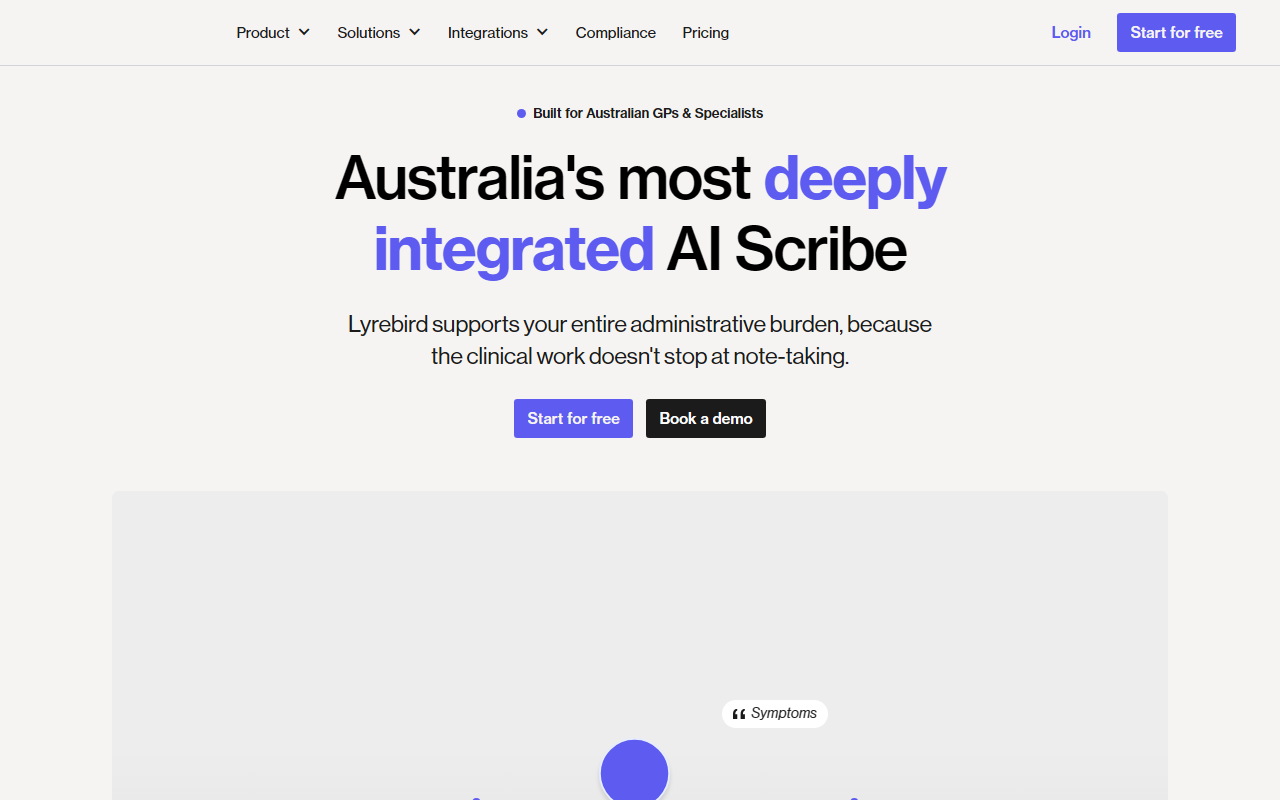
Upon visiting Lyrebird Health's website, I immediately noticed a clean, professional layout that prioritised clarity over flash. The navigation menu is straightforward: Solutions, Integrations, Resources, Compliance, Pricing. The homepage wastes no time stating its value proposition: "Australia's most deeply integrated medical AI Scribe." I clicked "Start for free" to see what happens. An account creation form appeared, asking for name, email, clinic, and specialty. No credit card — a smart move for a tool aimed at time-poor clinicians. The onboarding flow promises "consult-ready in minutes" and claims no training is required, which I found refreshing for medical software. I also spotted a "Book a demo" option, hinting at a more guided approach for clinics or enterprises.
When testing the free tier (which appears to be a limited trial), the dashboard shows a main "Start Consultation" button, with options for notes, assessments, and treatment plans. The interface is designed for minimal friction — a browser-based scribe that listens in real time. I simulated a few test phrases and the transcription was quick, handling my slight accent without issues, as advertised.
Core Features and Clinical Workflow Integration
Lyrebird is purpose-built for Australian GPs and specialists. It goes beyond standard note-taking by supporting the full documentation lifecycle: clinical assessments, treatment plans, symptoms, and examination findings. The tool saves time by automatically populating patient context across notes, letters, certificates, and care plans. I was particularly impressed with the claim that it can generate complex PDFs like CCMPs, MHTPs, Centrelink, WorkCover, and NDIS documents — tasks that traditionally take hours of manual retyping.
The EMR integrations are deep. Currently supporting Best Practice and Genie/Gentu, Lyrebird works directly inside these systems, allowing clinicians to finish notes and documents without switching tabs. Patient Summary features pull in medications, allergies, and history into one view, eliminating the painful search for context. For specialists, the tool adapts to clinical voice and terminology without constant correction. The tech stack isn't explicitly detailed, but it likely uses a combination of speech recognition (possibly Whisper or custom models) and a large language model for summarisation — all fine-tuned for medical language and Australian accents.
Data security is a strong selling point: bank-level encryption, onshore Australian data storage, and a policy of never using patient data for AI training. Compliance with APP, HIPAA, and GDPR is listed, which adds credibility for enterprise adoption.
Market Position and Pricing
Lyrebird positions itself as a deeply integrated alternative to more generic AI scribes like Suki or Nuance DAX. While Suki focuses on US workflows and Nuance DAX on ambient clinical intelligence, Lyrebird tailors its output to the specific administrative burden of Australian healthcare — a key differentiator. It is clearly built for the local regulatory and billing environment, which general international tools often fail to address.
Pricing is not publicly listed on the website. The site offers "Start for free" and "Book a demo," suggesting a subscription model with tiered plans for solo practitioners, clinics, and enterprises. The testimonials from large groups like Gold Coast Health (100+ clinicians, 21 specialties) and 7 Springs Medical Practice (32 doctors) indicate it scales well. There is no mention of an API or self-hosted option, so this is purely a SaaS offering.
Strengths: excellent EMR integration depth, strong compliance for Australian data laws, measurable time savings (80% reduction in documentation time claimed), and adaptations for complex local forms.
Limitations: currently only supports two EMRs (Best Practice and Genie/Gentu), so clinicians on other platforms may be locked out. The tool is explicitly for Australian practices only; international readers should look elsewhere. There is no mobile app mentioned (desktop and browser-based only). The lack of transparent pricing may be a barrier for individual buyers.
Verdict and Recommendation
Lyrebird Health is a standout for Australian GPs and specialists who want to drastically cut documentation time without sacrificing note quality or regulatory compliance. It is best suited for practices already using Best Practice or Genie/Gentu, and for those who handle a high volume of chronic disease management plans, referrals, and workers' compensation forms. If you are a solo GP in Australia, the free trial is worth a spin. For larger clinics or health services, the deep integration and enterprise testimonials make a compelling case. If you are outside Australia or use a different EMR, you will need to wait for broader rollout. Lyrebird is not a general-purpose AI writer — it is a focused, powerful tool for a specific clinical niche.
Visit Lyrebird Health at https://lyrebirdhealth.com/ to explore it yourself.










Comments