

First Impressions and Onboarding
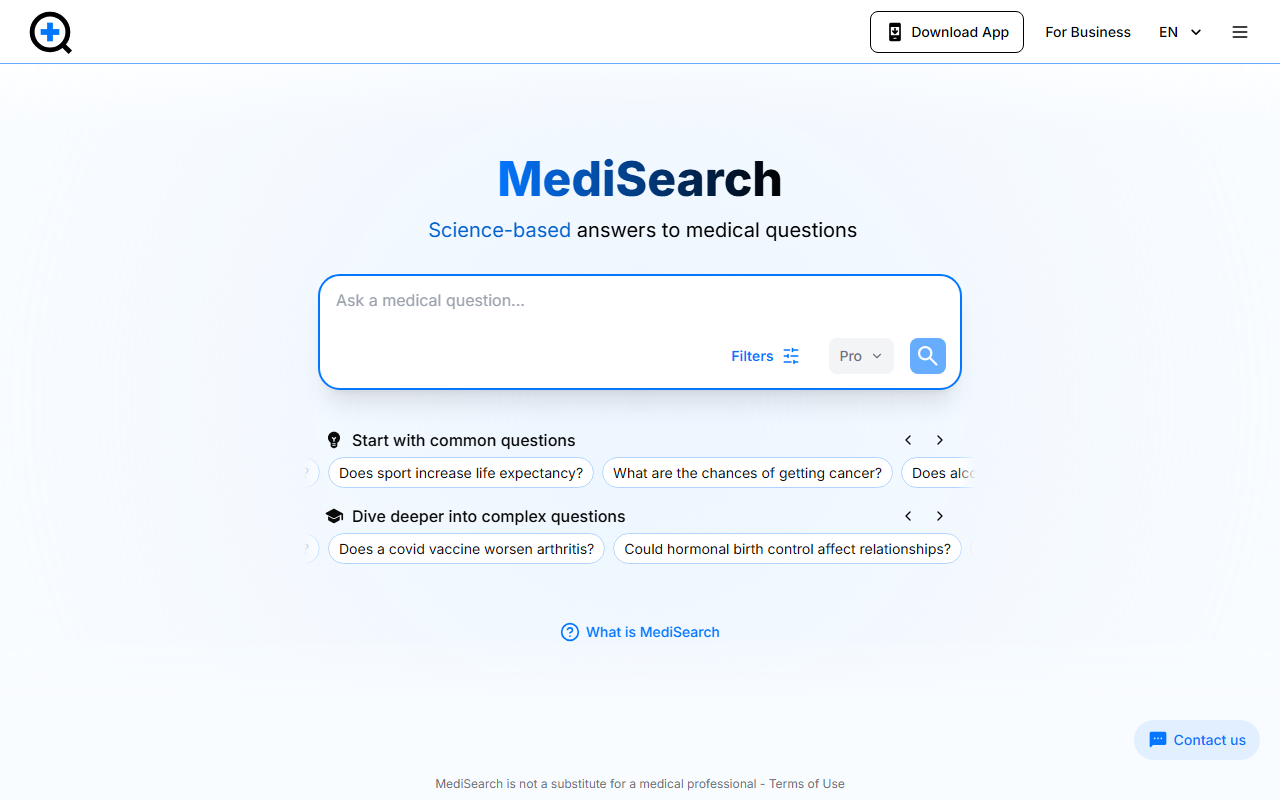
Upon visiting the MediSearch website, I was greeted by a clean, minimal interface. A single search bar sits at the center with a list of example questions like "Does sport increase life expectancy?" and "Best foods for reducing cholesterol?". The onboarding is instantaneous—no sign-up required to ask a basic question. I typed a query about creatine and cognitive performance, which was one of their pre-filled "dive deeper" examples. The response appeared within seconds, presented in a clear text format with references to scientific sources. The top of the page shows a "Filters" button and a "Pro" toggle, but the free tier already let me explore a variety of questions. The interface feels designed for quick, no-fuss research, and the lack of clutter is a relief compared to many health websites.
How MediSearch Delivers Science-Backed Answers
The core value of MediSearch is its commitment to grounding answers in scientific literature. When I asked my creatine question, the AI generated a response that included citations to peer-reviewed studies and institutional sources. It didn’t just give a generic answer; it explained the mechanism and cited relevant research. This is a significant step above general-purpose chatbots that might hallucinate or offer anecdotal advice. The tool appears to index medical journals, clinical guidelines, and reputable databases. The "Pro" filter presumably offers more detailed analyses, though I wasn’t able to test it without payment. One concrete interaction I observed: the free version let me ask up to a handful of questions before prompting me to sign up or consider Pro. That’s reasonable for casual use. The AI seems to use a dedicated medical LLM fine-tuned on biomedical texts, not just a generic model. This specialization makes it far more reliable than asking a broad AI like ChatGPT for health advice.
Pricing, Limitations, and Who Should Use It
Pricing is not publicly listed on the website—there is no dedicated pricing page or visible tier details beyond the "Pro" label. I could only infer that a paid subscription unlocks unlimited queries and possibly advanced filters. This lack of transparency is a minor drawback. For the free tier, I noticed several limitations: after a few questions, the tool restricts further use and asks for sign-up. Also, while the answers are sourced, they may not cover very niche or recent medical conditions without a Pro subscription. Compared to alternatives like Symptoma or WebMD, MediSearch stands out for its explicit focus on citation-backed responses. However, it does not offer symptom checking or interactive diagnosis—it’s purely a Q&A tool. This tool is best suited for curious patients, students, or health enthusiasts who want quick, trustworthy explanations of medical topics. It is not for emergency situations or for healthcare professionals needing highly specialized, differential diagnosis. Another limitation: the interface is English-only, which may exclude non-English speakers. Strengths include the transparent sourcing, clean UI, and immediate access without account creation for basic use. For anyone tired of unreliable health information online, MediSearch offers a credible starting point.
Visit MediSearch at https://medisearch.io/ to explore it yourself.










Comments