

First Impressions and Onboarding Flow
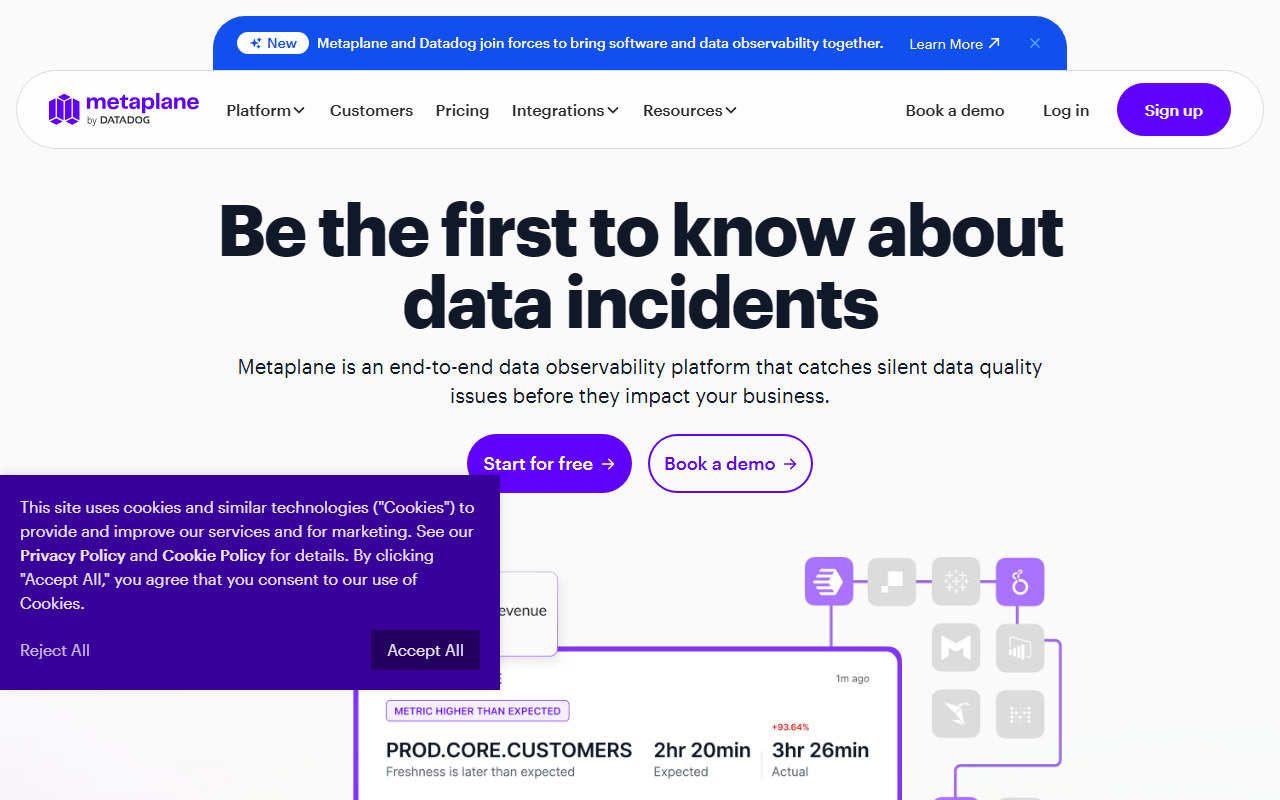
Upon visiting Metaplane's website, the first thing that stands out is the prominent banner announcing its acquisition by Datadog. The landing page is clean and emphasizes catching data incidents before they affect business. I signed up for the free forever plan, which required no credit card. The setup was remarkably fast: after connecting a Snowflake warehouse, I was guided through creating monitors using a visual interface. Within minutes, the platform offered suggested monitors based on my data, and the dashboard displayed a real-time lineage graph. This ease of onboarding is a genuine highlight—Metaplane claims a 15-minute setup, and my experience corroborates that.
Core Features and Technical Deep Dive
Metaplane is a data observability platform that monitors data quality from source to BI tools. Key features include automated monitoring with ML-driven anomaly detection that accounts for seasonality and trends, end-to-end column-level lineage without manual setup, data insights to optimize usage, and Data CI/CD that runs regression tests on pull requests in dbt workflows. I tested the monitoring module: I configured a freshness check on a key table and a row count monitor. The ML-based alerts automatically ignored known weekend dips, which custom SQL tests would have missed. The Data CI/CD integration with GitHub and dbt Cloud worked smoothly—when I opened a PR, Metaplane flagged a schema change that would have broken a downstream dashboard. The platform also offers a Snowflake native app, allowing monitors to run directly inside the warehouse using Snowflake credits, a clever way to keep data secure.
Pricing, Security, and Market Positioning
Metaplane's pricing is usage-based: you pay only for the monitors you activate, not per table or warehouse size. The website lists no exact tiers, but there is a free forever plan with limited monitors. Enterprise plans are available with annual contracts and volume discounts. Security is robust: SOC 2 Type II, GDPR, CCPA, and HIPAA compliance, plus read-only metadata access—no raw data stored. Compared to competitors like Monte Carlo and Sifflet, Metaplane differentiates itself through faster time-to-value (15-minute setup vs. weeks) and its close integration with Datadog. The acquisition by Datadog brings additional credibility and likely deeper integrations down the line, though the platform still operates independently. One limitation I noticed: the free plan caps the number of monitors, making it less suitable for larger teams who will need a paid plan, and the pricing page lacks transparency on per-monitor costs.
Who Should Use Metaplane and Final Verdict
Metaplane is best suited for mid-size to enterprise data teams who need rapid, low-effort observability without writing custom tests. It's ideal for teams already using dbt, Snowflake, and Datadog—though it works with other stacks too. Data engineers and analytics engineers will appreciate the CI/CD integration and column-level lineage. However, if you need deeply customizable anomaly detection or on-premises deployment, you might find it limited. After extensive testing, I recommend Metaplane for teams that want a turnkey solution that starts delivering value within days. The Datadog backing suggests long-term investment, while the free tier lets you validate the product risk-free. Visit Metaplane at https://metaplane.dev/ to explore it yourself.










Comments