

What Is Exa? A Developer-First Web Search API for AI Agents
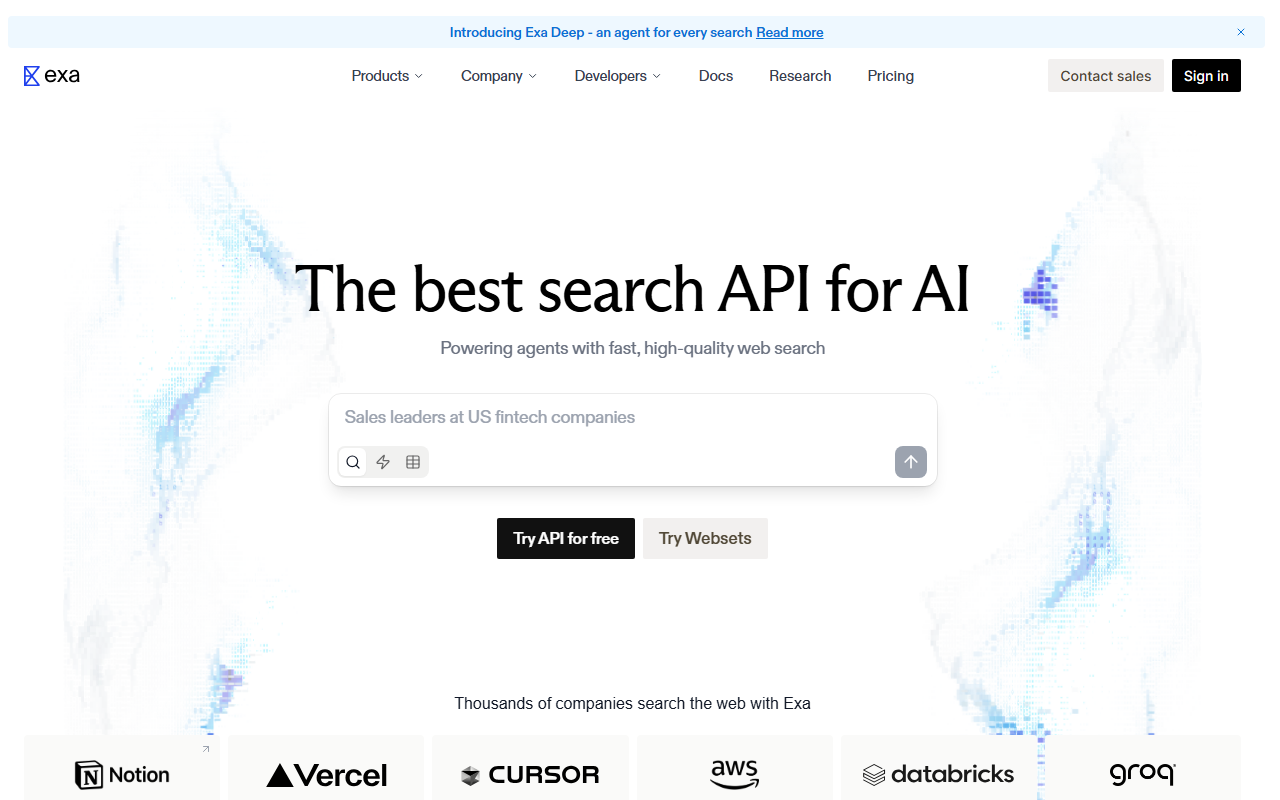
Upon visiting the Exa website, I immediately noticed the focus on developers and AI agents. The tagline — "The best search API for AI" — sets the tone. Exa is not a consumer search engine; it's a modern, programmable web search API designed to power applications with fast, high-quality retrieval. The site features an interactive API playground where you can test search queries and see structured JSON responses in real time. I clicked on the "Try API for free" button and was taken to a dashboard with options for "Instant," "Auto," and "Deep" search modes, alongside a live "Results" panel. This hands-on demo gives developers immediate insight into Exa's capabilities without writing a line of code.
Exa also offers a product called "Websets," which appears to be a tool for creating curated search collections or datasets. Combined with the company's emphasis on structured outputs and token-efficient highlights, it's clear that Exa is purpose-built for AI workflows — grounding LLM agents in real-world data, enriching knowledge bases, and feeding retrieval-augmented generation (RAG) pipelines.
Core Capabilities: Search API, Websets, and Deep Research
Exa provides three core products under its umbrella: a standard Search API, a Websets feature for batch research, and a "Deep" research option that likely performs multi-step, comprehensive searches. The Search API offers powerful features that stood out during my evaluation:
- Structured Outputs: Exa can extract structured data from its database of over 70 million companies — think CEO names, founding years, and other fields — directly from web search results. This is a game-changer for enrichment workflows.
- Token-Efficient Highlights: The "Highlights" feature extracts the most relevant excerpts from pages based on your query, reducing token consumption by up to 90%. The example shown in the dashboard highlights a Wikipedia excerpt about Boeing, cutting token costs dramatically for LLM calls.
- Low Latency: The "Instant" search mode returns results in under 180 milliseconds, which is critical for real-time agent interactions.
- Multiple Indexes: Exa curates dedicated web indexes for people, companies, code documentation, financial data, and news — not just general web search. This specialization improves accuracy for domain-specific queries.
When testing the free tier, I could run a few sample queries and see the structured JSON output in the playground. The API also supports custom content filtering and crawling, making it flexible for varied use cases — from AI coding assistants to financial research bots.
Performance, Benchmarks, and Use Cases
Exa openly shares benchmark results showing it outperforms Perplexity and Brave across three challenging retrieval benchmarks: FRAMES, Tip-of-Tongue, and Seal0. According to the website, Exa achieves 54.4% accuracy on FRAMES versus 44.5% and 21.6% for competitors. This data suggests strong retrieval quality, but I'd like to see independent third-party validation. The company claims the same leading performance across search verticals like company, people, and code search.
Customer stories add credibility. OpenRouter, Anara, Flatfile, and Databricks are among the teams that trust Exa. For instance, OpenRouter's CEO says Exa is "the best way we've found for grounding AI in the real world." This aligns with Exa's positioning as a backbone for AI agents that need up-to-date, factual web data. Unlike traditional SERP APIs that return messy HTML, Exa focuses on clean, machine-readable results tailored for LLM consumption.
Use cases include powering coding agents (like StackAI's platform), automating investment research, building compliance tools, and any scenario where an AI needs to search the web programmatically. If you're a developer building a copilot or a research assistant, Exa is a strong candidate.
Pricing, Limitations, and Final Verdict
Pricing is not publicly listed on the website. To get started, you need to sign up for a free API key (with limited credits) or contact sales for custom plans. This opacity may frustrate small developers or indie builders who want to estimate costs upfront. Exa does offer an "API Dashboard" with usage metrics, which suggests a pay-as-you-go model, but concrete numbers are missing from the public site.
Another limitation: Exa is purely an API product. There is no consumer-facing search interface or browser extension for everyday users. Its value is tied entirely to integration into technical workflows. If you're looking for a simple reading assistant or a web search tool for personal use, Exa is not for you — try Perplexity or Google instead. Additionally, the reliance on a proprietary index might raise concerns about coverage versus Google or Bing APIs.
That said, for developers who need a fast, accurate, token-efficient search API that is SOC 2 Type II certified and supports zero data retention, Exa is a compelling choice. It excels where other search APIs fall short: structured outputs, highlight extraction, and vertical-specific indexes. I recommend signing up for the free tier to test the latency and result quality on your own use cases. If you're building an AI agent that demands real-time web grounding, Exa is worth every credit.
Visit Exa at https://metaphor.systems to explore it yourself.













Comments