

First Impressions and Onboarding Experience
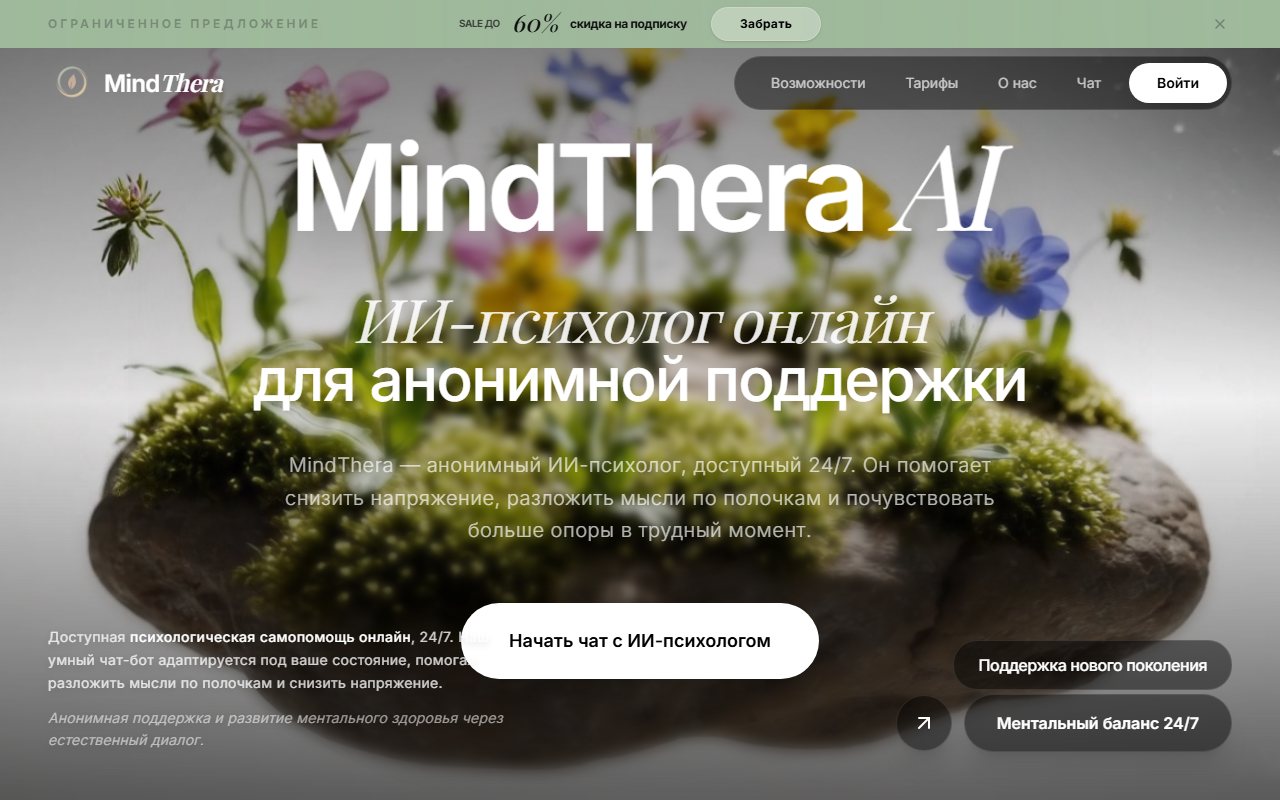
Upon visiting the MindThera website, I was greeted by a clean, minimal interface with a prominent call-to-action button labeled "Начать чат с ИИ-психологом" (Start chat with AI psychologist). The landing page is entirely in Russian, which immediately signals that the tool is primarily designed for Russian-speaking users. The onboarding flow is refreshingly straightforward: a single click takes you directly into the chat interface without requiring registration or an email. I began typing a simple phrase about feeling overwhelmed, and within seconds the AI responded with a calm, empathetic tone. The initial message acknowledged my feeling and asked a gentle follow-up question to help me elaborate. There was no sign of generic scripted replies; instead, the bot seemed genuinely attuned to my input.
The dashboard is essentially the chat window itself, with a sidebar that shows conversation history. During testing the free tier, I found the interface to be intuitive and distraction-free. The chatbot supports both text input and a voice chat option, which I tried by speaking a few sentences aloud. The voice transcription was accurate, and the AI's response maintained the same supportive style. The tool's deep memory feature was noticeable: when I returned to the chat after a few minutes, the AI referenced a key detail I had mentioned earlier, demonstrating context retention without requiring me to repeat myself.
What MindThera Does and How It Works
MindThera is an AI-powered conversational agent designed to provide anonymous psychological self-help and emotional support. It positions itself as an "ИИ-психолог" (AI psychologist) available 24/7. The core problem it addresses is the gap between professional therapy access and the need for immediate, non-judgmental emotional support. Unlike traditional therapy apps, MindThera emphasizes anonymity and zero-pressure interaction — you can start with a single phrase or even a physical sensation.
Technologically, the tool appears to use a proprietary language model fine-tuned for mental health conversations. The website mentions "глубокая память" (deep memory), suggesting it tracks user history, emotional patterns, and previously effective strategies. It also supports voice chat, a feature that can lower the barrier for users who find typing difficult during distress. The interaction is structured in three steps: share your worry, explore the feeling through guided questions, and receive a practical next step (a thought, practice, or action). The conversation history is preserved to avoid starting from zero each time.
Pricing is not publicly listed on the website. The site only shows a free tier (the chat function I tested), and there is no indication of a premium subscription or usage limits. I found no API documentation or integration options, suggesting MindThera is a standalone consumer product rather than a platform for developers.
Market Positioning and Alternatives
In the growing landscape of AI mental health tools, MindThera competes with services like Woebot (which uses CBT techniques and requires sign-up) and Replika (a general AI companion with mental health features). Unlike Woebot, which is heavily structured around therapeutic exercises, MindThera focuses on fluid, empathetic conversation with a memory of past interactions. It also distinguishes itself by supporting voice input and full anonymity without registration — a major plus for privacy-conscious users. The tool seems best suited for individuals who need immediate, low-cost emotional support and prefer a conversational style over structured therapeutic modules. It is less appropriate for people in acute crisis or those requiring formal clinical diagnosis and intervention (the website does not provide any crisis resources or escalation paths).
The tool's Russian-language interface means it primarily targets users in Russia, Ukraine, and other Russian-speaking regions. As of now, there is no English version, which limits its global reach. The site does not mention any clinical validation, partnerships with mental health professionals, or user base statistics. That said, the approach of combining deep memory with voice chat is innovative within the AI therapy niche.
Strengths, Limitations, and Final Recommendation
Strengths: The most impressive aspect of MindThera is its ability to retain context across conversations. The deep memory feature creates a sense of continuity that many AI chatbots lack. The voice chat option is genuinely helpful for users who struggle to type when anxious. The onboarding is frictionless — no account required — which encourages immediate use. The conversational style is empathetic and avoids robotic or overly clinical language.
Limitations: MindThera currently operates only in Russian, excluding a vast English-speaking audience. The website lacks clear safety features: there is no automatic detection of crisis keywords (self-harm, suicidal ideation) and no links to professional helplines. This is a significant ethical blind spot for a mental health tool. Additionally, without clinical oversight or transparency about the underlying model's training data, users should not treat it as a replacement for professional therapy.
Who should try it: Anyone who is fluent in Russian and seeks casual, anonymous emotional support — especially for stress, anxiety, or daily mental maintenance — will find MindThera valuable. It is also a good entry point for those hesitant to see a human therapist. Who should look elsewhere: English speakers, individuals in crisis, or those needing evidence-based therapeutic techniques should explore alternatives like Woebot or BetterHelp (for professional counseling).
Visit MindThera at https://mindthera.ai/ to explore it yourself.










Comments