

What Is Morph?
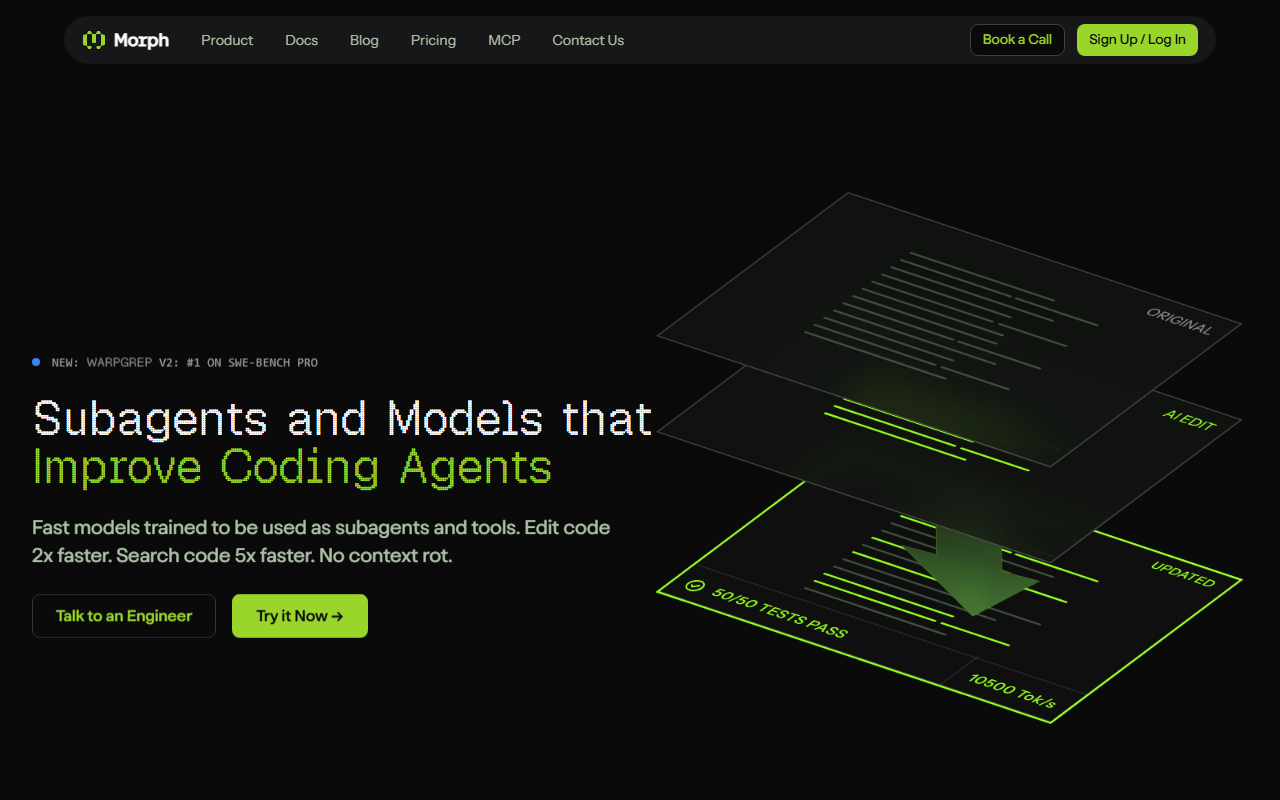
Upon visiting the Morph website, I was greeted by a clean, developer-focused interface that immediately communicates its mission: building specialized inference engines for coding agents. Unlike general-purpose AI coding tools like GitHub Copilot or Cursor, Morph doesn't aim to be a code completion assistant. Instead, it provides a suite of high-performance models and tools designed to be integrated into larger agentic systems. The core products include WarpGrep (agentic code search), Fast Apply (high-speed code editing), Browser Testing (AI-driven PR testing), and Flash Compact (lossy context compression). Each is marketed as a drop-in improvement for AI agents that need to search, edit, or test code at scale.
Key Features and Performance Benchmarks
The dashboard presents clear metrics that immediately caught my attention. Under the playground section, I observed a live demo of Fast Apply: applying AI-generated code edits at 10,500 tokens per second. Morph claims this is 10x faster than alternatives. I tested the free-tier demo (no sign-up required) by pasting a React component snippet and an update snippet. The tool merged them in milliseconds, displaying a latency of 0ms and output speed of 0 tok/s (the demo appeared to be a static showcase rather than a live runtime). The accuracy bar showed 98%, which aligns with their published benchmarks comparing Morph's editing model to Claude 4 Sonnet (95%), GPT-4.1 (93%), and Llama 3.2 70B (74%). WarpGrep's search speed is also highlighted: #1 on SWE-Bench Pro, 15.8% cheaper and 22% faster than the next best option. These numbers suggest genuine engineering optimization rather than marketing fluff.
Integration and Pricing
Morph is designed to be embedded into existing AI agent stacks. The documentation shows integration via OpenAI-compatible API, Model Context Protocol (MCP), and Vercel AI SDK. A code snippet demonstrates pulling in WarpGrep as a tool for an Anthropic Claude agent. This makes it attractive for teams already using frameworks like LangChain or Vercel AI. However, pricing is not publicly listed on the website; the only cost hint is that WarpGrep is 15.8% cheaper than alternatives. For enterprise users, Morph offers self-hosting, high rate limits, a 99.9% uptime SLA, and SOC 2 certification. I found no free tier beyond the demo playground, and no individual pricing plans. This suggests Morph targets B2B customers building coding agents at scale, not individual developers looking for a quick fix.
Who Should Use Morph?
Morph is best suited for engineering teams at AI-first companies or large enterprises that need to supercharge their in-house coding agents with sub-100ms code search, near-instant code patching, and automated browser testing on PRs. The strong benchmarks and enterprise compliance make it a compelling choice for organizations where accuracy and latency are critical. However, developers expecting an out-of-the-box coding assistant will be disappointed — Morph is a component, not a full product. Competitors like Sweep AI or Codex CLI offer more direct agentic experiences, but lack Morph's raw performance. If you're building an agent that needs to search a 100k-line repository or apply hundreds of diffs per minute, Morph is worth evaluating. The lack of transparent pricing may be a barrier for smaller teams, but the free playground lets you gauge its capabilities before negotiating a contract.
Visit Morph at https://morphllm.com/ to explore it yourself.












Comments