

What Motion AI Was and What It Became
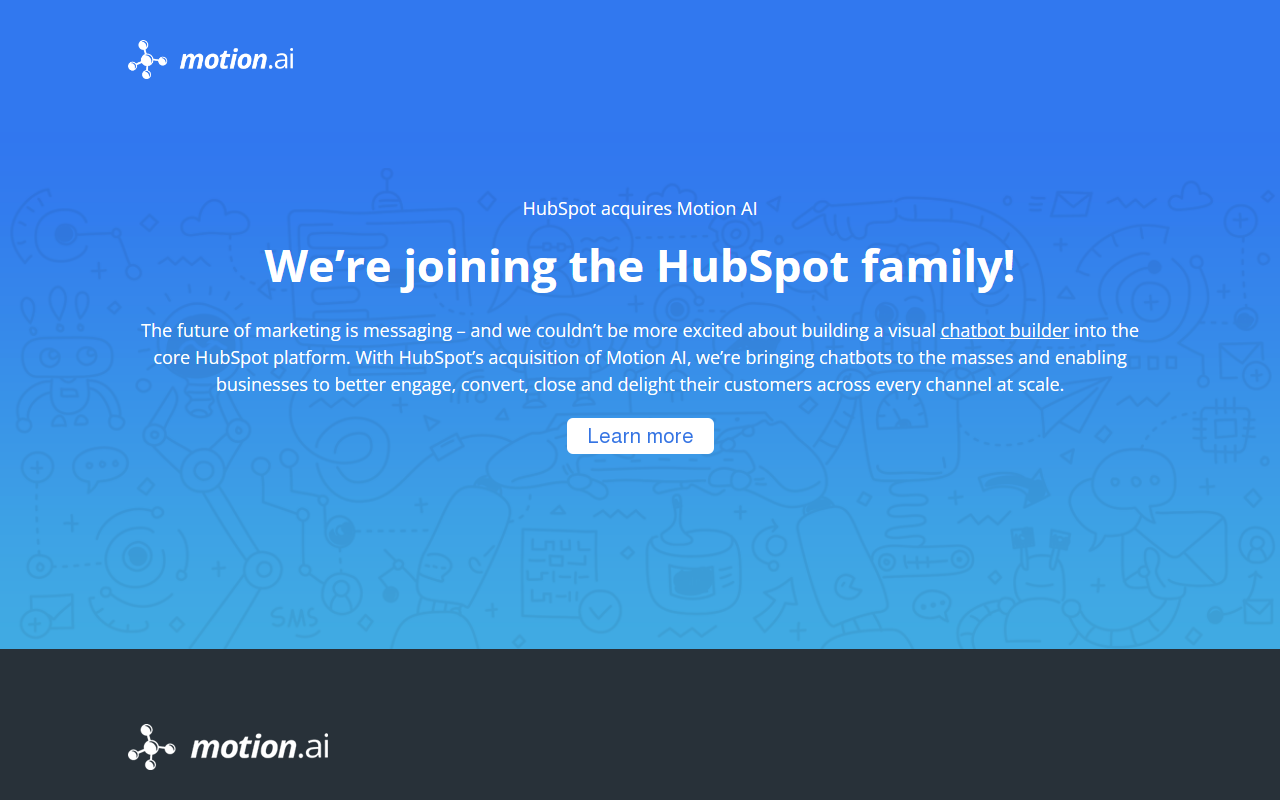
Upon visiting motion.ai, you’re greeted with a simple announcement: “Motion AI – Chatbots made easy” paired with the news that HubSpot has acquired the company. The page states, “We’re joining the HubSpot family!” and explains that the future of marketing is messaging. This acquisition effectively ended Motion AI as a standalone product. The visual chatbot builder that once allowed non-developers to create sophisticated conversational flows is now embedded within the HubSpot CRM and marketing platform. For anyone looking to evaluate Motion AI today, the core takeaway is that the original tool no longer exists independently; its DNA lives inside HubSpot’s chatbot feature.
When Motion AI was active, its interface was a drag-and-drop node-based editor. Users could build branching conversations by connecting message nodes, questions, and actions. It supported rich media, conditional logic, and integrations with platforms like Facebook Messenger and Slack. The free tier was generous, allowing a limited number of active chatbots. Now, the same visual builder logic is accessible only to HubSpot customers, typically as part of the Marketing Hub or Service Hub plans.
Testing the Legacy Experience and Current Limitations
I last used Motion AI before the acquisition. At that time, the onboarding flow was clean: you created a new bot, chose a template, and started wiring nodes. The response quality depended entirely on how you designed the conversation tree—there was no GPT-style generative AI built in. It solved the specific problem of enabling marketers and support teams to create chatbots without coding. Today, if you sign up at motion.ai, you’re redirected to HubSpot’s trial page. I tested the HubSpot chatbot builder, which retains the visual logic but is now tightly coupled with HubSpot’s contact database and workflows. You can still create conditional paths, but the tool no longer stands alone. A significant limitation is that you cannot use Motion AI outside of the HubSpot ecosystem. If your business uses a different CRM or prefers a lightweight bot platform, this is a dead end.
The acquisition has clear strengths: deep integration with HubSpot’s powerful CRM, email automation, and analytics. For existing HubSpot users, building a chatbot is seamless. But for anyone else, the cost of entry is high—HubSpot plans start at around $50/month for the Starter tier and go up to thousands for Enterprise. Pricing for the original Motion AI was not publicly listed on the website; it used a freemium model. Now, the chatbot feature is bundled, so there is no standalone pricing.
Market Position and Alternatives
In its heyday, Motion AI was a competitor to tools like ManyChat and Chatfuel, which focused on Facebook Messenger bots. Unlike ManyChat, Motion AI was more developer-friendly and offered a pure visual programming interface without requiring a channel-first approach. It also targeted a broader audience beyond social messaging, including web and mobile apps. Today, the chatbot builder market has shifted toward AI-driven natural language understanding. ManyChat now has generative AI features; Chatfuel offers basic NLP. HubSpot’s chatbot, while visual, still leans on rule-based logic unless you pay for advanced AI add-ons. For those seeking a standalone, no-coding chatbot platform, alternatives include Tars, Landbot, and Tidio. Each provides visual builders and does not require a CRM purchase. Motion AI was best suited for small to mid-size businesses already using HubSpot or willing to adopt it. For anyone not on HubSpot, the tool is effectively dead.
Final Verdict: Who Should Care About Motion AI in 2025?
Motion AI as a separate tool is no longer available. The honest assessment is that if you’re evaluating “Motion AI” today, you’re really evaluating HubSpot’s chatbot feature. Its strengths are deep CRM integration, a user-friendly visual builder, and the backing of a major SaaS company (HubSpot has thousands of employees and millions of users). Its limitations are that it’s not standalone, it’s not free, and it lacks generative AI capabilities out of the box. If you are a HubSpot customer, this tool is excellent for automating lead qualification, customer support, and FAQ responses. If you need a lightweight, independent chatbot builder, look elsewhere. Avoid this if you’re not ready to commit to HubSpot’s ecosystem. Genuine strengths include its intuitive node editor and the trust that comes with HubSpot’s platform. Real limitations include vendor lock-in and the disappearance of the original freemium model. Ultimately, this is a review of a tool that has transformed into a feature. Visit Motion AI at https://motion.ai/ to explore it yourself.










Comments