

First Impressions and Onboarding
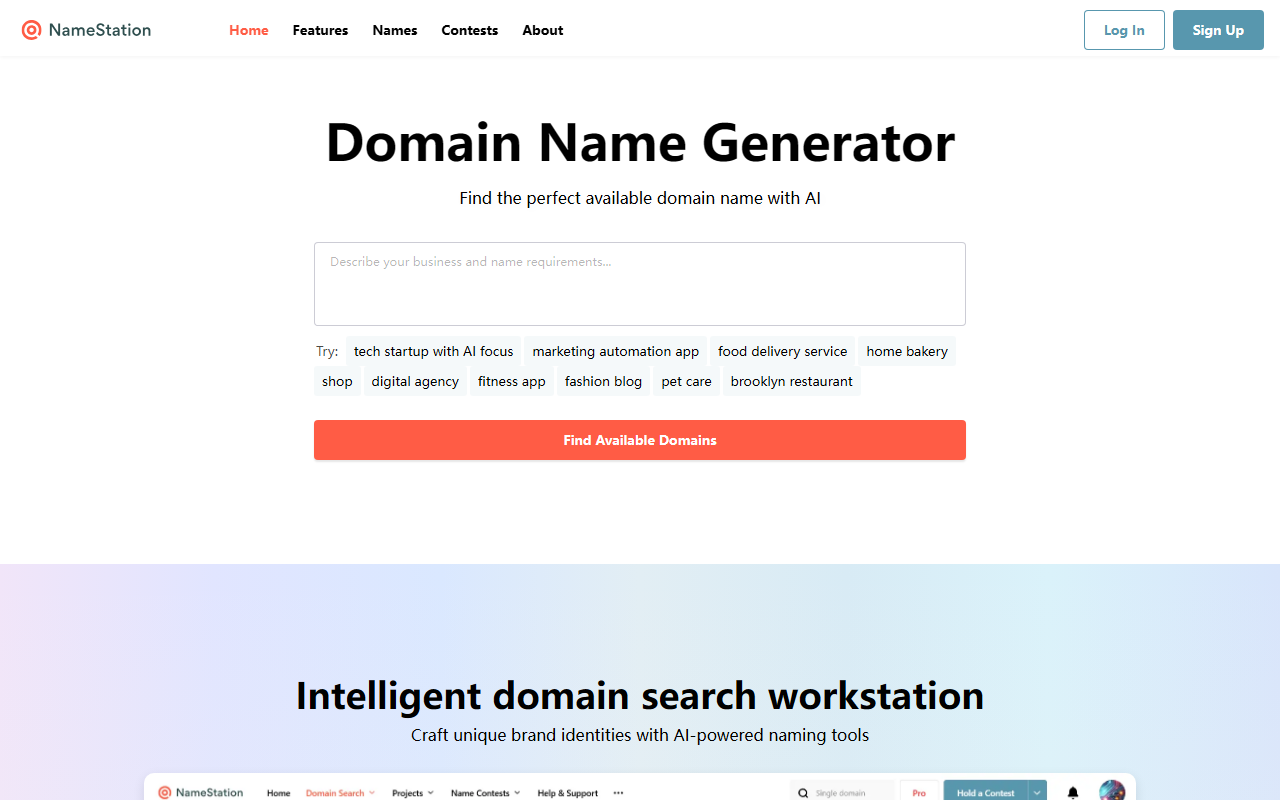
Upon visiting NameStation’s homepage, I was greeted by a clean, modern interface with a prominent search bar asking, “Pick the perfect name.” The onboarding is frictionless: you can start generating names immediately without creating an account. The main input box invites you to describe what your business does, and below it, example prompts like “Fitness app” or “Brooklyn bakery” show how easy it is to get started. Clicking “Generate Names” triggers a real-time feedback loop — within seconds, you see a grid of suggestions, each with a brandability score, domain extension, and an availability badge. The entire process took me less than 10 seconds from landing to seeing results.
Core Features: AI Generation and Naming Strategies
NameStation’s AI generator works by parsing your plain English description — not just keywords — and producing names that capture the vibe of your brand. In my test, I used “AI startup in healthcare that helps patients track vitals.” The tool returned 247 names in 0.8 seconds, with 189 marked as available. Each suggestion includes a score (out of 100) and highlights the best pick. What impressed me most was the variety of naming strategies available: the platform offers Compound Words, Portmanteaus, Translations (across 31 languages), and Made-up Names. You can toggle these filters to narrow results. For instance, switching to Translations showed names like “lumavita.com” (Italian for light + life) and “solcura.com” (Spanish sun + cure). Each name’s availability is verified in real time against the domain registry, so you never waste time on taken domains. The AI also learns from your preferences across sessions if you create an account.
User Experience and Workflow
The platform is designed for speed. After generating names, you can save favorites, start a team naming project, or browse curated lists of available domains by industry. The dashboard shows a clear breakdown of generated names, available options, and strategies used. I appreciated the “Team Naming Project” feature: you can invite collaborators (free reviewers) and collect votes or comments, which is perfect for agencies juggling multiple client briefs. For solo founders, the workflow is equally streamlined — you go from idea to registered domain in three steps: describe, generate, pick. NameStation also provides an AI evaluation score for objective comparison, reducing subjective debates within teams. The real-time verification uses zone files, covering 500+ extensions including .com, .io, and .ai. One minor limitation: the free tier’s naming limits are generous, but the website doesn’t explicitly detail what the paid plans unlock — the FAQ cuts off with “Paid plans unlock unlimited…” suggesting a subscription model for heavy usage.
Pricing and Market Position
NameStation offers a free tier that includes the core AI generator, name lists, and availability checks. You can generate names, save favorites, and export shortlists without paying. More advanced features — such as unlimited naming projects, priority support, or team workspaces — likely require a paid plan, though specific pricing isn’t publicly listed on the homepage. Compared to alternatives like LeanDomainSearch or Domainr, NameStation stands out for its AI-driven creativity and multiple naming strategies (translations, invented words). It also supports domain registration directly through the platform, which is a nice convenience. The tool has generated over 4.4 million names this year and facilitated 30,000+ domain registrations, a testament to its adoption among founders and branding experts. Since launching in 2012, it has built a community of 651 naming experts, adding credibility.
Strengths and Limitations
The primary strength is the combination of AI generation with real-time availability — you don’t need to manually check if a name is taken. The variety of strategies (compounds, translations, made-up words) yields creative results you’d otherwise get from a brainstorming session or a naming agency. The interface is intuitive and fast. However, the lack of transparent pricing for premium features can be a deterrent for users who want to budget. Also, while the AI does a good job capturing intent, some generated names feel generic or overly similar to existing brands (though availability reduces that risk). For serious brand naming, you may still want to run trademark checks separately.
Who should use NameStation? Solo founders and startups who need a quick, available domain name will love it. Agencies and branding professionals will benefit from the team collaboration and client workspaces. Enterprises with naming committees can use the voting and score features to make decisions faster. If you’re looking for a simple domain availability checker without brand strategy, consider LeanDomainSearch instead.
Visit NameStation at https://namestation.com/ to explore it yourself.











Comments