

First Impressions and Onboarding
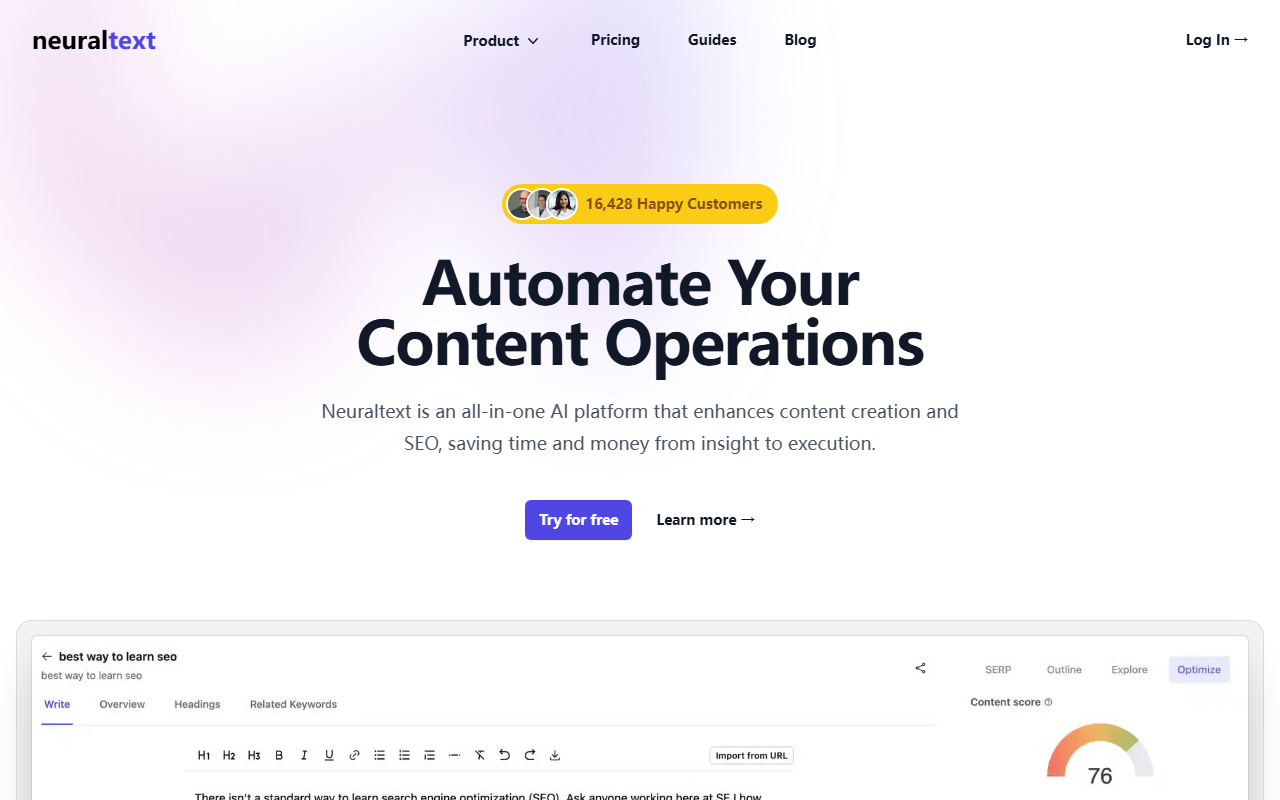
Upon visiting the NeuralText website, I was greeted by a clean, modern interface that immediately communicates its purpose: an all-in-one AI platform for content creation and SEO. The dashboard is well-organized, with clear navigation to its core features: Content Brief, Keyword Clustering, Content Analytics, and AI Writing tools. The onboarding flow is smooth; after signing up for a free trial, I was guided through a quick tutorial that highlighted the main sections. The tool claims 16,428 happy customers, and I can see why the polished onboarding makes it easy to get started.
Core Features and Workflow
NeuralText is not just an AI writer; it's a content operations platform. The Content Brief feature uses real-time SERP data to generate briefs that include recommended keywords, questions, and readability targets. When testing it with a query about "remote work tools," I was impressed by the depth of analysis—top-ranking pages were dissected for word count, headings, and topic coverage. The Keyword Clustering tool automatically groups related keywords by search intent, saving hours of manual work. I found the cluster output intuitive, showing which pages to create for comprehensive topic coverage.
The AI Writing Assistant offers inline autocompletion and a contextual menu for rewriting, summarizing, or expanding text. During my test, the AI generated a coherent blog intro that matched the brief's guidelines. The quality of output was good, though not groundbreaking—it rivals tools like Jasper or Copy.ai but focuses more on SEO-packed content. The Google Search Console Integration (marked as new) gives direct access to performance metrics like traffic and rankings, and offers content optimization suggestions. I appreciated the seamless workflow: you can send keywords directly from Search Console to the research tools.
Pricing and Positioning
NeuralText offers three paid tiers: Starter at $19/month (100K AI words, 5 content briefs, 2K keyword suggestions), Basic at $49/month (100K words, 40 briefs, 20K keywords), and Pro at $119/month (300K words, 100 briefs, 50K keywords, up to 5 GSC properties, 3 seats). A 5-day free trial is available. Unlike some competitors that charge per word or seat, NeuralText’s pricing is transparent and generous for small teams. The Starter plan is affordable for solo bloggers, while the Pro plan suits small agencies. Compared to MarketMuse or Clearscope, NeuralText is cheaper and bundles writing and research, though those tools offer deeper content scoring. For pure AI writing, Jasper is more feature-rich, but NeuralText’s integration with SEO research gives it an edge for content marketers who need both in one tool.
Strengths and Limitations
Strengths: The tight integration between content research, keyword clustering, and AI writing is a genuine time-saver. The SERP analysis for briefs is detailed and data-driven, and the inclusion of Google Search Console analytics is a standout feature—you don't need a separate reporting tool. The UI is fast and intuitive, reducing the learning curve.
Limitations: The AI writing output, while solid, sometimes lacks the creativity or tone variety of dedicated writing assistants. The paraphrasing tool worked well but occasionally produced awkward phrasing. Additionally, the keyword clustering algorithm could be more transparent—I would like to see why certain keywords are grouped together. The free trial is short at 5 days, which may not be enough to fully evaluate for large projects.
Who Should Use NeuralText?
NeuralText is best suited for content teams, SEO specialists, and solo marketers who want an all-in-one solution for researching, writing, and optimizing content. If you need a pure AI writer with advanced generation features, look at Jasper or Writesonic. If you want only in-depth content intelligence, tools like Clearscope or Frase might be better. But if you value an integrated workflow from keyword discovery to publishing, NeuralText is a strong contender. I recommend starting with the free trial to test the briefs and keyword clustering—they are the true differentiators.
Visit NeuralText at https://neuraltext.com/ to explore it yourself.










Comments