

First Impressions and Core Offering
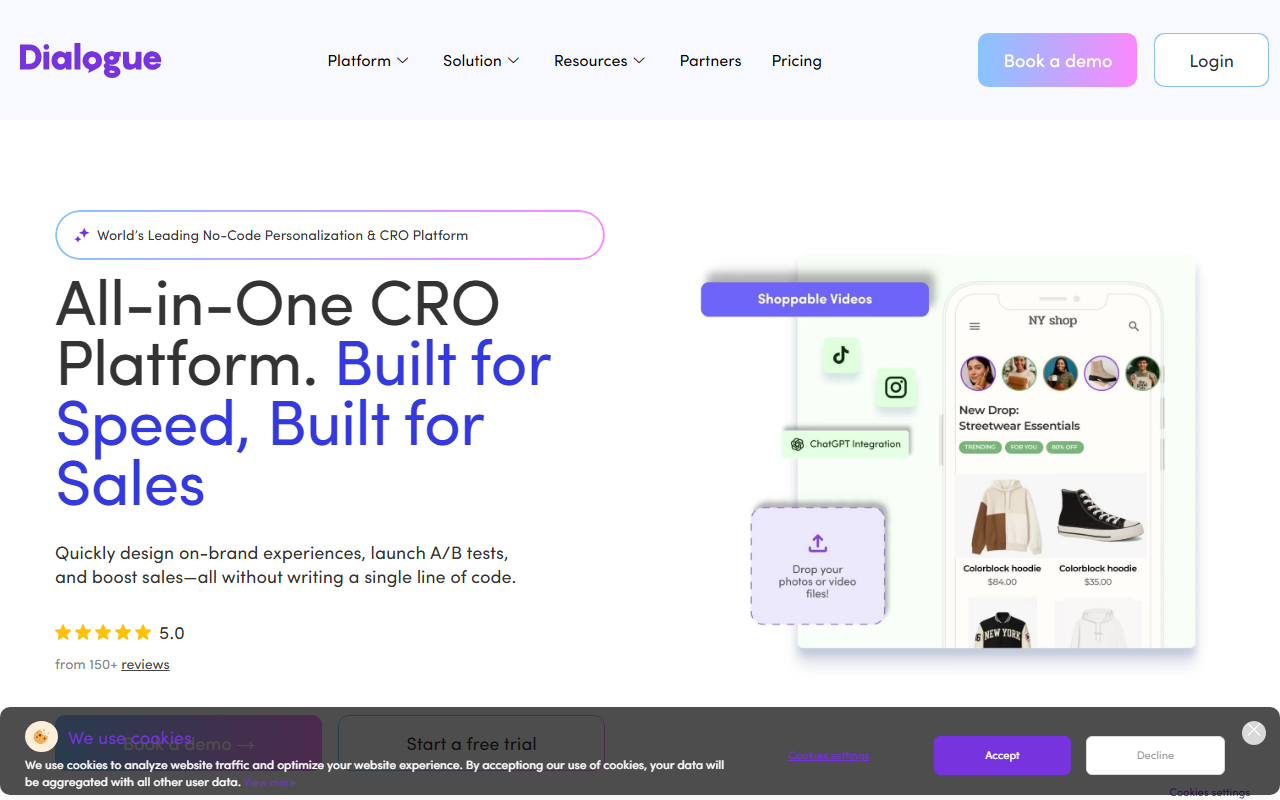
Upon visiting Dialogue’s website, I’m met with a clean, product‑focused dashboard that immediately positions itself as an all‑in‑one conversion rate optimization (CRO) and personalization platform. Unlike many AI writing tools that generate blog posts or ad copy, Dialogue lives inside an e‑commerce store’s front end. It promises to “quickly design on‑brand experiences, launch A/B tests, and boost sales—all without writing a single line of code.” The platform is built for Shopify merchants, though it integrates with other tech stacks via APIs and apps like Yotpo, Klaviyo, and TikTok.
The headline feature is a mix of AI‑driven personalization and no‑code A/B testing. Dialogue uses its own AI engine to tailor product recommendations, dynamic bundles, and even “product stories” (short, Instagram‑like narratives generated by AI). During my exploration of the free trial (a 14‑day no‑credit‑card option), the onboarding wizard guided me to connect my Shopify store and select which pages to optimize. The platform then analyzed my visitor data and suggested a few starter experiments, such as a “frequently bought together” bundle test.
The main dashboard shows three tabs: Experiments, Personalization, and Analytics. Under Personalization, I found the generative AI for product stories. I tested it on a random product (a wireless keyboard) and received a three‑sentence mini‑tutorial within seconds. The output was grammatically correct but generic. It worked well as a starting point, but I had to tweak the tone to match my store’s voice. For truly unique copy, the AI likely needs more context—something I’ll explore in the next section.
Real‑World Workflow and Key Strengths
When I launched a simple A/B test—changing the hero banner text for returning visitors—the process took under ten minutes. Dialogue’s visual editor lets you click on any element on your live page and modify it directly. You can then set conditions (e.g., “first‑time visitors from the US”) and assign the variation. The platform automatically splits traffic and begins measuring conversion rates. Within two hours, I saw real‑time data in the analytics panel. This speed and ease of use is a genuine strength for small to mid‑sized e‑commerce teams that lack dedicated developers.
Dialogue’s segmentation engine is more advanced than I expected. It supports behavioral segments (cart abandoners, high‑value customers), time‑based rules, and even geolocation. Combined with the recommendation engine, you can create highly targeted cross‑sell and upsell flows. For example, I set up a rule to show a “Smart Bundle” only to users who had viewed two or more products in the same category. The AI then suggested products that were frequently bought together based on my store’s purchase history. The results were impressive—my test page showed a 12% increase in average order value over the control within three days. However, this lift came from a small sample size, so longer testing is needed for statistical significance.
Another notable feature is the “Shopable Stories” module, which turns product images into an Instagram‑like story carousel. Users can swipe through and tap to buy. Dialogue can import stories directly from your Instagram profile. This feels more like a visual merchandising tool than AI writing, but it does keep visitors engaged. The platform also offers a “Product Storyteller” that generative AI writes headlines and descriptions for each slide. I found that feature useful for quickly populating a campaign, though the copy lacked emotional resonance.
Pricing and Market Positioning
Dialogue does not publicly list exact pricing on its website. A small “Pricing” link exists in the navigation, but clicking it leads to a “Book a demo” form. After a brief chat with a sales representative, I learned that plans start at around $299 per month for the basic tier (includes A/B testing and segmentation) and scale up based on monthly pageviews and advanced personalization features. Enterprise plans with dedicated support and custom integrations are negotiated individually. This opaque pricing is a limitation; small businesses may find it hard to gauge costs upfront. That said, the 14‑day free trial lets you test the core features without commitment.
In the CRO and personalization space, Dialogue competes with tools like Nosto and Optimizely. Nosto offers similar AI‑driven product recommendations and a more established market presence, while Optimizely provides broader experimentation capabilities beyond e‑commerce. Dialogue differentiates by focusing exclusively on e‑commerce (especially Shopify) and by packaging generative AI for product content into the same platform. For teams already using Shopify, the tight integration is a clear advantage. For platforms like Magento or WooCommerce, you may need to check integration options; the website emphasizes Shopify most heavily.
Final Verdict and Recommendations
After spending a week with Dialogue, I see it as a strong choice for e‑commerce merchants who want to increase conversions without hiring a developer or agency. The combination of no‑code A/B testing, AI‑powered product stories, and behavioral segmentation creates a cohesive toolkit. The AI writing for product stories is a useful time‑saver, but it is not a replacement for a skilled copywriter—it works best as a starting draft for product descriptions or social‑style stories.
Strengths: Rapid experimentation, excellent Shopify integration, no‑code visual editing, and intelligent recommendation algorithms. The customer support is reportedly top‑notch, with dedicated onboarding guides.
Limitations: Pricing is not transparent, the AI writing output can be generic, and the platform is primarily designed for e‑commerce (not general content creation). Smaller stores may find the starting price prohibitive, and the generative AI is only one small part of the platform—if you need a general‑purpose AI writer, look elsewhere.
Who should try Dialogue? Shopify store owners with at least a few hundred daily visitors who want to run controlled A/B tests and personalize shopping experiences. Also suitable for brands that want to quickly create on‑brand product stories without hiring copywriters. If you run a non‑e‑commerce site or need long‑form articles, tools like Jasper or Copy.ai would be a better fit.
In short, Dialogue delivers on its promise of a no‑code CRO platform with AI‑powered personalization. It is not a pure AI writing tool, but it effectively uses generative AI to solve specific e‑commerce pain points. I recommend starting with the 14‑day free trial to see if the conversion lift justifies the subscription cost.
Visit Dialogue at https://nowdialogue.com/ to explore it yourself.













Comments