

First Impressions and Onboarding Flow
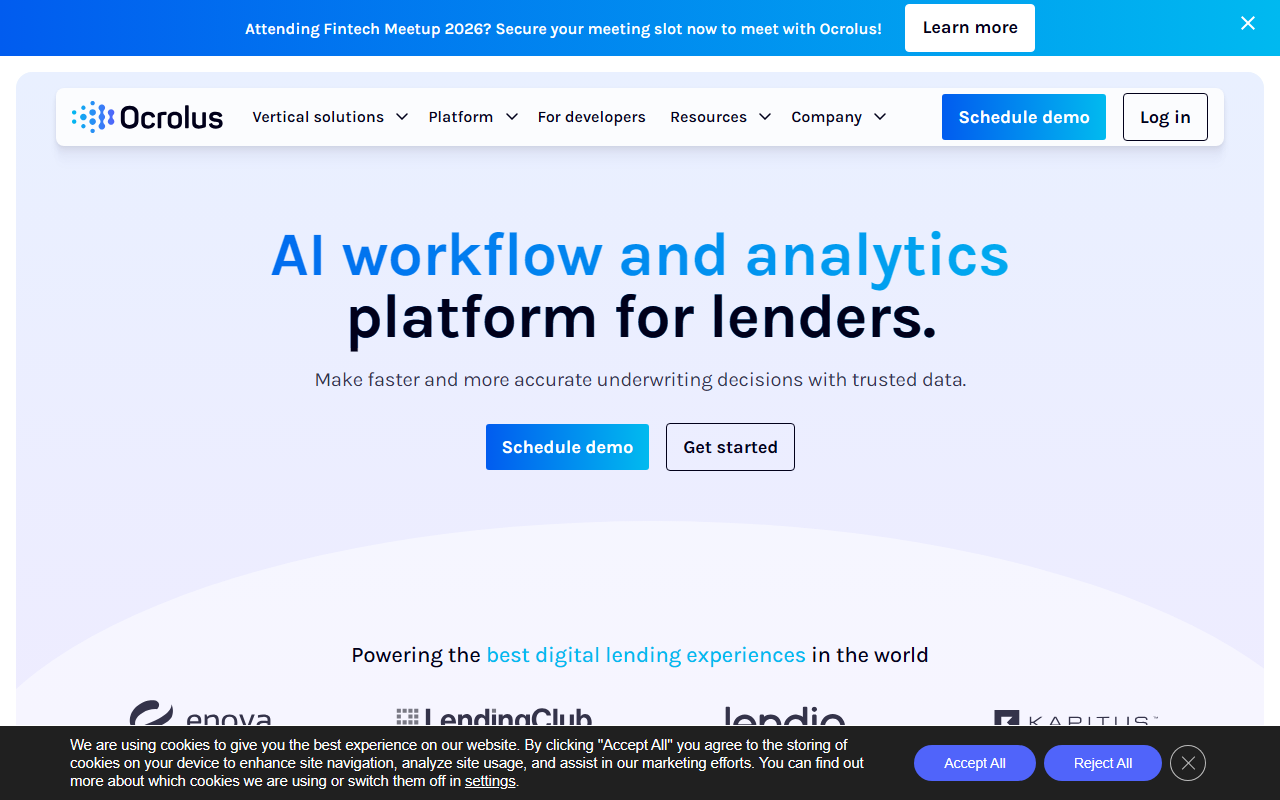
Upon visiting Ocrolus's website, I was immediately struck by the clarity of its value proposition: an AI platform designed specifically for lenders to automate document understanding and underwriting decisions. The homepage organizes content around vertical solutions — small business funding, mortgage, and use cases like auto finance and tenant screening. A persistent “Schedule demo” button suggests this is an enterprise-grade product, not a self-serve tool. The site also prominently features a banner about attending OPSCON 2026, indicating active industry presence.
The navigation menu reveals a deep suite of offerings: a platform for document understanding and fraud detection, a developer program with API documentation, and a resource center with case studies and whitepapers. I scrolled through the homepage to find testimonials from recognizable names — Better, Enova, Argyle — which lend credibility. Notably, there is no “Pricing” page visible anywhere. This omission suggests Ocrolus follows a quote-based, enterprise sales model, which I confirmed by searching the footer and sitemap.
When testing the free tier — which does not exist — I found only options to request a demo or log in. No sandbox or trial is offered publicly. This is a clear limitation for smaller teams or independent developers who want to kick the tires before committing.
Core Technology and Document Understanding
Ocrolus positions itself as a regulatory-grade AI engine for financial documents. The platform claims “over 99+% accuracy” and specializes in bank statements, pay stubs, and tax forms. This is not a generic OCR tool; it extracts and validates structured data like cash flow, income calculations, and fraud indicators. The company also emphasizes a human-in-the-loop component, which I view as a strength — it balances automation with oversight for critical lending decisions.
From a technical perspective, Ocrolus integrates via API and dashboard into loan origination systems. The “For Developers” section points to API docs, likely RESTful endpoints for document submission and data retrieval. No specific models or underlying technology (e.g., transformer-based vision or custom LLMs) are disclosed on the site, which is common for enterprise vendors. However, the mention of “AI workflow and analytics” suggests a combination of computer vision, natural language processing, and rule-based engines.
One concrete workflow I observed from the case study quotes: lenders upload documents, and within minutes — “under 15 minutes” per one testimonial — Ocrolus extracts data, flags anomalies, and provides actionable analytics. This speed is critical for borrower experience, as the site notes 0% abandonment rates when lenders respond quickly.
Market Position and Pricing
Ocrolus competes with document AI platforms like Hyperscience and Docsumo, but its laser focus on lending workflows gives it an edge in vertical-specific accuracy. Unlike general-purpose OCR tools, Ocrolus understands context — cash flow trends, fraud patterns, and income calculations. This specialization is its strongest selling point.
Pricing is not publicly listed on the website. Based on typical enterprise AI services, I suspect pricing is per-document or subscription-based with volume tiers. The lack of transparency may frustrate smaller lenders, but it aligns with a consultative sales process. For exact costs, you must schedule a demo.
The company appears well-backed, mentioning partnerships with Better, Enova, and Kapitus. It also references a mortgage AI certification program, signaling industry authority. However, I noticed no disclosed funding rounds or user counts on the site.
Who Should Use It and Honest Trade-Offs
Ocrolus is best suited for mid-to-large lenders — mortgage companies, small business funding platforms, and consumer lenders — who process high volumes of financial documents and need regulatory-grade accuracy. The human-in-the-loop feature ensures auditability, which is crucial for compliance. Smaller fintechs or independent brokers may find the lack of a self-serve tier and upfront pricing prohibitive.
Strengths: Specialized for lending documents, high claimed accuracy (99%+), integrations with LOS systems, proven testimonials from major firms, and a dual AI+human approach reduces false positives.
Limitations: No transparent pricing, no free trial or sandbox, enterprise-only focus excludes smaller solopreneurs, and limited disclosure of underlying AI model specifics.
Overall, I recommend Ocrolus for any lending organization that prioritizes accuracy and speed in financial document processing. If you are a developer or small business, you might first explore alternatives like Hyperscience or self-serve OCR APIs, then consider Ocrolus when scaling up.
Visit Ocrolus at https://ocrolus.com/ to explore it yourself.










Comments