

First Impressions and Onboarding
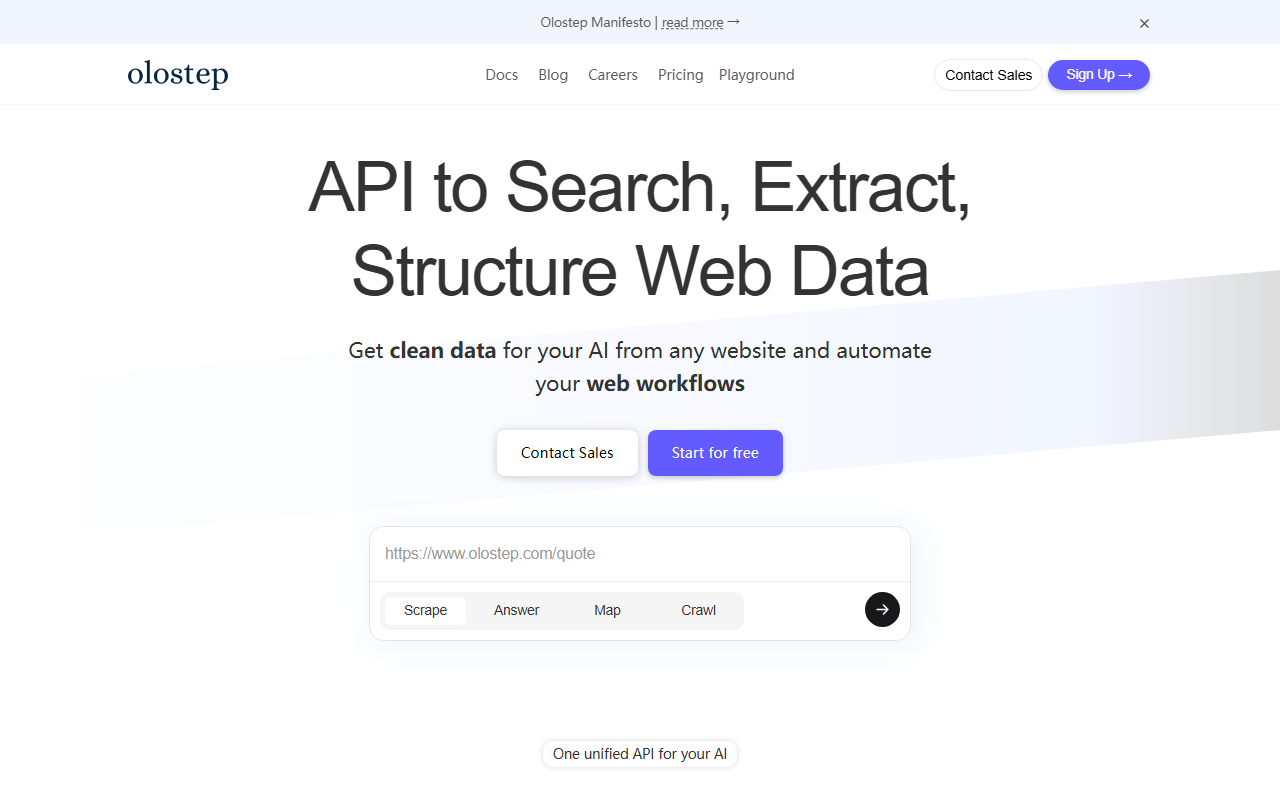
Upon visiting Olostep's website, I was struck by the clean, developer-focused interface. The landing page features a hero section with a playground link and a prominent "Start for free" button. I clicked through to the playground, where I could test the scrape endpoint immediately without signing up. The dashboard itself is minimal, but the documentation is well-organized, with code examples for Python and Node.js. I noticed the free tier appears to allow a limited number of requests, though exact quotas aren't spelled out publicly. The overall vibe is modern and geared toward engineers who want to integrate web data into their AI pipelines quickly.
Core Capabilities and Technical Deep Dive
Olostep positions itself as a unified API for web data extraction, offering several endpoints: /scrapes returns clean Markdown from any URL; /crawls retrieves all subpages from a start URL; /answers performs web search with AI-powered answers; /agents lets you define automated research workflows using a simple prompt; and /batches processes up to 100k URLs in minutes. The API also includes a parsers system—pre-built extractors for sites like Google Search, Instagram, Reddit, and emails—which can be combined or custom-built via prompt. I tested the scrape endpoint with a sample URL, and the response returned clean Markdown and JSON metadata in under two seconds. The architecture appears to use distributed infrastructure with VM sandboxes, which explains the reliability for large-scale tasks. Integrations listed include Brave Search and various social media parsers, though the site mentions a parser store for community contributions. The API is truly developer-centric, with code snippets for Python and Node.js on every endpoint page.
Pricing, Market Position, and Alternatives
Pricing is not openly listed on the website beyond a "Start for free" call-to-action and a "Contact Sales" option for enterprise needs. This is a common pattern among developer tools that offer usage-based pricing, but it does require prospects to engage with sales to get specific numbers. In terms of competition, Olostep competes directly with tools like Firecrawl (which also offers scraping, crawling, and AI-powered extraction) and ScrapingBee (a more traditional scraping API with proxy support). Unlike Firecrawl, Olostep emphasizes its agent framework and pre-built parsers, making it particularly suited for AI researchers and automation engineers. Another alternative is Bright Data, but Olostep's developer experience feels more modern and lightweight. The tool is best suited for developers building AI agents, data pipelines, or competitive intelligence workflows. Teams needing a simple, one-off scraper may find it overkill, while enterprise users will benefit from the batch processing and agent capabilities.
Strengths, Limitations, and Final Verdict
Olostep's strongest asset is its unified, API-first design that combines scraping, crawling, search, and agent execution into a single interface. The pre-built parsers for common websites save hours of work, and the ability to create custom parsers via prompt is genuinely innovative. The documentation is excellent, with ready-to-run code examples. However, I found two significant limitations: first, the lack of transparent pricing makes it hard to evaluate cost-effectiveness for small projects; second, there is no visible webhook or callback mechanism for long-running batch jobs, which would be helpful for production workflows. Despite these drawbacks, Olostep delivers a polished, high-performance tool for integrating web data into AI systems. I recommend it to any team building AI agents that need to extract, structure, and act on web content at scale. Visit Olostep at https://olostep.com/ to explore it yourself.













Comments