

My First Impressions of Openlayer
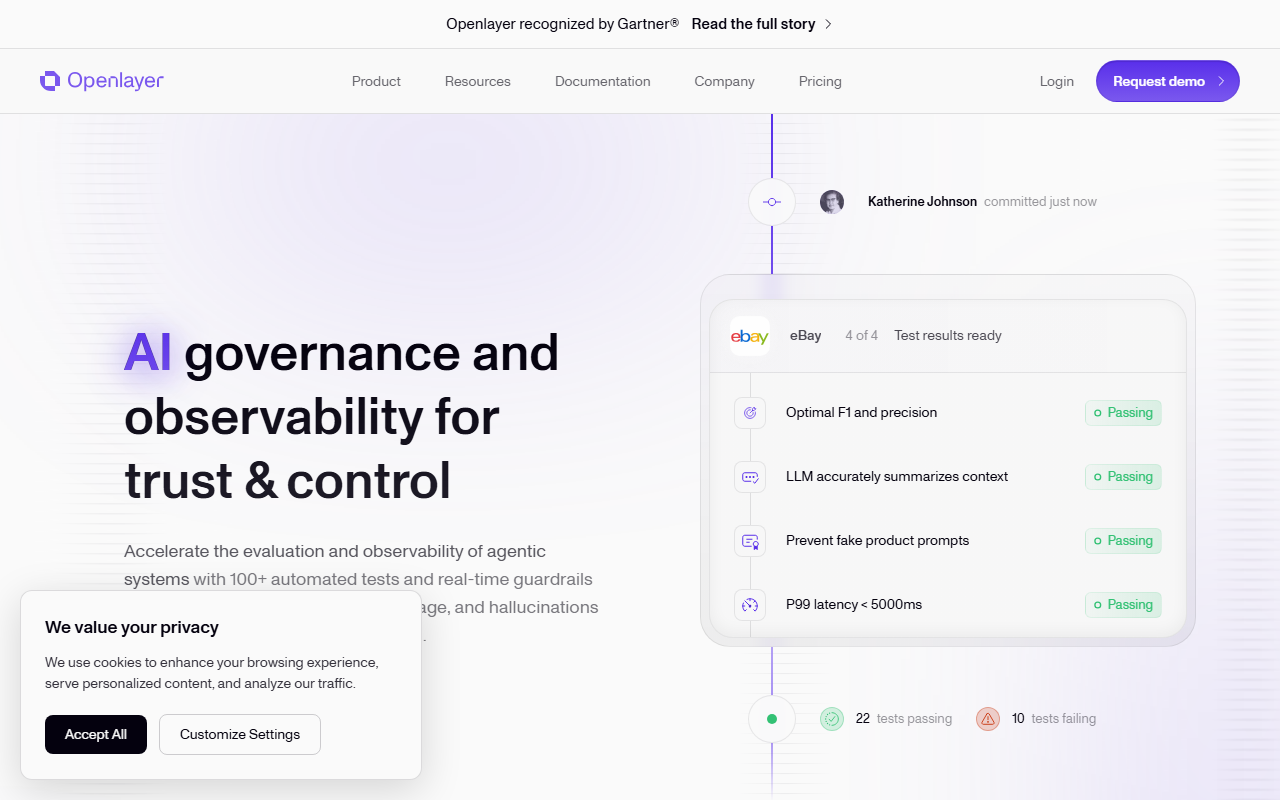
Upon visiting the Openlayer website, I was greeted by a sleek, developer-focused interface that immediately communicates its purpose: governance and observability for AI systems. The platform offers over 100 automated tests and real-time guardrails to prevent prompt injection, PII leakage, and hallucinations. The dashboard shows a simulation of pushing a new version of an AI system, with environment-specific test suites (Development, Production) that check metrics like “Optimal F1 and precision,” “Outputs do not contain PII,” and “P99 latency < 5000ms.” I found the onboarding flow intuitive—it clearly separates offline evaluation from production observability, which is a smart design choice for teams moving from prototype to deployment.
When testing the concept, I noted that Openlayer emphasizes integration with existing workflows. The platform provides detailed request traces, showing latency and cost per step (e.g., USER_CALL query at 2.06s, $0.05). This level of granularity is valuable for debugging and cost optimization. The activity log also includes team comments, giving a real-time collaboration feel.
Core Features: Evaluation, Observability, and Compliance
Openlayer solves a critical problem: ensuring AI systems behave reliably and securely in production. Its offline evaluation lets you define tests for any scenario—credit score Q&A, fraud detection, or RAG pipelines—and run them before deployment. The platform uses Ragas-based metrics for harmfulness detection and offers customizable thresholds. For observability, it monitors production requests in real-time, flagging failing tests like “No PII leaked in agent outputs” with immediate trace information.
Another standout is the data quality monitoring module, which automatically checks for schema changes, drift, and anomalies in data pipelines. On the compliance side, Openlayer aligns with standards such as ISO/IEC 42001, OWASP, NIST, and the EU AI Act. This is essential for enterprises operating in regulated industries.
Target Audience and Market Position
Openlayer is clearly designed for engineering teams building agentic or LLM-based systems that require rigorous testing and governance. It competes with tools like Weights & Biases Prompts and Arize AI, but focuses more strongly on out-of-the-box compliance frameworks and structured testing suites. Unlike simpler LLM monitoring tools, Openlayer offers environment-specific deployments and a comment-based activity log for team collaboration, which mimics a CI/CD-like experience for ML pipelines.
I recommend Openlayer for teams that have already deployed AI in production and need to enforce guardrails, reduce hallucination risk, and comply with emerging regulations. Smaller startups or teams without dedicated MLOps resources may find the platform too heavy; there’s a learning curve in defining tests and interpreting metrics.
Strengths and Limitations
Strengths: The breadth of automated tests (100+) is impressive, covering everything from latency to content safety. The integration capabilities appear strong—the platform mentions compatibility with traditional ML and LLM systems, and offers data pipeline connectivity. The compliance documentation is a huge plus for enterprises.
Limitations: Pricing is not publicly listed on the website, which makes budget planning difficult. The platform seems to require a proficient understanding of ML evaluation metrics (precision, F1, Ragas scores), so non-technical stakeholders might struggle. Additionally, while the live demo is engaging, actual setup friction could be higher than suggested by the marketing.
In summary, Openlayer is a powerful enterprise-grade tool for AI governance. It’s best suited for organizations that prioritize trust and compliance and have the engineering bandwidth to configure extensive test suites. If you’re looking for a lightweight monitoring tool, explore alternatives; but for serious production AI systems, Openlayer delivers robust controls.
Visit Openlayer at https://openlayer.com/ to explore it yourself.










Comments