

First Impressions and Setup
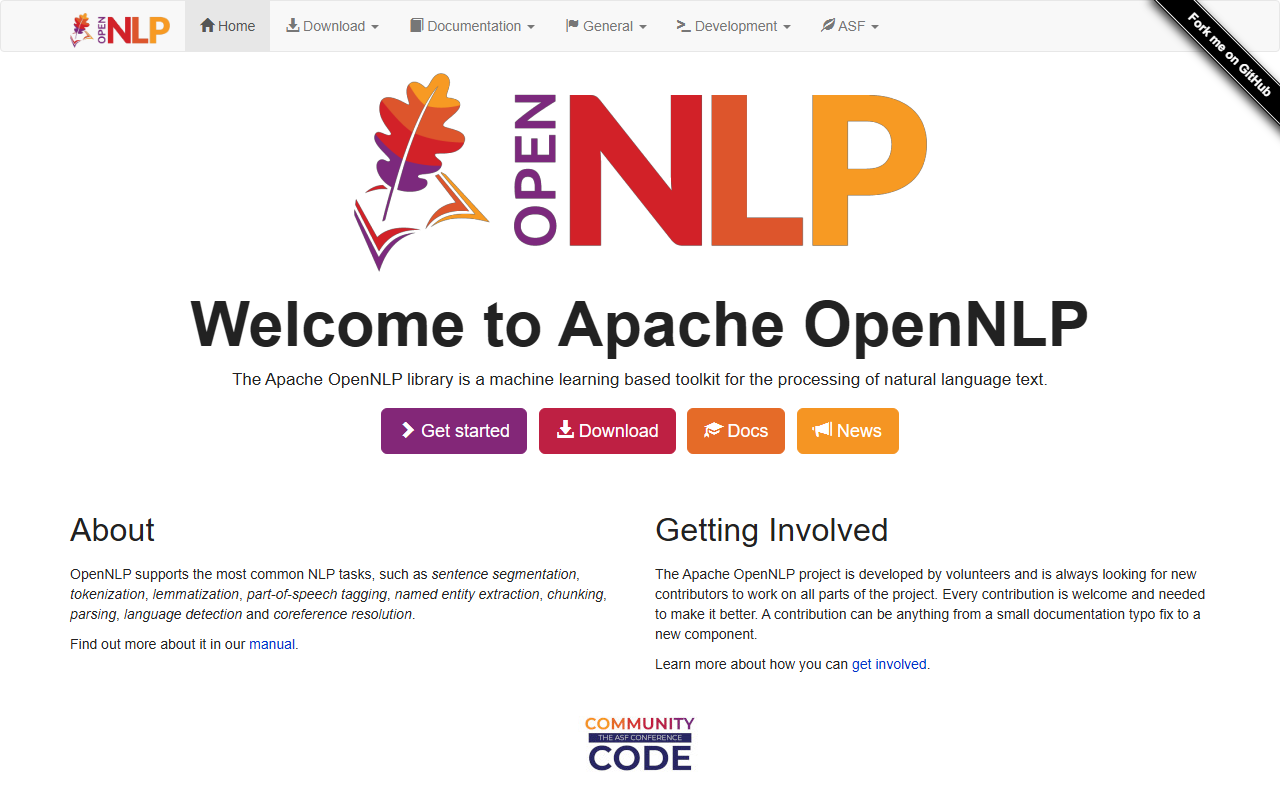
Upon visiting the Apache OpenNLP website, I was greeted by a clean, no-fuss homepage that immediately directs you to getting started, downloads, and documentation. There is no fancy dashboard or trial registration—this is a developer framework, not a SaaS product. I downloaded the latest binary distribution and imported the JAR files into a Java project. The onboarding is entirely manual: you read the manual, add the dependency, and start coding. For a Java veteran, this is straightforward; for someone newer to Maven or Gradle, the site offers snippets for both. When testing the free tier—which is the entire library—I ran the provided sentence detector model on sample text and observed quick, accurate segmentation. The library doesn’t require an API key or internet connection, which is a major plus for offline use.
Core Capabilities: What Apache OpenNLP Does Well
The Apache OpenNLP library supports a comprehensive range of NLP tasks: sentence segmentation, tokenization, lemmatization, part-of-speech tagging, named entity extraction (NER), chunking, parsing, language detection, and coreference resolution. Under the hood, it uses maximum entropy and perceptron-based machine learning models. I tested tokenization on several languages; the default models work decently for English, but you can train custom models for domain-specific jargon. The library integrates tightly with the Java ecosystem—you can embed it in any JVM application without extra dependencies. Unlike spaCy (Python) or Stanford NLP (multilingual), OpenNLP is purely Java, making it ideal for enterprise systems that already run on the JVM. A notable strength is its long-term stability: it is an Apache project with a mature codebase and a permissive Apache 2.0 license.
Strengths and Real Limitations
Genuine strengths: OpenNLP is completely free and open-source, with no pricing tiers or hidden costs. It offers a wide range of pre-trained models and a clean API that follows standard NLP pipeline patterns. The documentation (though dense) includes a manual and JavaDoc that are thorough. The community, while small, is responsive via mailing lists and Jira. Another strength is its lightweight footprint—no GPU required, and it runs well on any modern JVM.
Real limitations: The biggest drawback is that OpenNLP feels dated compared to modern Python-based libraries. The pre-trained models are not as accurate as state-of-the-art transformer-based models (e.g., from Hugging Face). There is no native deep learning integration; you must write custom code to combine it with frameworks like DL4J. Additionally, the project’s development pace has slowed—some modules, like coreference resolution, remain experimental. Java developers who want cutting-edge accuracy may find OpenNLP lacking. Furthermore, the library does not support GPU acceleration out of the box, which can be a bottleneck for large-scale processing.
Target Audience and Final Verdict
Apache OpenNLP is best suited for Java developers who need a reliable, license-free NLP library for production systems where data cannot leave the network. It fits well in legacy enterprise stacks that cannot easily adopt Python. If you are starting a new NLP project and are not constrained to Java, I would point you toward spaCy or Hugging Face Transformers for better performance and community support. However, for a quick, on-premise sentence detector or NER solution inside a Spring Boot application, OpenNLP remains a solid choice. It is not a flashy tool, but it gets the job done when you need a no-frills, battle-tested NLP framework.
Visit Apache OpenNLP at https://opennlp.apache.org/ to explore it yourself.













Comments