

First Impressions: A Polished, Enterprise-Focused Onboarding
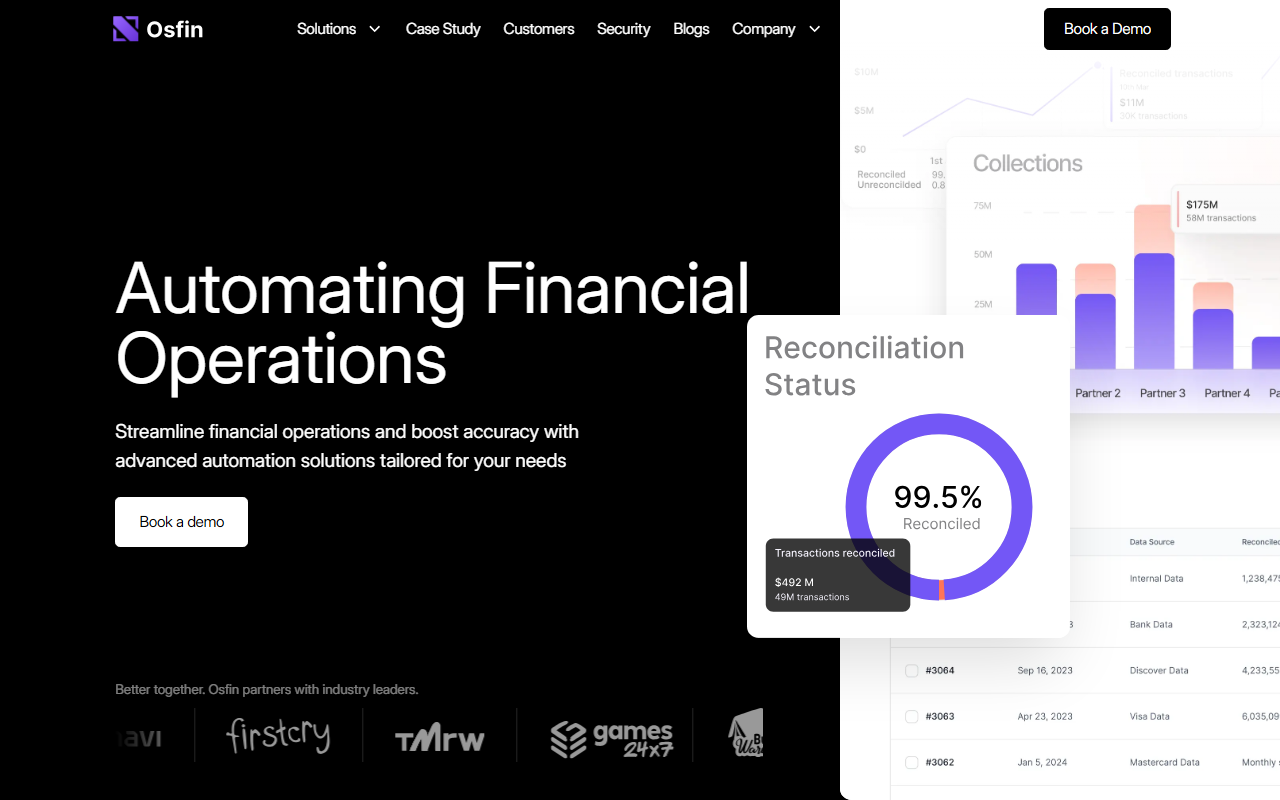
Upon visiting the Osfin website at osfin.ai, I was immediately struck by the clean, professional design that clearly targets enterprise finance teams. The homepage leads with a bold tagline—"Automate your financial reconciliation with Osfin"—and a prominent "Book a Demo" button. There is no free tier or self-service signup; the only way to engage is through a demo request form. That form asks for first name, last name, email, phone number, company name, and a message, plus a checkbox agreeing to terms. It's a classic B2B SaaS funnel: no friction for serious buyers, but a barrier for casual explorers like me. The site also showcases a carousel of customer logos (though I couldn't determine exact names without deeper inspection) and a footer with compliance badges: GDPR, ISO 27001, SOC 2, 256-bit SSL, and PCI DSS/SSF. That level of certification immediately signals trustworthiness for financial data.
Core Capabilities: What Osfin Actually Does
Osfin is an intelligent automation platform purpose-built for high-volume financial reconciliation. It ingests data from over 170 sources—payment gateways, banks, ledgers, ERPs, and internal databases—via a low-code integration framework. Once data is ingested, the platform performs lightning-fast matching and reporting. The key workflows I observed from the site include: tracking deposits, loans, payments, invoices, and trades; reconciling ACH transactions; and generating real-time dashboards with cashflow visibility at an SKU level. The site highlights specific verticals: banking, payments & cards, fintech, insurance, capital markets, gaming platforms, and retail. For example, a customer testimonial from PharmEasy's accounting team mentions achieving "real-time visibility of cashflows at an SKU level" and managing state-wise charges and taxes. Another from Games24x7 praises seamless handling of voluminous transaction data. This suggests Osfin's engine is built for complex, multi-channel, multi-entity scenarios. The platform claims to process "millions of entries quickly" and offers agile configuration to tailor reconciliation rules, payout validation, and data reporting. A dedicated support team is also part of the package.
Market Positioning and Pricing
Pricing is not publicly listed on the website. Like many enterprise financial tools, Osfin uses a demo-and-negotiate model. This is common among competitors such as Trullion (AI for accounting compliance) and FloQast (financial close management). However, Osfin differentiates itself by focusing specifically on high-speed reconciliation for high-volume transaction environments, rather than broader accounting workflows. The tool is best suited for finance teams in mid-to-large enterprises that handle tens of thousands of daily transactions across multiple channels. Startups or small businesses with simpler reconciliation needs may find the offering overkill—and likely too expensive without transparent pricing. The website does not mention any free tier, trial period, or usage-based pricing, so budget-conscious buyers should be prepared for a sales conversation.
Strengths, Limitations, and Final Verdict
Osfin's greatest strengths are its speed, breadth of integrations, and compliance posture. The ability to reconcile millions of records rapidly and output actionable dashboards gives finance teams a tangible efficiency boost. The security certifications (ISO 27001, SOC 2, PCI DSS) make it viable for highly regulated industries. Customer testimonials reflect genuine satisfaction, especially in reducing manual effort and preventing revenue leakage. On the downside, the lack of transparent pricing and the absence of any self-service tier is a barrier for smaller companies. Additionally, the platform's complexity means onboarding likely requires professional services or dedicated support, which may increase total cost. There is also no mention of AI-native features like anomaly detection or predictive reconciliation—the offering seems rule-based with automation rather than generative AI. That said, within its niche, Osfin appears to be a powerful, well-backed solution (the website lists multiple industry partnerships). I recommend it for any enterprise finance team drowning in manual reconciliation across many data sources. Others should look for lighter alternatives. Visit Osfin at https://osfin.ai/ to explore it yourself.











Comments