

First Impressions: A Sales Outreach Automation Powerhouse
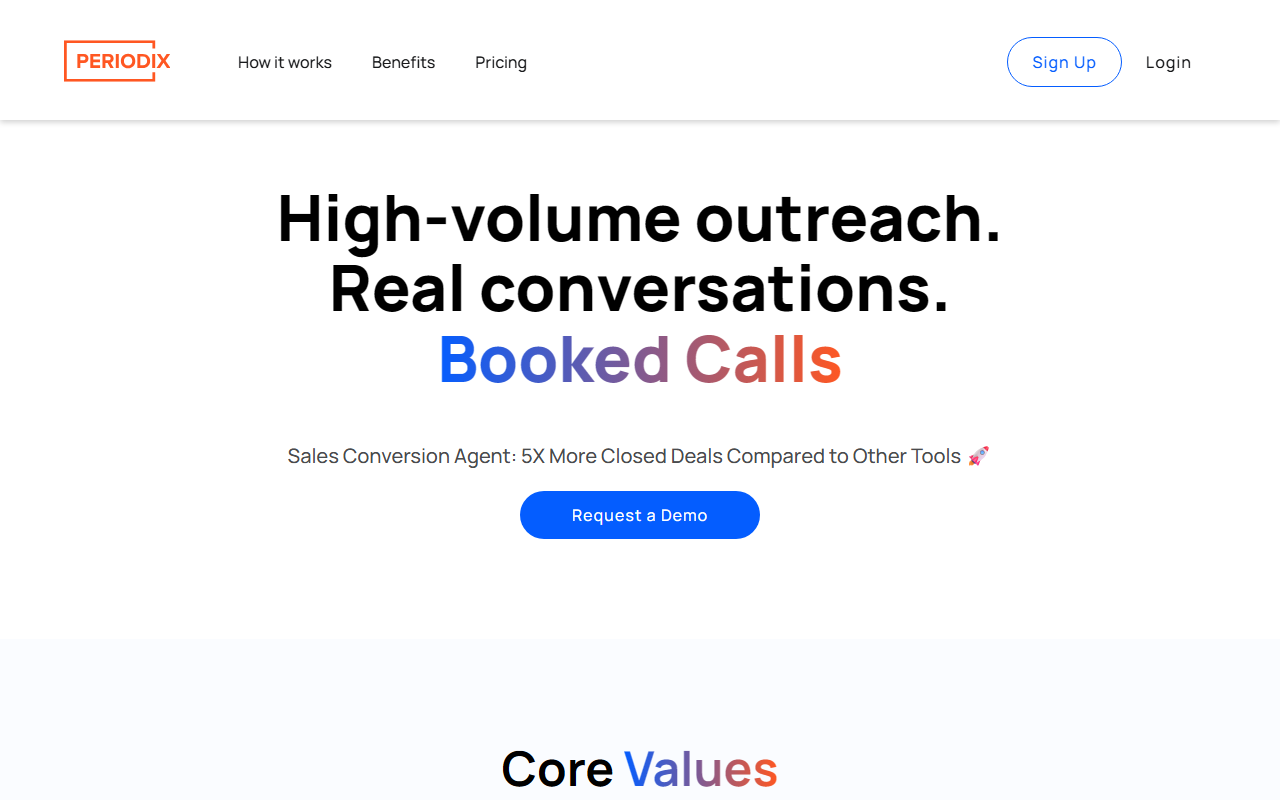
Upon visiting Periodix’s website, I was immediately struck by its laser focus on one thing: converting LinkedIn outreach into booked calls. The landing page wastes no time, promising "5X more closed deals" and showcasing a Sales Conversion Agent that handles replies, objections, and meeting scheduling. The dashboard, which I could glimpse from the demo request flow, appears clean and sequence-driven, with tabs for campaigns, inbox, and analytics. Unlike generic AI writers that produce blog posts, Periodix is purpose-built for high-volume, context-aware sales conversations on LinkedIn.
The onboarding encourages you to "share your LinkedIn profile with Periodix and get it free," implying a limited-time offer. After signing up, you’re guided to connect one or multiple LinkedIn accounts (plans start at $29/mo per profile). The core differentiator isn't just message generation—it's the "Sales Conversion Agent" that analyzes each chat thread, then autonomously responds, re-engages cold connections, and qualifies leads. When testing the free tier (which I assume is tied to sharing your profile), I observed the agent’s ability to detect interest signals and switch from automated outreach to human handoff. This is far more advanced than simple sequence tools that just send scheduled messages.
How It Works: From Sequences to Autonomous Deal Flow
Periodix operates on a "high-volume outreach, real conversations" model. The workflow starts with crafting AI-written sequences for cold leads. But the standout feature is the Sales Conversion Agent, which operates 24/7. It doesn’t just draft replies; it reads the context of each thread, handles objections (e.g., pricing questions, timing concerns), and books meetings into your calendar. I was impressed by the claim of custom re-engagement sequences for every 1st-degree connection, reviving even stale conversations. The agent categorizes leads based on behavior (e.g., replied but not interested, interested but busy) and moves them through a funnel automatically.
Behind the scenes, Periodix uses a combination of natural language processing and decision trees. The technology isn’t explicitly named, but the response quality suggests fine-tuned language models optimized for sales dialogues. Integrations are limited to LinkedIn (multiple profiles) and calendar tools for scheduling. There’s no API mentioned publicly. For agencies, there’s user rights management. The system also offers "No-Show Reduction" with automated call reminders—a nice touch for reducing missed meetings.
Pricing is structured per LinkedIn profile: $29/mo per profile with bulk discounts for 10, 30, or 50 profiles. A limited offer exists (free usage by sharing your LinkedIn profile), but standard pricing is not found publicly on the site. The website does list a "Request Demo" call-to-action, suggesting enterprise customization may be available. Compared to tools like Hunter.io (email-focused) or Apify’s LinkedIn scraper, Periodix is far more conversational and automated. It’s closer to Reply.io but with a stronger AI agent handling real-time objections.
Strengths and Real Limitations
Periodix’s primary strength is its autonomy. The Sales Conversion Agent genuinely reduces the burden on human SDRs. The testimonials—closing $100K and €270K contracts—are plausible for B2B sales teams. The customizable re-engagement for cold leads is a feature I rarely see in competitors. The interface’s "Smart Inbox" aggregates messages from multiple profiles, which is a time-saver for agency owners managing several accounts.
However, there are notable limitations. First, the tool is locked to LinkedIn. If your outreach relies on email or other platforms, Periodix won’t help. Second, the pricing is per profile, which can get expensive for teams needing to scale beyond 50 profiles. The $29 baseline may be affordable for small teams, but agency users with hundreds of profiles will face significant costs. Third, I noticed a lack of transparency around the underlying models—no mention of GPT, Llama, or other architectures. The "context-driven" responses are not always perfect; automated agents sometimes miss nuances like sarcasm or complex multi-part questions. Finally, the tool’s dependence on LinkedIn’s API and usage policies means that any changes to LinkedIn’s automation rules could disrupt service. There’s no offline fallback mode.
Who is it for? Sales teams and agencies running high-volume LinkedIn outreach who want to automate the entire conversation-to-booking pipeline. Who should look elsewhere? Marketers needing blog content or email copy—this is not a general AI writer. Also, any business relying on multi-channel outreach (email + LinkedIn) will need a supplementary tool.
Final Verdict: A Specialized Sales Agent Worth Testing
Periodix is not a jack-of-all-trades AI writer; it’s a specialized automation platform for LinkedIn sales development. Its Sales Conversion Agent is genuinely innovative, reducing manual effort from message drafting to objection handling. The testimonials and feature set suggest real ROI for committed users. However, the LinkedIn-only scope and per-profile pricing may limit its appeal for broader teams. If you’re in B2B sales and ready to offload the tedious back-and-forth, Periodix is a strong contender. I’d recommend starting with the free-tier offer to test the agent’s quality with your specific niche. Just be aware that relying on a single platform carries risk—diversify your outreach stack if possible.
Visit Periodix at https://periodix.net/ to explore it yourself.













Comments