

First Impressions: What PromptLayer Offers
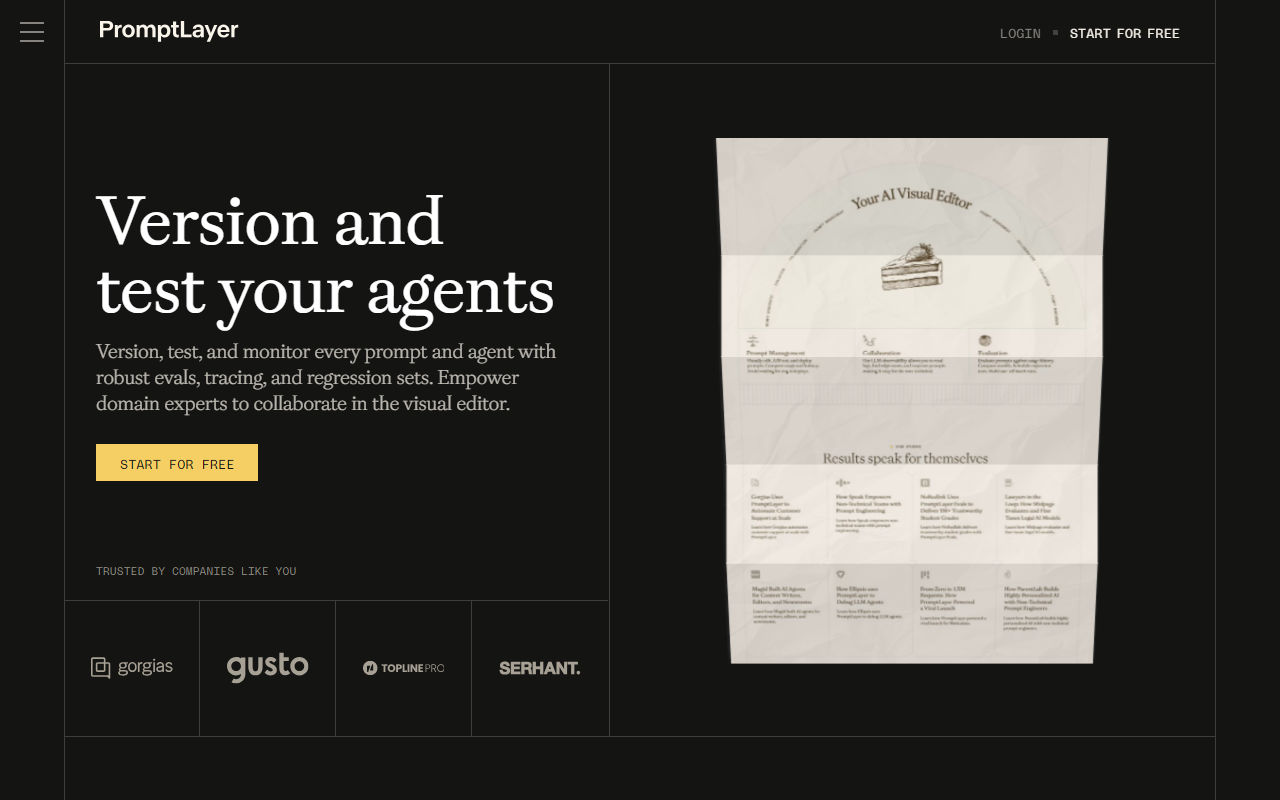
Upon visiting PromptLayer's website, I encountered a clean, minimal landing page that immediately communicates its core mission: version and test your agents. The headline is straightforward, and the inclusion of a new case study about Magid building enterprise-grade AI agents signals real-world credibility. The tagline — "Version, test, and monitor every prompt and agent with robust evals, tracing, and regression sets" — gives a clear sense of the platform's focus on the lifecycle management of LLM prompts and agents. There is no cluttered dashboard or overwhelming feature list upfront. Instead, the site directs attention to a visual editor designed for domain experts to collaborate without deep technical overhead. I noticed a distinct emphasis on enterprise readiness, reinforced by the phrase "Trusted by companies like you." The overall impression is that PromptLayer is built for teams that need rigorous testing and version control for their generative AI workflows, moving beyond simple prompt engineering into production-grade agent management.
Core Features: Versioning, Testing, and Monitoring
PromptLayer differentiates itself by combining three critical capabilities into one platform. First, versioning allows users to track every iteration of a prompt or agent configuration. This is especially important for teams running experiments or deploying updates to production — you can revert to a previous version if a new prompt performs worse. Second, the testing framework includes evals (evaluations) and regression sets. Evals enable you to define custom metrics for prompt quality, such as accuracy, tone, or adherence to guidelines. Regression sets allow you to run a batch of test cases whenever you modify a prompt, ensuring that changes do not break expected behaviors. Third, tracing offers deep observability into each LLM call, showing exactly what input was sent and what output was received, along with latency and cost. The visual editor is a standout feature: it lets non‑technical stakeholders — like product managers or subject matter experts — collaboratively edit prompts without writing code. From a technical standpoint, the platform likely integrates with popular LLM APIs (OpenAI, Anthropic, etc.), and while the website does not explicitly list supported models, the architecture suggests broad compatibility. I also noted that PromptLayer provides a case study, which indicates that the tool is being used by enterprises like Magid to ship production agents. Pricing is not publicly listed on the website, which is common for enterprise‑focused tools that require a custom quote.
Who Should Use PromptLayer?
PromptLayer is best suited for teams that are moving beyond simple chatbot prototypes and into building reliable, scalable AI agents. If you are an organization that needs to maintain a library of prompts across multiple products, collaborate with both engineers and subject matter experts, and ensure quality through automated testing, this tool is a strong candidate. It competes with platforms like LangSmith and Langfuse, but its emphasis on a visual editor and regression sets sets it apart. LangSmith, for instance, offers similar tracing and evaluation but lacks the same collaborative visual editing for non‑engineers. PromptLayer seems particularly tailored for enterprises that have dedicated prompt engineering squads or AI governance teams. On the other hand, individual developers or small startups may find the product overkill if they only need a simple prompt management tool. The lack of visible free tier information and the absence of immediate pricing suggests that PromptLayer is targeting teams with a budget for observability and testing tooling. From the website content, I gather that the platform is still relatively new, but the published case study adds trustworthiness.
Final Verdict: Strengths and Limitations
PromptLayer's genuine strengths include its unified approach to versioning, testing, and monitoring; the visual editor that empowers domain experts; and the inclusion of regression testing, which is crucial for maintaining quality in production. The case study with Magid demonstrates that the tool can handle enterprise‑grade workloads. However, there are notable limitations. The website lacks detailed documentation, model support specifics, and transparent pricing — all of which are important for evaluation. The onboarding experience could be more developer‑friendly; for instance, I could not find a quick‑start guide or interactive demo without signing up. Additionally, the tool's reliance on its own visual editor might introduce friction for teams that already use Git‑based version control. For whom is this tool ideal? Enterprise teams that need robust prompt lifecycle management, especially those with non‑technical collaborators. Individual developers or small projects should look elsewhere or wait for a more accessible entry tier. Overall, PromptLayer shows promise as a dedicated platform for AI agent versioning and testing, but its true value will become evident only after a hands‑on trial. Visit PromptLayer at https://promptlayer.com/ to explore it yourself.










Comments