

First Impressions and Interface
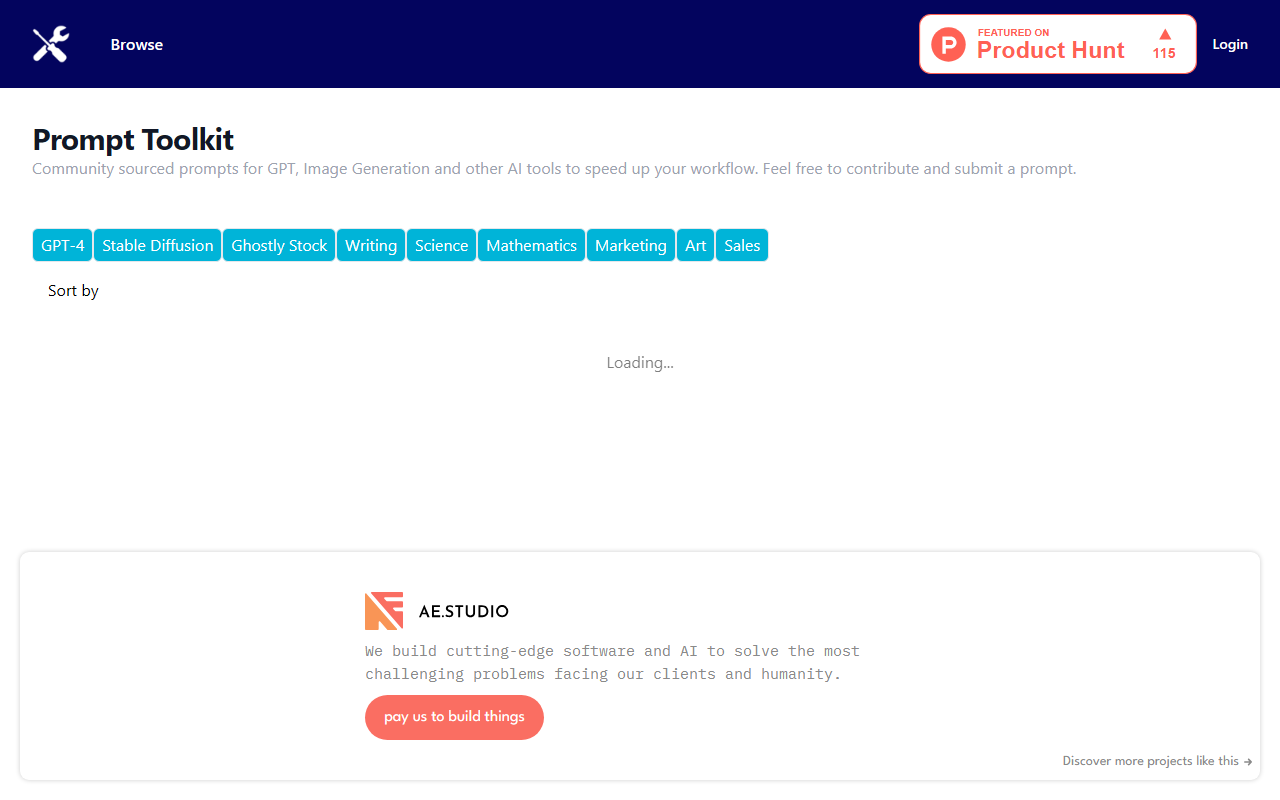
Upon visiting Prompt Toolkit, I was greeted by a clean, minimal dashboard that prominently displays a grid of prompt categories: GPT-4, Stable Diffusion, Ghostly Stock, Writing, Science, Mathematics, Marketing, Art, and Sales. The layout is straightforward — each category acts as a filter, and a "Sort by" dropdown hints at ordering options (likely popularity or date). However, the page shows a persistent "Loading..." message, which suggests that the prompt database is either still populating or relies on dynamic fetching. During my test, I clicked the "Writing" tag, and after a brief delay, a list of community-submitted prompts appeared, each with a title and a short description. The experience felt a bit sparse, but the core idea is clear: this is a crowdsourced prompt library, not a polished SaaS tool.
Features and Functionality
Prompt Toolkit essentially solves the problem of finding effective prompts for AI tools without having to start from scratch. Users can browse existing prompts or contribute their own — the site invites submission with a "Feel free to contribute" call-to-action. I tested a few prompts from the "GPT-4" category by copying them into ChatGPT; they performed reasonably well for general creative writing tasks, though they lacked the specificity of curated prompt marketplaces. The tool does not appear to offer any advanced features like prompt chaining, version history, or API integration. It is purely a repository. For image generation, the Stable Diffusion section includes prompts with style modifiers and negative prompts, which is useful for beginners. The lack of user accounts or ratings means you cannot see which prompts are most effective, making discovery a bit hit-or-miss.
Pricing and Market Position
Pricing is not publicly listed on the website. Based on the interface — no login gate, no subscription tiers — Prompt Toolkit appears to be completely free to access and submit prompts. This positions it as a community-driven alternative to paid prompt marketplaces like PromptBase (which charges per prompt) or the built-in prompt libraries within tools like Midjourney and DALL·E. Unlike PromptBase, which offers a curated and rated marketplace, Prompt Toolkit relies entirely on user contributions without moderation, which can lead to inconsistent quality. The tool is best suited for AI hobbyists and early-stage experimenters who want a quick, no-cost resource for inspiration. Power users who need reliable, vetted prompts or advanced features like API integration should look elsewhere.
Strengths, Limitations, and Final Verdict
Prompt Toolkit's greatest strength is its simplicity and open contribution model — anyone can share their favorite prompts, and the categories cover a broad range of use cases from marketing to mathematics. It is genuinely useful for quickly finding a starting point for a GPT or Stable Diffusion session. However, the major limitation is the lack of curation and the sparse content (many categories showed only a handful of prompts during my visit). The "Loading..." delay and absence of search functionality further hamper usability. Additionally, there is no way to upvote or comment, so users cannot trust the quality of a prompt at a glance. In conclusion, Prompt Toolkit is a decent free resource for casual prompt browsing, but it is not yet a mature product for professional workflows. I recommend it for curious users who want to discover community-created prompts without spending money. For serious prompt engineering, invest in a curated marketplace or build your own library.
Visit Prompt Toolkit at https://prompttoolkit.com/ to explore it yourself.













Comments