

First Look at Rayscape: Interface and Onboarding
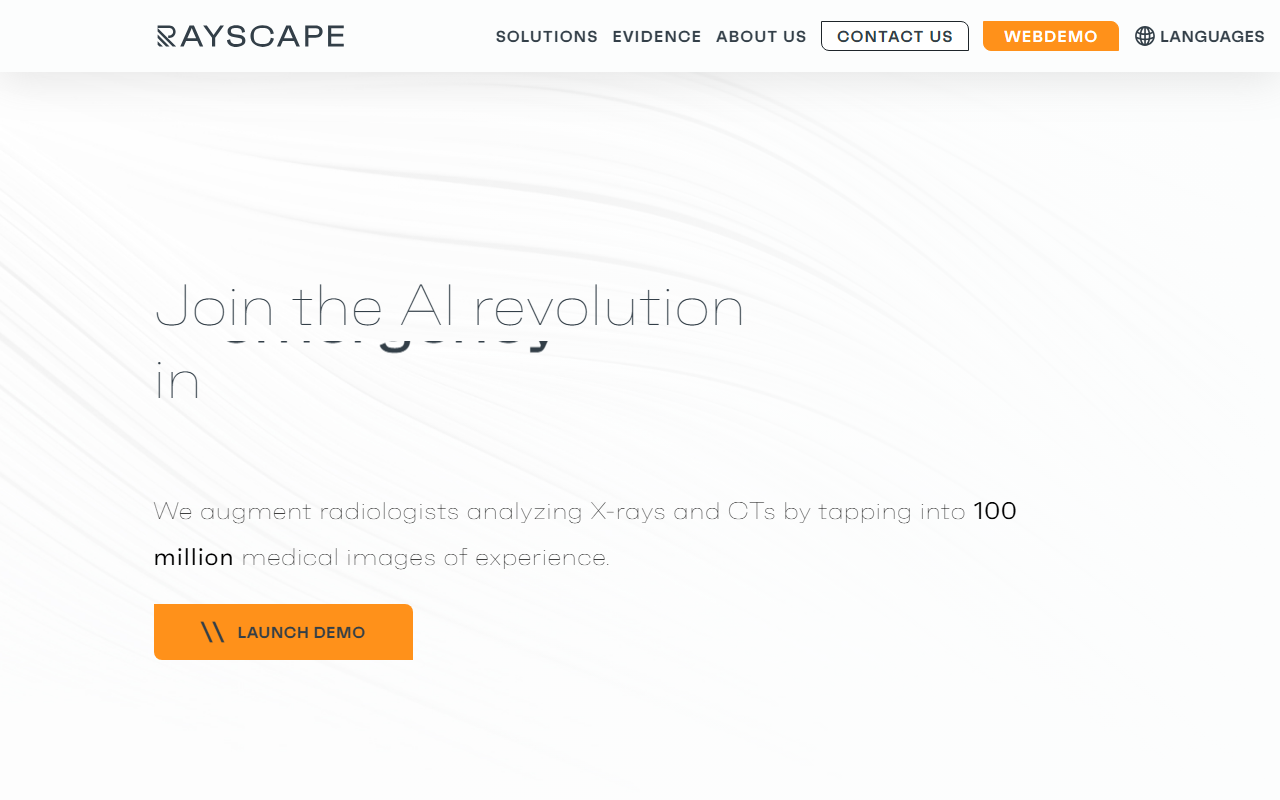
Upon visiting the Rayscape website at rayscape.ai, I found a polished landing page centered on a bold promise: “AI designed for everyday imaging.” The homepage uses clean visuals and short copy to introduce two core products: Rayscape CXR and Rayscape Lung CT. The navigation menu offers clear paths to solutions, evidence, and an about section. Notably, there is no self-service signup or free trial—access is gated behind a contact form labeled “WEB DEMO” and a separate “LAUNCH DEMO” button. To test the tool, you must submit a form with your name, email, job title, institution, and a brief description. This is standard for enterprise medical software, but it means the typical user cannot instantly explore features. The site metadata hints at multilingual support, offering English, Spanish, French, Polish, and German, which suggests a European or global target audience. From a reviewer’s standpoint, the lack of an immediate interactive demo is a limitation, but the website clearly outlines what the tool does and the clinical problems it solves.
Core Capabilities: CXR and Lung CT Analysis
Rayscape is positioned as a decision-support platform for radiologists and oncologists. The CXR module claims to detect over 140 findings from chest X-rays, producing structured outputs and visualizations. This covers abnormalities common in emergency, ICU, and tuberculosis screening settings. The Lung CT module focuses on nodule identification, measurement, and temporal tracking, which is critical for lung cancer screening and oncological follow-up. I was impressed by the specificity: the tool is not a general radiology AI but tightly focused on thoracic imaging. The company states its AI was trained on 104,067,063 images from around the globe—an enormous dataset that likely improves generalizability. The website mentions “predictive insights,” “automated analysis,” and “efficient workflow” as core value propositions, including automated prioritization of urgent cases and structured report generation. These are well-known needs in radiology. A notable feature is the integration story: the site includes a section titled “Discover how Rayscape works” with a demo request button, implying the tool can be integrated into hospital infrastructure. I did not find open API documentation, but given the enterprise nature, it is likely a deployment-ready solution.
Pricing, Market Context, and Competitors
Pricing is not publicly listed on the website. The only route to learning costs is through a contact form submission. This is common for medical AI vendors, as pricing often depends on volume, deployment type (cloud vs. on-premise), and institutional contracts. The website does list evidence and clinical resources under a dedicated “evidence” tab, including research, clinical evidence, and industry resources. This suggests the tool has been validated, though specific study results were not immediately visible on the landing page. From a market position standpoint, Rayscape competes with established players like Aidoc (which offers a broader multi-modality AI suite) and Zebra Medical Vision (now part of Nanox, providing a wide range of AI algorithms). Unlike Aidoc, which has a plug-and-play cloud platform, Rayscape appears more specialized in thoracic imaging and emphasizes both X-ray and CT. Another competitor is Qure.ai, which also targets chest X-ray AI. Rayscape’s claim of being “trusted by public and private clinics from 18+ countries” suggests early adoption, and testimonials from European radiologists (e.g., Prof. Dr. med. Alexander Huppertz, MD Moritz Halfmann from Universitätsmedizin Mainz) lend credibility. However, I cannot verify the exact user count or revenue. For pricing specifics, a demo inquiry is necessary.
Strengths, Limitations, and Verdict
The tool’s genuine strength lies in its focused specialization and the massive training dataset. Covering over 140 findings in CXR and providing nodule tracking in CT addresses two high-volume, high-impact areas in radiology. The structured output and workflow automation are real time-savers. However, there are limitations. First, the lack of a public demo or trial means that potential users cannot assess performance on their own data without a sales process. Second, the website provides limited transparency about the underlying AI model architecture or specific accuracy metrics (e.g., AUC, sensitivity, specificity) for the 140 findings. Independent validation benchmarks are not prominently displayed. Third, the tool appears to target only X-ray and CT—no MRI or ultrasound support—so it may not suit departments needing multi-modality AI. Rayscape is best suited for radiology departments and hospitals that process high volumes of chest X-rays and lung CT scans, especially those focusing on emergency care, tuberculosis screening, and lung cancer pathways. General practitioners or small clinics may find the enterprise deployment model too heavy. I recommend trying a demo if your institution meets these criteria. For a balanced perspective: the tool seems promising but requires hands-on evaluation to confirm its clinical utility. Visit rayscape.ai to explore it yourself.










Comments