

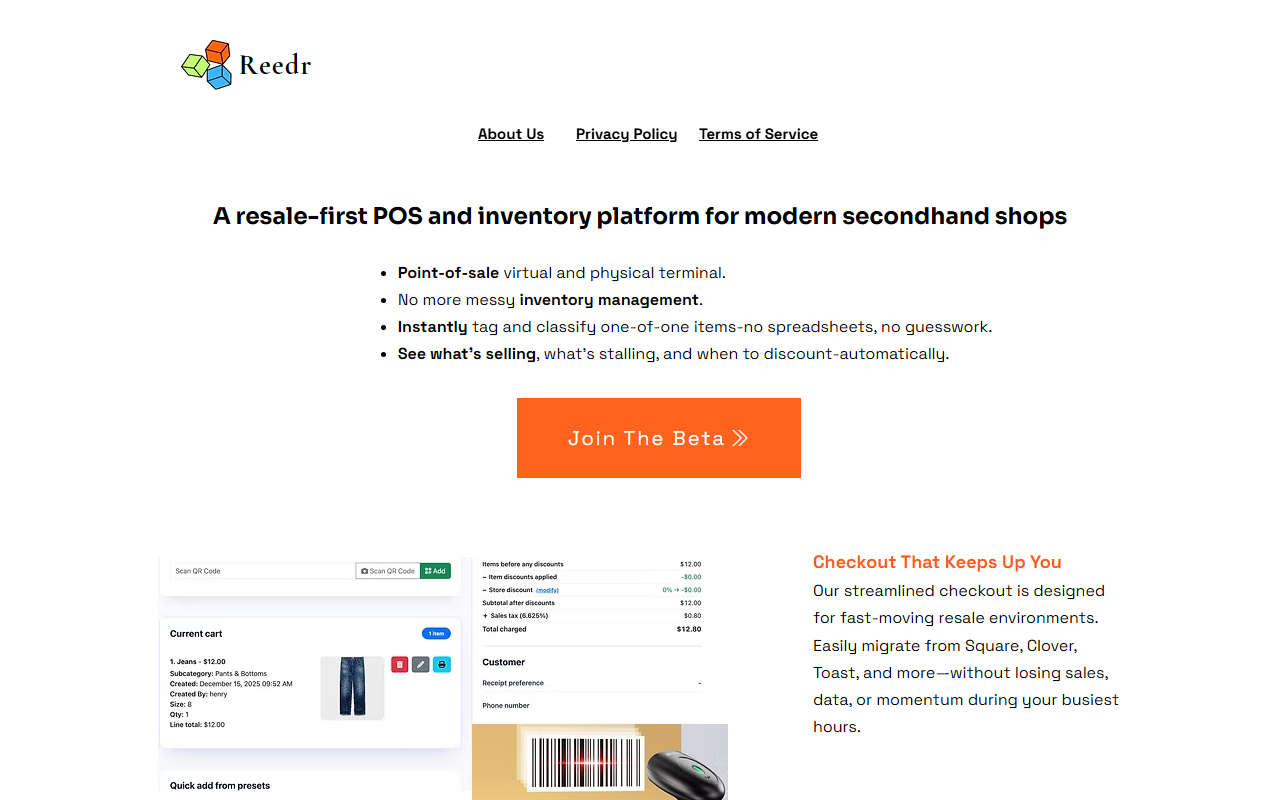
First Impressions and Core Functionality
Reedr positions itself as a purpose-built solution for secondhand and resale businesses, filling a gap left by generic POS systems. Upon visiting the site, the messaging is clear: it focuses on reducing manual inventory work and providing actionable analytics. The platform claims to handle the “tedious, resale-specific work behind the scenes” such as item classification, sales tracking, and automated discount timing. While the website is sparse on technical details—no pricing, no API documentation, and no model information—the description suggests a level of AI integration that sets it apart from traditional retail tools.
The dashboard is not accessible without joining a beta, so I could not test the interface directly. However, the feature list implies an intelligent backend that learns from your sales data. For example, the “automated discount timing” likely uses historical patterns to suggest markdowns, which would be a huge time-saver for shop owners who currently rely on gut feeling or manual spreadsheets.
AI Capabilities and Resale-Specific Features
Reedr’s core AI proposition revolves around classification and analytics. It promises to “instantly tag and classify one-of-one items” without spreadsheets or guesswork. In a resale context, where every item is unique (vintage clothing, secondhand electronics, etc.), manual tagging is notoriously slow. An AI that can recognize product categories, brands, or conditions could cut inventory processing time by 50% or more. The platform also offers “sales tracking and automated discount timing,” which implies a recommendation engine that adjusts prices based on sell-through rates and seasonality.
Another standout is the analytics dashboard, which provides real-time insights into what’s selling and what’s stalling. Users can receive reports via email, Google Sheets, or other integrations. This flexibility is smart—not every small shop owner wants to log into a proprietary tool daily. The mention of migration from Square, Clover, and Toast shows they’re aware of the incumbent competitors. However, the site offers no sample reports or demo, making it hard to verify the depth of the AI.
I noticed the absence of any discussion around the underlying technology (e.g., machine learning models, computer vision, or natural language processing). For a tool categorized under “AI Programming,” this omission is notable. It may rely on third-party APIs, but that remains speculation. If you’re a developer looking for an API-extensible AI tool, Reedr likely isn’t it—this is a closed SaaS platform for end-users.
Who Should Use Reedr and Competitor Context
Reedr is clearly built for owners and operators of secondhand stores, thrift shops, vintage boutiques, or any high-volume resale environment. If you currently use spreadsheets to track inventory or rely on a generic POS that doesn’t understand “one-of-one” items, Reedr could streamline your operations. It’s also ideal for those migrating from Square or Clover and wanting a more specialized solution.
Competitors include Loyverse (a free POS with inventory features) and Vend (now part of Lightspeed), but neither offers resale-specific AI. A more direct alternative is Rezolve, which provides AI-powered retail analytics, though it’s broader in scope. Reedr’s advantage is its laser focus on secondhand shops—its recommendation engine is likely trained on resale data, making it more relevant than general retail tools.
On the downside, the lack of transparent pricing is a red flag. Many small resellers operate on thin margins and need cost visibility. Additionally, the platform is still in beta, meaning features may change, and reliability is unproven. There is no mention of offline capabilities, which could be critical for stores with unreliable internet.
Strengths, Limitations, and Verdict
Reedr’s greatest strength is its specialized design. By tackling the unique pain points of secondhand retail—unique items, inconsistent pricing, and slow inventory management—it offers more than a generic POS. The AI classification and automated discounting could genuinely save hours per week. The ability to receive reports via Google Sheets is also practical for owners who want to keep using familiar tools.
However, the limitations are significant. Pricing is not publicly listed on the website, which immediately lowers trust. For a small business, unclear costs can be a dealbreaker. Additionally, the beta status means no guarantee of stability or support. The website lacks case studies, detailed feature breakdowns, or a knowledge base, making it hard to evaluate the product thoroughly. If you’re a developer looking for an “AI Programming” tool, this is not it—this is a business application, not a developer API.
In conclusion, Reedr shows promise for secondhand shop owners who are tired of manual inventory and want AI-driven insights. But proceed with caution: join the beta to get a free trial, but wait for public pricing and more user reviews before fully committing. It’s not for enterprises or developers. If you fit the target audience, it’s worth a look. Otherwise, stick with established POS systems or wait for a more mature product.
Visit reedr at https://reedr.io/ to explore it yourself.











Comments