

First Impressions and Onboarding
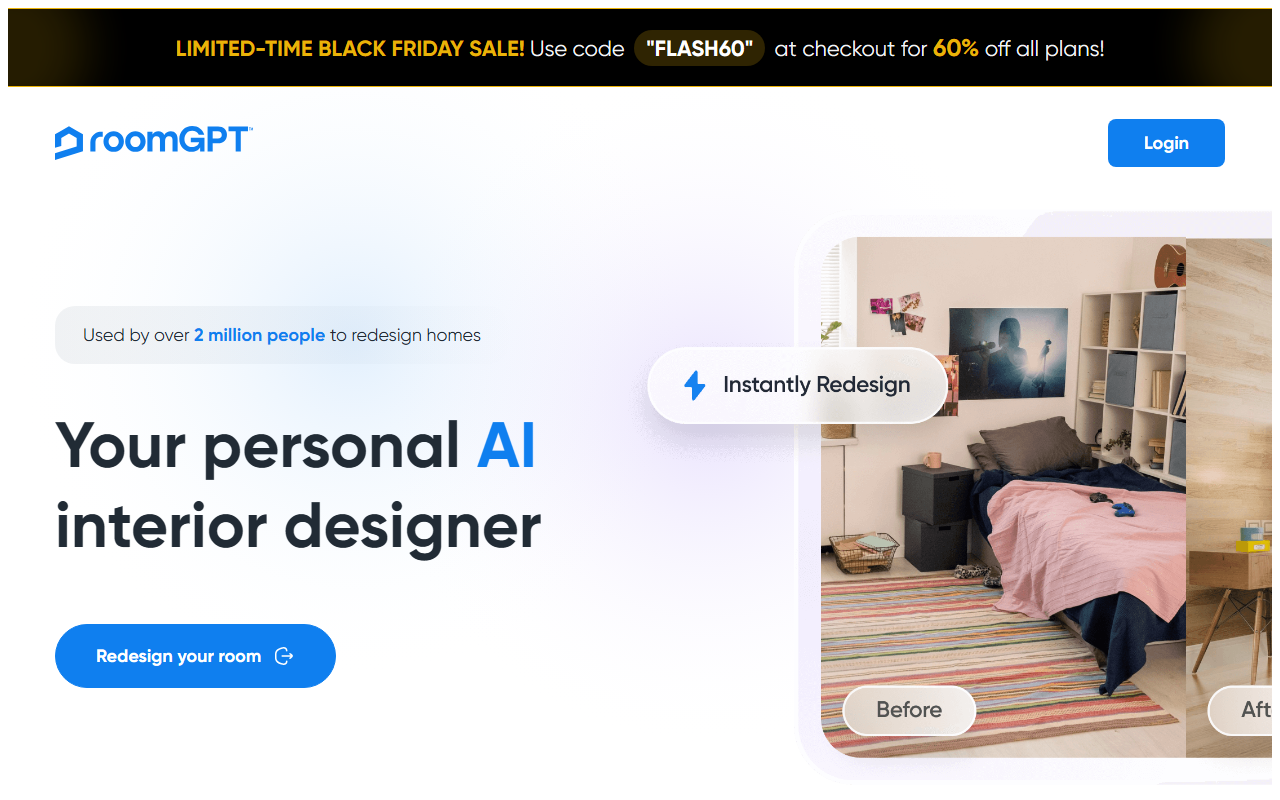
Upon visiting RoomGPT's website, the first thing I noticed is the minimalistic, almost single-page design. A hero image shows a room before and after transformation, and a bold headline declares the tool as your "personal AI interior designer." The site immediately encourages action with a call-to-action button labeled "Redesign your room." Scrolling down, I found a gallery of sample transformations and testimonials from happy users, including startup founders and engineers. The interface is clean, but there is no detailed explanation of how the AI works or what models it uses.
To test the free tier, I uploaded a photo of my living room. The process was straightforward: select a room type (e.g., living room, bedroom), upload an image, and choose from a list of design themes such as Modern, Minimalist, or Scandinavian. Within about 30 seconds, RoomGPT generated several redesigned versions of my room. The results were impressive in terms of style consistency, though some details like furniture placement felt slightly unnatural. Nonetheless, the speed and ease of use made a strong first impression.
How It Works and AI Technology
RoomGPT appears to use a generative adversarial network (GAN) or diffusion model specifically fine-tuned for interior design tasks. While the website does not specify the exact backend model, the output suggests a system trained on thousands of room images paired with style labels. When I selected the "Modern" theme, the AI replaced my old sofa with a sleek, low-profile couch and added abstract wall art. The lighting and shadows were adjusted to match the new layout, indicating sophisticated scene understanding.
The workflow is entirely browser-based; no app download is required. After uploading, the AI processes the image on the server and returns up to four variations per theme. A notable strength is the ability to keep the room's structural elements (windows, doors, floor layout) intact while only modifying furniture, decor, and wall colors. This makes the tool feel like a realistic preview rather than a generic art generator. However, I noticed that the AI sometimes struggles with complex geometry, such as non-rectangular rooms or rooms with multiple focal points. The tool does not offer manual adjustments or fine-tuning beyond theme selection, which limits creative control for power users.
Pricing and Value
RoomGPT offers paid plans, but the specific tier prices are not publicly listed on the website. Instead, the site prominently displays a limited-time sale: use code "FLASH60" at checkout for 60% off all plans. This suggests there are multiple plans, likely based on the number of renders or access to premium themes. Without transparent pricing, potential users may hesitate, though the sale period indicates a lower barrier to entry. The free tier allows for a limited number of redesigns, which was enough for me to evaluate the quality. For occasional home decor inspiration, the free version suffices; for frequent use, a paid plan would be necessary. Compared to competitors like Interior AI or DecorAI, RoomGPT focuses more on simplicity and speed, but lacks the advanced customization options of those tools.
Given the lack of disclosed pricing, I advise users to check the most current rates on the site or contact support. The 60% discount makes the tool more accessible, but I cannot state exact dollar amounts without official data.
Who Should Use RoomGPT
RoomGPT is best suited for homeowners, renters, or anyone looking to quickly visualize different interior styles without hiring a professional designer. Its straightforward interface and fast results make it ideal for inspiration and decision-making. The tool's strength lies in its simplicity—upload a photo, choose a theme, and get instant redesigns. However, professionals seeking granular control over every element (like texture mapping or furniture catalogs) will find it limiting. There is no API available for developers, and the tool does not integrate with design software like SketchUp or Revit.
One notable limitation is the lack of support for uploading multiple room photos for a cohesive home redesign. Each room is handled individually, so you cannot maintain a consistent aesthetic across your entire house in one session. Additionally, the AI occasionally produces artifacts (e.g., floating objects or distorted shapes) that require regeneration. Despite these drawbacks, RoomGPT delivers on its core promise: making interior design accessible to everyone. If you're indecisive about decor themes or want to experiment with styles before buying furniture, this tool is worth trying. Visit RoomGPT at https://roomgpt.io/ to explore it yourself.













Comments