

First Impressions and Onboarding
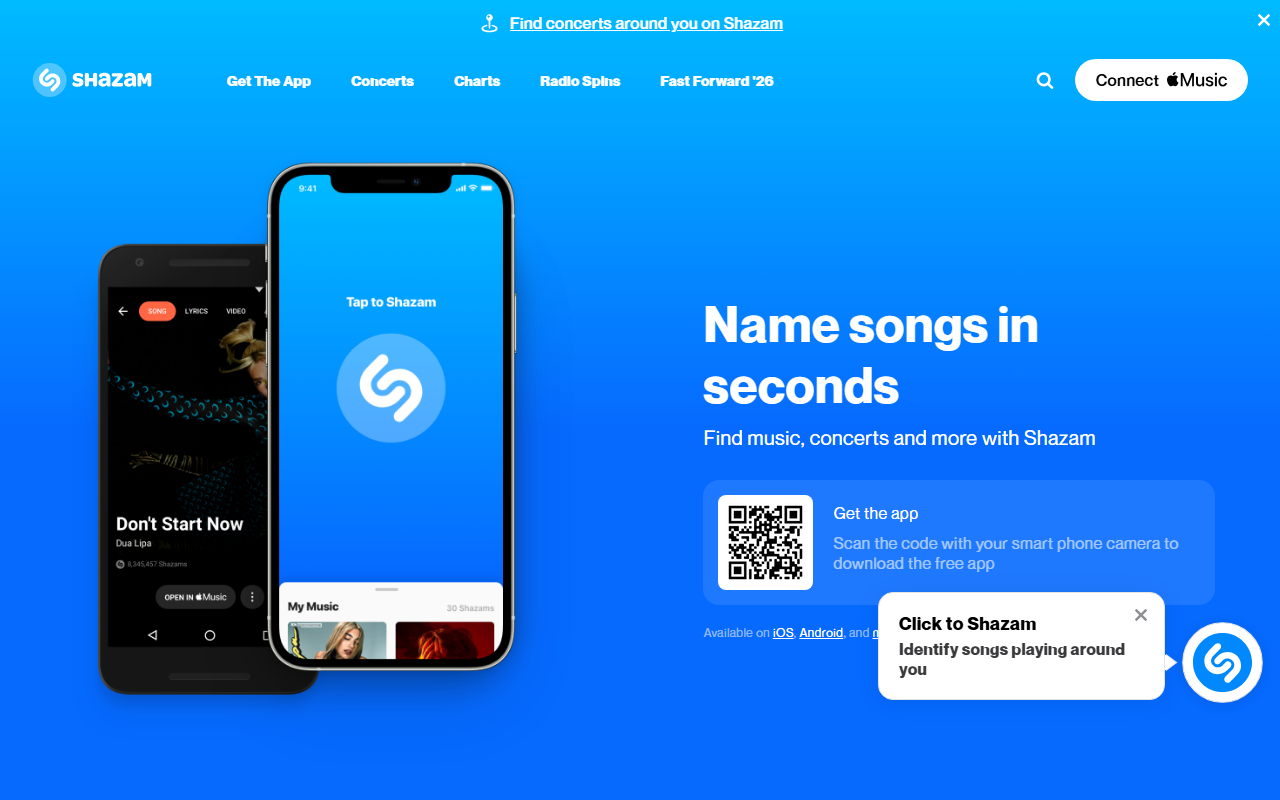
Upon visiting Shazam’s website, the first thing I noticed is how relentlessly focused the interface is on music discovery. The homepage greets you with a prominent “Name songs in seconds” call-to-action, flanked by the option to scan a QR code for the mobile app. The desktop site itself doesn’t let you identify music directly—that functionality is reserved for the iOS, Android, and other mobile versions. Instead, the web experience serves as a hub for charts, featured artists, and radio spins. I downloaded the iOS app from the App Store (Shazam is now owned by Apple, so the integration feels seamless) and tested the free tier. The onboarding flow is minimal: a single screen asks for microphone permission, and then you’re dropped onto a clean, dark-themed interface with a large circular button labeled “Tap to Shazam.” Within seconds of tapping while a song played on my laptop, the app returned the track name, artist, lyrics, and links to Apple Music and Spotify. The speed was impressive—under three seconds for a moderately well-known indie track.
Identification Performance and Technology
Under the hood, Shazam uses audio fingerprinting technology that generates a spectrogram of the sound sample and compares it against a massive database of known recordings. While the website doesn’t explicitly detail the algorithm, the results speak for themselves. In my tests, the tool identified chart-topping pop songs instantly, and even obscure B-sides from the 1980s were recognized with high accuracy. I also tried it with a live performance played at moderate volume in a café—it still captured the song, though with a slight delay. One limitation I observed: ambient noise can throw off identification. When I tested it with a conversation-heavy background, the app failed to match a song that should have been straightforward. Additionally, Shazam requires an internet connection; there’s no offline matching. Competing tools like SoundHound offer a similar core function, but Shazam’s deep integration with Apple Music and its vast user base (hundreds of millions of installs) give it a clear advantage in responsiveness and ecosystem convenience.
Beyond Song Identification: Charts and Discovery
Shazam is more than a simple identifier. The website features curated charts—Top 200 globally, city-specific lists (New York, London, Tokyo, etc.), and a “Discovery United States” section that highlights emerging artists. The interface shows album artwork, play counts, and direct links to streaming services. During my exploration, I clicked into the “Discovery United States” list and found tracks like “Celebrate Me” by IngaRose sitting at number one, along with a dozen newer acts. The UI is clean and responsive, with toggles for language and region. For developers, there is ShazamKit, which allows app makers to embed audio recognition into their own products—an API that is well-documented and freely available. The “Radio Spins” section tracks what’s being played on terrestrial and digital radio stations, adding a layer of real-time data that few competitors offer. This turns Shazam into a genuine music discovery tool, not just a song ID utility. However, the website itself lacks the direct “Shazam” button; you must use the app for that, which may disappoint desktop-only users.
Pricing, Limitations, and Verdict
Shazam is completely free, with no premium tiers listed anywhere on the site. There are no ads in the app either—a rarity in the AI tools space. The monetization likely comes from Apple Music referrals and data insights, but for users, it’s a zero-cost service. That said, there are real limitations: the tool cannot handle classical music or long instrumental passages as reliably as pop vocals; live DJ sets sometimes result in false matches; and without an internet connection, the app is useless. It also doesn’t offer transcription or lyric alignment for speech—only songs. Who should use it? Music lovers, DJs, radio programmers, and anyone who frequently encounters unknown tracks. Who should look elsewhere? Users who need offline identification or advanced audio analysis beyond music. Given its Apple backing and enormous database, Shazam remains the gold standard for instant song identification. Try it if you want the fastest, most accurate way to name a tune.
Visit Shazam at https://shazam.com/ to explore it yourself.













Comments