

First Impressions: A Mental Health Platform, Not a Writing Tool
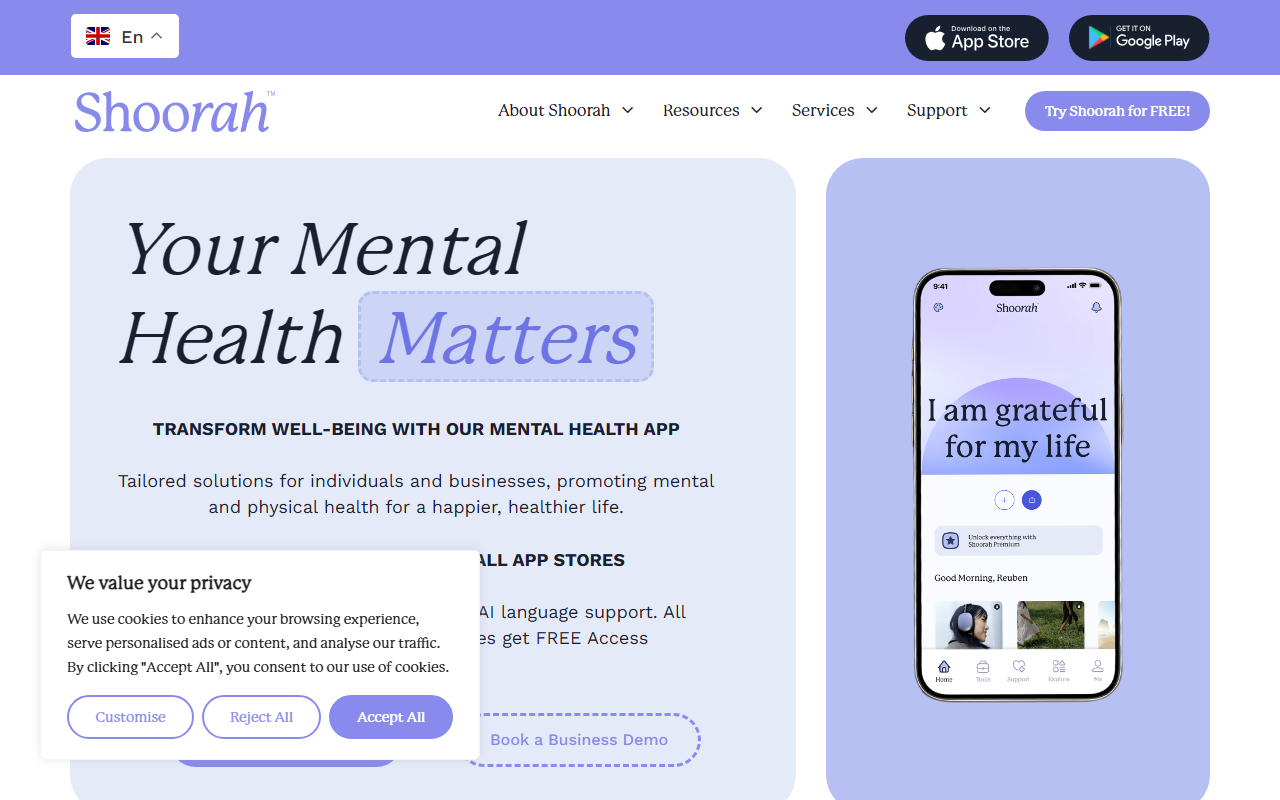
Upon visiting Shoorah’s website, I was immediately struck by the discrepancy between the tool’s listed category — Text AI > AI Writing — and its actual offering. This is not a writing assistant. Shoorah is a comprehensive mental health and well-being platform that includes an AI-powered therapy companion called “Shuru.” The landing page presents a clean, modern interface with sections for individuals, businesses, and even a “Shoorah Kids” service. The main call-to-action invites users to “Try Shoorah for FREE,” and navigation highlights features like home testing kits, a marketplace, and a well-being toolkit. The platform is accessible via iOS and Android apps, and the website supports multilingual content with “Fluent AI language support.” If you came here expecting an AI writing tool, you will be disappointed — but if you’re seeking a holistic approach to mental health, keep reading.
What Shoorah Does: Shuru AI and the 360° Well-being Ecosystem
Shoorah combines AI-based therapy, digital bio-marking tests, guided wellness tools, and human expert support under one umbrella. The core AI feature is “Shuru,” described as a “trusted guru” that provides confidential, personalised mental health assistance 24/7. Shuru supports chat and voice sessions, and the website highlights “multilingual voice chat” and “AI-driven” workouts and recipes. The platform also offers what it calls “Digital-Bio Health Assessment Tests” — over 160 screening tools covering areas like cancer pre-screening, neurodivergence, hormone levels, and gut health. For deeper intervention, there is a premium assistance programme (PEAP) granting access to human specialists, and a marketplace where users can spend “well points” earned through app engagement. In addition, Shoorah provides pulse surveys, a well-being score, and white-label API leasing for businesses.
From a technical perspective, the AI model behind Shuru is not publicly specified, but the emphasis on “AI-driven” and “multilingual” suggests a sophisticated natural language processing engine. The platform appears to be cloud-based, with mobile apps and a web presence. Integration options for businesses include API leasing, employee benefit programmes, and an EAP (Employee Assistance Program) with instant support. This places Shoorah in a competitive landscape similar to tools like Woebot or BetterHelp’s AI components, but with a notably broader scope that includes physical health tests and a rewards ecosystem.
Strengths, Limitations, and Honest Assessment
Strengths: Shoorah’s most compelling advantage is its all-in-one approach. Rather than addressing only mental health through chat, it bundles at-home diagnostic kits, mood tracking, meditation, sleep sounds, and even a children’s version — all under one subscription. The AI companion Shuru promises 24/7 availability, which is a genuine benefit for users who need immediate, stigma-free support. The multilingual support is another strong point for global accessibility. For businesses, the white-label and API leasing options offer customisation that many corporate well-being programmes lack.
Limitations: Despite the impressive feature list, Shoorah suffers from a serious identity problem for anyone looking for an AI writing tool. Beyond that, the website does not disclose pricing publicly — a transparency issue. The “Individuals Plans” and “Business Plans” pages require sign-up or a demo booking, which adds friction. The platform’s reliance on self-reporting for bio-marking tests also raises questions about clinical accuracy and data privacy. Moreover, while Shuru is positioned as an “AI-powered therapy tool,” it is unclear whether it meets regulatory health standards (e.g., HIPAA, GDPR) or is merely a conversational companion. The market is crowded with similar mental health apps, and Shoorah’s breadth may come at the cost of depth in any single area.
Who Should Use Shoorah — And Who Should Look Elsewhere
Shoorah is best suited for individuals or organisations wanting a single platform that covers both mental and physical well-being. Employees, health-conscious users, and parents looking for a family-oriented solution may find value, especially with the Shuru AI for daily check-ins and the home test kits for proactive health monitoring. Business clients seeking white-label mental health solutions with employee pulse surveys will appreciate the customisable enterprise plan.
However, if your primary need is an AI writing tool — for content creation, copywriting, or editing — this is not the right choice. Also, users who want clinically validated therapy rather than a digital companion should look at dedicated therapy platforms like BetterHelp or Talkspace. For those willing to explore a broad, AI-driven well-being ecosystem, Shoorah is worth a free trial, but proceed with caution regarding pricing and data policies.
Visit Shoorah at https://shoorah.io/ to explore it yourself.













Comments