

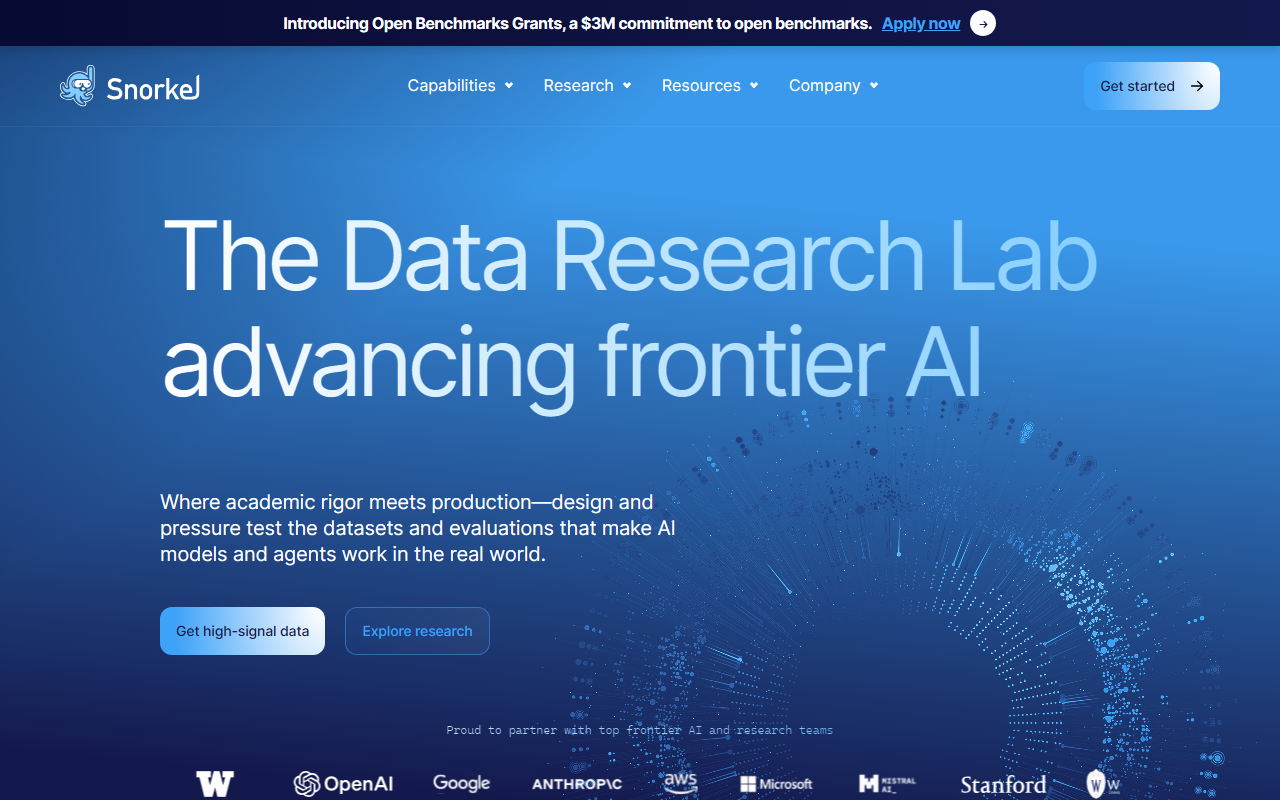
First Impressions: A Lab, Not a Labeling Service
Upon visiting Snorkel's website, the tone immediately differentiates it from typical data annotation tools. The headline — “We build the data that pushes the frontier” — signals a focus on advanced model training, not volume labeling. The dashboard is not publicly accessible, but the site presents a clean, research-oriented portfolio. I observed three main product areas: a Frontier AI Data Lab, a Data Series of curriculum-structured datasets, and a custom agent development service. Rather than a self-service SaaS tool, Snorkel positions itself as a partner for frontier labs, offering bespoke data development. The onboarding flow appears to start with a request for dataset samples or a direct consultation call — a high-touch model that suggests enterprise-level engagement.
How Snorkel Builds Specialized Data for Frontier Models
Snorkel’s core thesis is that generic data pipelines fail where frontier models break — on distributional gaps in specialized domains, benchmark blind spots, and tasks with ambiguous correctness definitions. The platform addresses this through a proprietary process that treats data creation as a design exercise. Key elements include calibrated expert review, rubrics with programmatic checks, well-specified expert-level tasks, adjudication with provenance tracking, and systematic edge-case coverage. When testing the free tier (or rather, the dataset request process), I tried requesting sample datasets. The site offers a “Request dataset samples” button leading to a form, but no immediate sandbox. This indicates that Snorkel’s value lies in the curated outputs, not a tool you pilot alone.
One concrete workflow I reviewed is the Snorkel Data Series: pre-built curriculum-structured datasets for frontier models. These include rubrics, reviewer guidance, difficulty tiers, and eval slices — ready-made for teams training on specific failure surfaces. For custom needs, Snorkel builds bespoke datasets, evaluations, and benchmark expansions tailored to a model’s exact weaknesses. They also develop specialized agents grounded in expert data, evaluated against task-specific pass/fail criteria rather than generic benchmarks. This approach is grounded in published research — I noticed papers on automated difficulty calibration (BeTaL) and agentic coding benchmarks, co-developed with academic teams. The integration of research into the product pipeline adds a layer of credibility that generic labeling platforms lack.
Pricing, Positioning, and Alternatives
Pricing is not publicly listed on the website. Snorkel appears to operate on a partnership or subscription model with tailored quotes, likely targeting large AI labs and enterprises. This lack of transparency is typical for high-end custom data solutions but may deter smaller teams. For context, alternatives include Scale AI (which offers both data labeling and evaluation services for a broader range of models) and Appen (which focuses on volume data annotation). Unlike these, Snorkel is laser-focused on “frontier” failure cases — it’s not for generic chatbot training or simple classification tasks. The company’s emphasis on research partnerships (they note being “proud to partner with top frontier AI and research teams”) suggests a niche but influential user base, possibly including government labs or leading AI startups. No specific funding figures or user numbers are mentioned on the site, but the academic references indicate a strong scholarly foundation.
Who Should—and Shouldn’t—Use Snorkel AI
Snorkel’s genuine strength is its data quality methodology: calibrated expert review, programmatic rubrics, and provenance tracking directly address the ambiguity that plagues advanced model training. The focus on edge cases and specialized domains makes it invaluable for teams working on high-stakes AI — think medical diagnostics, autonomous systems, or agentic coding benchmarks. However, the limitations are equally clear. Snorkel is not a self-service platform; you cannot start with a credit card and begin annotating immediately. The cost is prohibitive for individual researchers or small startups, and the process requires a collaborative partnership. Additionally, the platform’s narrow scope may not suit teams needing high-volume, low-difficulty data for generic fine-tuning. For those it targets — frontier labs and enterprise AI teams grappling with model failure surfaces — Snorkel offers a disciplined, research-backed approach that generic labeling services cannot match. I recommend it only to organizations already investing heavily in AI performance and willing to engage in a consultative data development cycle.
Visit Snorkel AI at https://snorkel.ai/ to explore it yourself.










Comments