

First Impressions and the Onboarding Experience
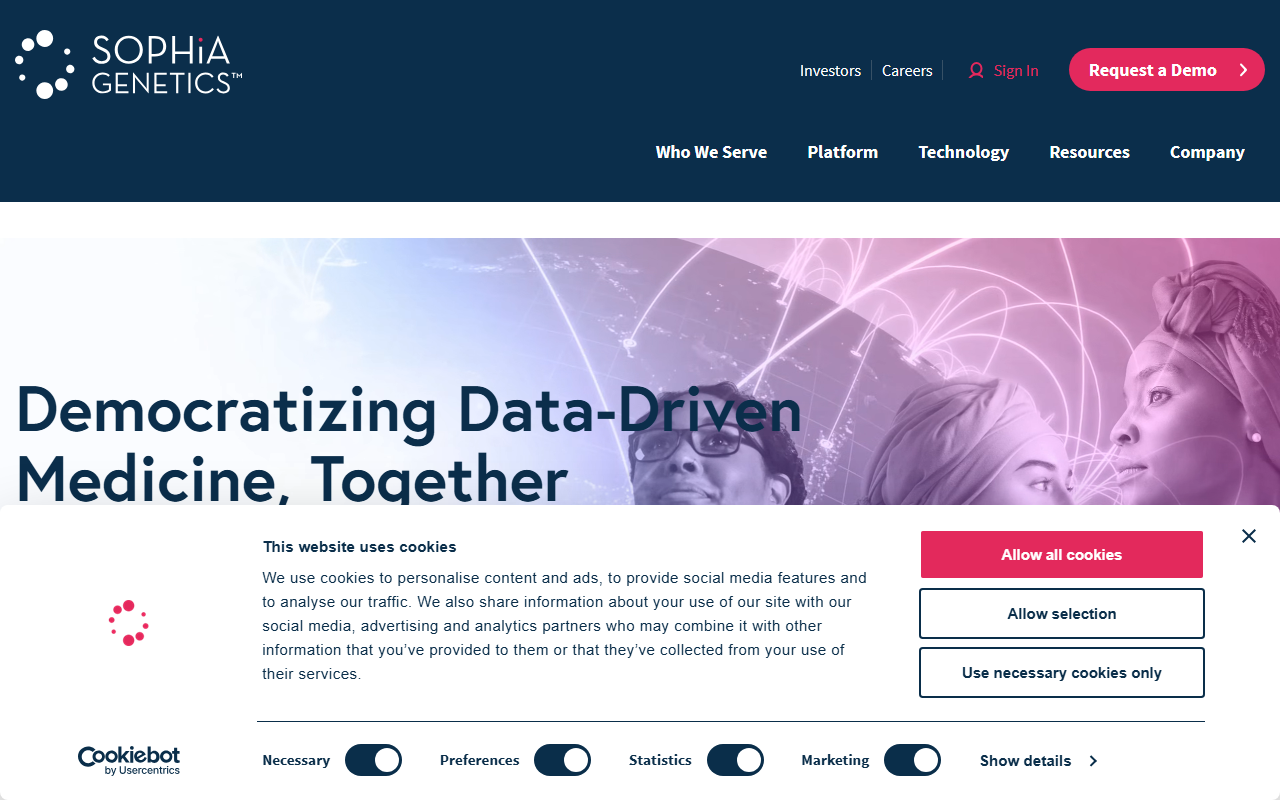
Upon visiting SOPHiA GENETICS at sophia.ai, the homepage immediately signals that this is not a generic AI reading tool. The site greets you with the tagline "Democratizing Data-Driven Medicine, Together" and an interface heavily focused on healthcare professionals. The main menu is dense with options for providers, BioPharma, patients, and detailed platform sections like SOPHiA DDM for Genomics and Radiomics. I clicked through the "Request a Demo" flow to see how onboarding works for a potential user. The form is standard but clearly targets institutions—it asks for organization type, role, and specific interests. This is not a tool you sign up for individually; it’s an enterprise clinical platform. The resource section provides whitepapers, webinars, and documentation, but no free trial or sandbox environment for casual testing. For a journalist trying to gauge usability, the lack of immediate hands-on access is a limitation, but understandable given the sensitive nature of medical data.
Core Technology and the SOPHiA DDM Platform
SOPHiA GENETICS is built around its proprietary AI engine, SOPHiA DDM (Data-Driven Medicine). The platform analyzes multimodal health data—primarily genomic and radiomic—to generate actionable insights for oncology and rare inherited disorders. The website claims 98-99% accuracy in AI algorithms, with weekly processing of thousands of patient profiles. Notably, the system learns from the collective data computed and user inputs, creating a feedback loop that improves over time. The technology is grounded in three principles: accurate (high standards of care), rapid (short turnaround times with end-to-end workflows), and scalable (supports local data generation while ensuring full data control). Compliance with HIPAA, GDPR, and other local regulations is emphasized. The platform has already analyzed over 2.3 million genomic profiles across 990+ healthcare institutions in 75+ countries. This is not a text-based reading AI like a chatbot or document summarizer; it reads and interprets complex biological signals—think of it as an AI reading the language of DNA and medical images to assist clinicians in precision medicine decisions.
Target Audience and Use Cases
This tool is strictly for specialized medical professionals and organizations. The "Who We Serve" section lists oncologists, radiologists, pathologists, geneticists, lab technicians, and bioinformaticians in clinical settings. BioPharma companies are another key audience, using the platform for drug development, clinical trial optimization, and market access. Patients are also listed as a category, but the value is indirect—their healthcare team uses SOPHiA GENETICS to derive insights from global data. Unlike general-purpose AI reading tools (e.g., ChatGPT for summarizing research papers), SOPHiA GENETICS is purpose-built for a very specific, high-stakes diagnostic workflow. For example, a pathologist might upload a tumor sample’s genomic sequence and receive a report on actionable mutations, homologous recombination deficiency status, or treatment recommendations. The platform includes add-on modules like Alamut Visual Plus for variant interpretation and OncoPortal Plus for cancer genomics. For radiomics, modules like Deep Lung IV and UroCCR focus on imaging data. This is a deep vertical solution, not a horizontal text AI.
Pricing, Strengths, and Limitations
Pricing is not publicly listed on the website. The only call-to-action is "Request a Demo," which indicates a subscription-based enterprise model with custom quotes based on institution size and modules used. This is a significant limitation for anyone seeking transparent costs. Strengths are clear: high accuracy claims (98-99%), a massive global network with over 2 million profiles analyzed, strong compliance with medical data regulations, and a dedicated focus on both oncology and rare disorders. The team’s deep biology expertise—30% of staff hold PhDs—lends credibility. However, the limitations are equally important. First, the tool is expensive and inaccessible outside large healthcare systems or research institutions. Second, its narrow focus means it cannot help with general text reading tasks like summarizing news articles or answering everyday questions. Third, the platform’s effectiveness relies on institutional buy-in and data sharing; smaller clinics may struggle to integrate it. For who should use it: this is ideal for hospital networks, cancer centers, and BioPharma companies committed to precision medicine. For individual researchers or general tech enthusiasts, look elsewhere—consider alternatives like Tempus or Foundation Medicine for similar genomics analysis. Visit SOPHiA GENETICS at https://sophia.ai/ to explore it yourself.













Comments