

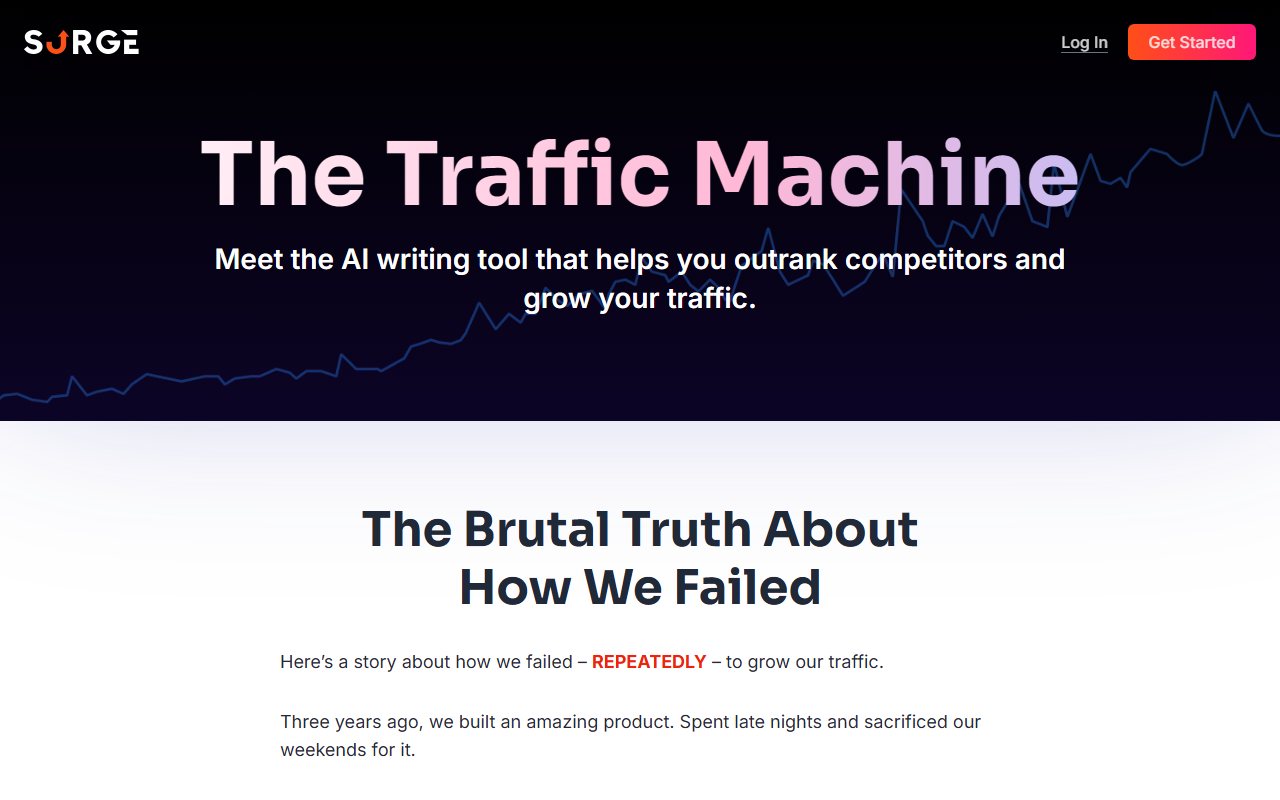
First impressions: a dashboard built for the AI-era agency
Upon visiting the SurgeGraph website, I was immediately struck by the clarity of its value proposition: this is not another AI writing tool. It is an AI Visibility and AEO (Answer Engine Optimization) platform designed specifically for agencies. The landing page is heavy with data—80% of searches end without a click, 700M users on ChatGPT, a 527% jump in AI-driven traffic—and it stings because I have lived through those stats. The dashboard, which I previewed via the waitlist sign-up flow, promises a single pane of glass to track citations across six major AI answer engines: ChatGPT, Perplexity, Gemini, Google AI Mode, and Google AI Overview. There is no public demo yet, but the mockups show a clean, metric-heavy interface with client names, citation counts, and a score for each platform. The focus is clearly on helping agencies answer the one question clients are asking: “Why does our competitor show up in ChatGPT and we don’t?”
How SurgeGraph works and what it tracks
The tool’s core functionality is monitoring AI mentions. You plug in your client’s brand or keywords, and SurgeGraph scans the outputs of leading AI search engines to see when and how often those terms are cited. The system then scores that visibility and offers “one-click AEO fixes”—presumably suggestions to tweak content, schema, or entity signals to increase the chance of being cited. From the website copy, it’s clear that citations rotate frequently: 40–60% of AI citations change monthly. The platform also generates white-label reports, so agencies can deliver branded analytics to clients without stitching together four different tools. Notably, the tool does not create content; it tracks and optimizes for visibility in AI-generated responses. This is a pure analytics and recommendations layer, sitting on top of your existing SEO workflow. Integrations are not listed yet, but given the target audience, I would expect API access and export options in the final product.
Pricing and market positioning
Pricing is not publicly listed on the website. SurgeGraph is currently in a pre-launch phase with a waitlist. The copy mentions a “flexible credit model that scales as you grow,” suggesting a usage-based pricing scheme rather than a flat seat license. This aligns with the agency focus: you can allocate credits across clients. Competitors in this nascent space include tools like Brand24 for social listening, and more specific AEO dashboards like those from SE Ranking’s AI Overview tracking (if added). But SurgeGraph is unique in bundling detection across five distinct AI answer engines and offering explicit AEO fixes rather than just monitoring. The company has not disclosed funding or user numbers, but the 4.9/5.0 and 5.0/5.0 ratings on the site (likely from beta testers) suggest early traction among a small group. For now, the biggest limitation is availability: you cannot test the core functionality until the platform launches.
Who should use SurgeGraph and final verdict
SurgeGraph is built for agencies that manage brand reputation and search visibility for multiple clients. If you’re an in-house marketer for a single brand, the tool may feel overkill, and you might be better served by monitoring ChatGPT manually or using a simpler tracker like ChatGPT Status. But for agencies fielding the questions listed on the site—“Where did our traffic actually go?” and “Are other brands getting cited instead of us?”—SurgeGraph promises a dedicated answer. The strength is its singular focus on the gap between traditional SEO and AI visibility. The real limitation is that it is not yet launched. You cannot evaluate response quality, dashboard performance, or the accuracy of citation tracking until the waitlist opens. Also, the tool does not cover Bing Chat or other smaller AI platforms, which may be a gap depending on your client base. My recommendation: if you are an agency losing sleep over AI citation drops, get on the waitlist. This could become an essential part of your reporting stack. For everyone else, wait for the launch and independent reviews.
Visit SurgeGraph at https://surgegraph.io/ to explore it yourself.










Comments