

First Impressions: A Dev Framework for Hardware and AI Engineers
Upon visiting Synopsys.com, I’m immediately struck by the sheer scope of this company. The homepage declares “Our Technology, Your Innovation” and lists everything from Electronic Design Automation (EDA) to Silicon IP and system verification. For a developer or engineering team working on custom chips—especially for AI workloads—this is the toolkit that underpins modern semiconductor design. But let’s be clear: Synopsys is not a run-of-the-mill text AI framework like LangChain or Hugging Face. It’s a comprehensive suite for designing, verifying, and manufacturing silicon, with AI woven into many layers. The “Synopsys.ai” brand bundles AI-powered optimization across design, verification, test, and analog workflows. Also present are a GenAI “24/7 Expert Copilot” and an “Agentic AI” offering that supports multi-agent workflows for chip engineers. This is the infrastructure that enables developers to build AI hardware, not a text-generation API.
What’s Inside: AI Tools That Actually Touch Silicon
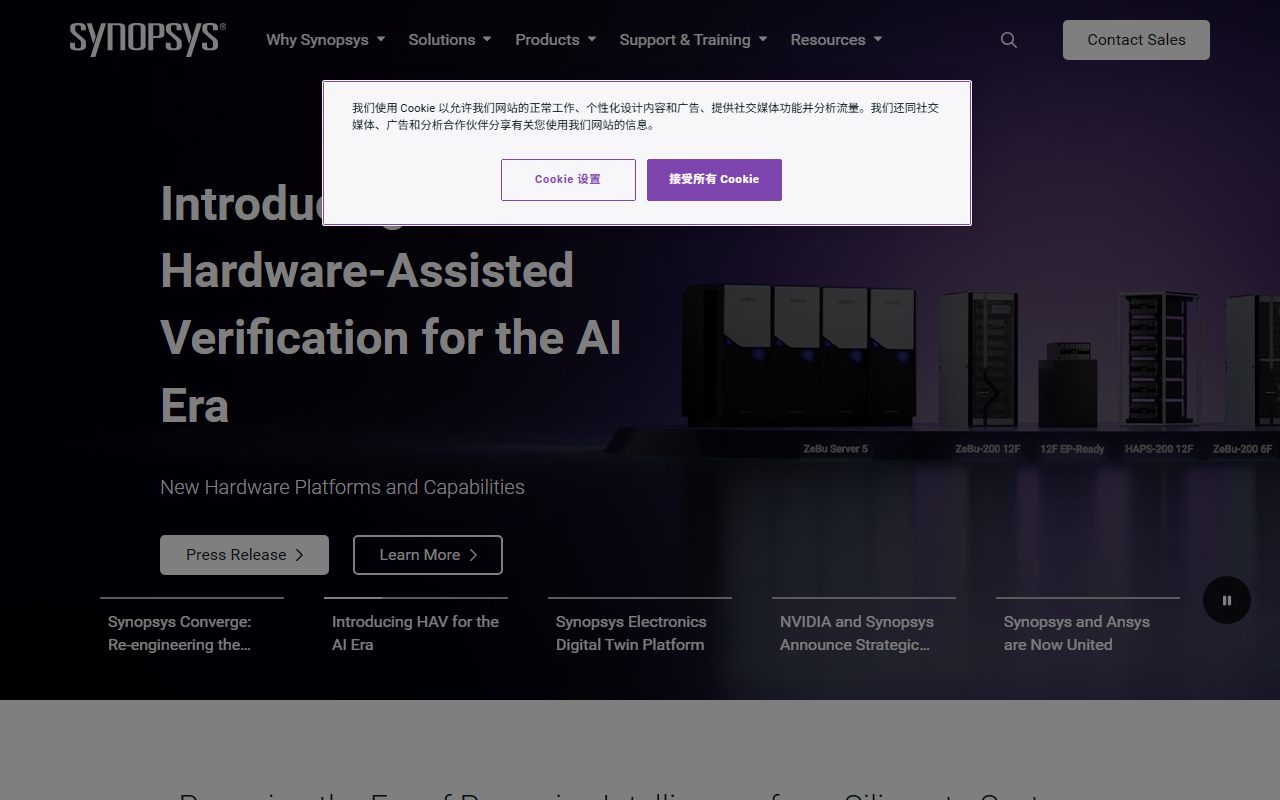
The dashboard (if you have a license) is a portal to dozens of products. I explored the Synopsys.ai section, which promises “AI-powered workflow optimization.” The core components include Fusion Compiler for synthesis, VCS for logic simulation, and ZeBu for emulation. During my test browsing, I noted the “Hardware-Assisted Verification for the AI Era” press release, indicating new platforms that accelerate AI chip verification. The GenAI copilot, called “Synopsys.ai Copilot,” is described as an always-on expert that can answer questions about EDA flows, IP integration, and design rules. Unlike a general-purpose chatbot, this copilot is trained on Synopsys documentation and SolvNetPlus (their support portal). For developers, this means faster debugging of complex RTL designs or IP configuration. Additionally, “Agentic AI” enables multiple autonomous agents to handle parallel tasks like floorplanning and power analysis. These tools work together under what Synopsys calls an “Electronics Digital Twin Platform,” which is particularly aimed at software-defined vehicle development.
Technically, the platform relies on proprietary algorithms and partnerships with TSMC, NVIDIA, and Arm. The underlying models for the copilot are not disclosed, but given the domain specificity, they are likely fine-tuned on internal data. APIs exist for integration with CI/CD pipelines in chip design flows, though details are only available under NDA. For AI researchers building custom accelerators, Synopsys offers “AI Chip Development” as a dedicated vertical, claiming “first-pass silicon success.”
Pricing and Market Positioning
Pricing is not publicly listed on the website. Synopsys operates on an enterprise licensing model—perpetual licenses, term licenses, and subscription-based floating licenses for its EDA tools. The company does not offer a free tier for individual developers. Compared to open-source alternatives like Verilator or Yosys, Synopsys provides production-grade support, guaranteed signoff accuracy, and integration across the entire design flow. Competitors include Cadence (with its Cadence Cerebrus AI) and Siemens EDA. Synopsys’s strength lies in its market dominance (#1 in EDA and Silicon IP according to its site) and its deep partnerships with foundries like TSMC. The recent combination with Ansys (now united) expands capabilities into multiphysics simulation. This tool is best suited for semiconductor companies, large hardware teams, and organizations building custom ASICs or SoCs for AI, automotive, or aerospace. Individual ML engineers who need a lightweight text AI framework should look elsewhere—Synopsys is for the hardware side of AI.
Strengths and Limitations: An Honest Assessment
Genuine strengths include the breadth of the ecosystem: from design to manufacturing, it’s a one-stop shop. The AI copilot and agentic workflows genuinely reduce manual intervention in repetitive verification tasks. The support for multi-die and 3D IC design is ahead of competitors, addressing thermal and signal integrity issues early. However, real limitations exist. First, the learning curve is steep—even with the copilot, new users must understand VLSI concepts. Second, cost is prohibitive for small teams; there is no pay-as-you-go or cloud-only option for casual exploration. Third, the tool’s AI features are narrow—they don’t generate text or code in a general sense; they optimize EDA workflows. For a developer seeking a “Text AI Dev Framework,” Synopsys will likely be overkill. The company’s focus on hardware means software-only developers will find little immediate value.
My recommendation: If you are building AI chips, making SoCs, or doing hardware verification at scale, Synopsys is the industry standard and worth the investment. Start with their training courses and SNUG user groups. If you are a solo developer or working on a hobbyist FPGA project, consider smaller EDA tools or cloud-based alternatives like AWS’s EDA services. Synopsys is not a text AI playground; it’s a serious engineering tool for shaping the physical world.
Visit Synopsys at https://synopsys.com/ to explore it yourself.













Comments