

First Impressions and Onboarding
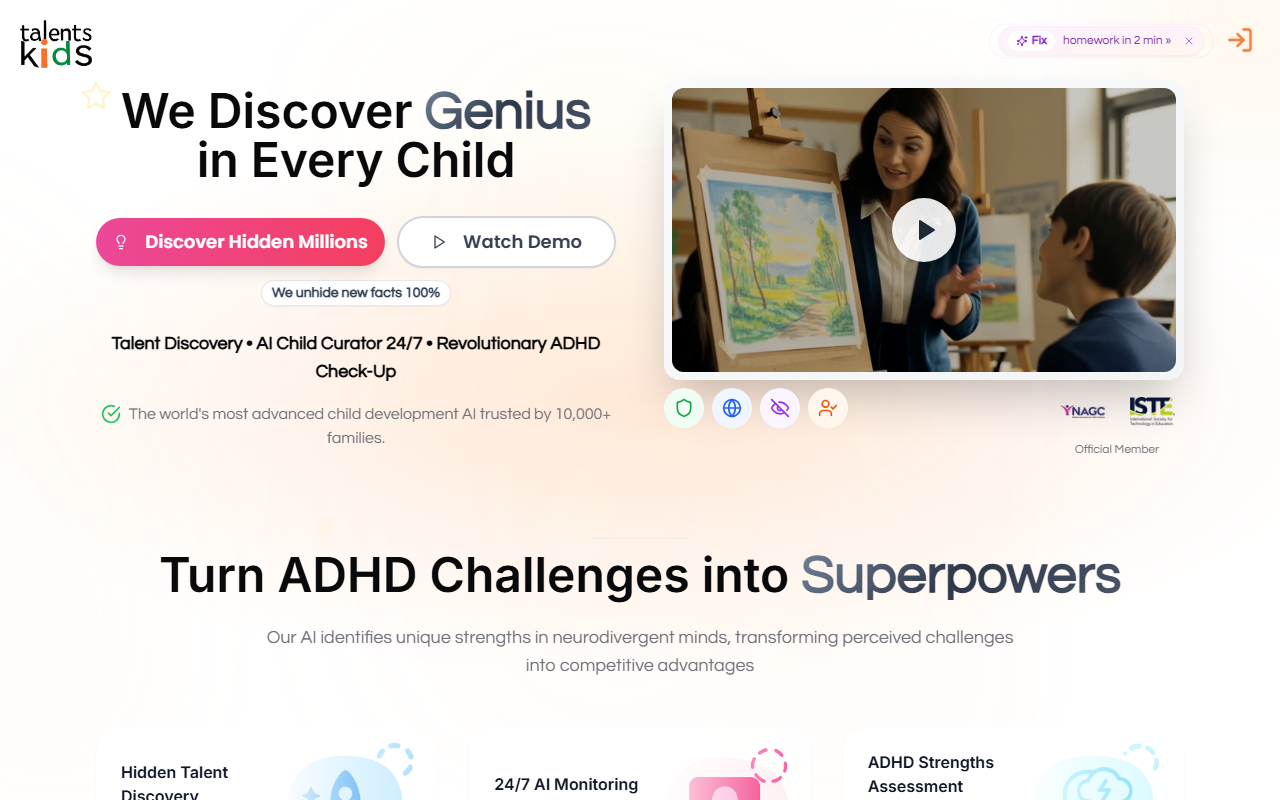
Upon visiting Talents.Kids, I was greeted by a clean, modern landing page that immediately puts its institutional backing front and center. The site prominently displays its affiliation with the National Association for Gifted Children (NAGC) and the International Society for Technology in Education (ISTE), two heavyweights in gifted education and edtech standards. The navigation is minimal: a brief description of the platform, a call-to-action to start an assessment, and a footer with trust logos. The loading state I observed showed a simple spinner—nothing flashy, but functional. I clicked through to begin the free trial (which does not require payment upfront). The onboarding asks for basic child information: age, grade, and a few parent observations about attention, learning preferences, and social behaviors. This took about five minutes. The interface is intuitive, with clear progress indicators and accessible language—no jargon heavy enough to intimidate non-expert parents.
The AI Assessment Experience
Talents.Kids claims to use over 50 AI agents working in concert to analyze a child’s talents and learning profile, with a specialized focus on ADHD assessment and neurodiversity talent discovery. During my test drive, I filled out a detailed questionnaire that covered executive function skills—things like task initiation, working memory, and emotional regulation. After submission, the platform processes responses through its AI engine (no specific model names are disclosed, but the interface suggests a combination of rules-based logic and machine learning). The report generated within minutes included a strengths map, suggested enrichment activities, and a “neurodiversity profile” that highlighted areas like hyperfocus, creative problem-solving, and divergent thinking. Notably, the tool does not attempt to provide a clinical diagnosis; its output is framed as “indicators” and “talent strengths” to avoid overreach. The dashboard then offers follow-up resources, including curated articles and activities aligned with the child’s profile.
Market Context and Credentials
Talents.Kids differentiates itself from generic learning assessments (like Renzulli Learning or the Davidson Institute’s screening tools) by explicitly targeting neurodiverse learners and leveraging AI to identify hidden strengths. The backing from NAGC and ISTE is a significant trust signal—these organizations rarely endorse commercial platforms, and their involvement suggests a commitment to research-based practices. However, I found no publicly listed pricing on the website; the site mentions a free trial but does not disclose what happens after that period. This lack of transparent pricing is a limitation for potential users who want to evaluate cost upfront. Additionally, while the AI agents are impressive in breadth, the platform does not provide details on the data privacy measures or the models themselves, which may concern tech-savvy parents. Compared to clinical ADHD assessments (which require licensed psychologists), Talents.Kids is best viewed as a preliminary screening and strengths discovery tool, not a replacement for professional evaluation.
Who Should Use Talents.Kids?
This platform is ideally suited for parents and educators who suspect a child may have neurodivergent traits and want a structured, AI-driven way to identify strengths rather than deficits. It is also useful for schools seeking to differentiate instruction for gifted and twice-exceptional students. However, families already working with a specialist or those seeking a clinical diagnosis should look elsewhere. The tool’s strengths lie in its positive framing of neurodiversity and its holistic assessment of executive function skills. A real limitation is the lack of concrete pricing information and the absence of third-party validation studies (aside from the institutional endorsements). If Talents.Kids can publish pricing and open up about its AI methodology, it could become a valuable resource in the gifted education and ADHD communities. For now, it offers a promising, research-aligned starting point for talent discovery.
Visit Talents.Kids at https://talents.kids/ to explore it yourself.










Comments