

First Impressions: A Developer-First AI Agent
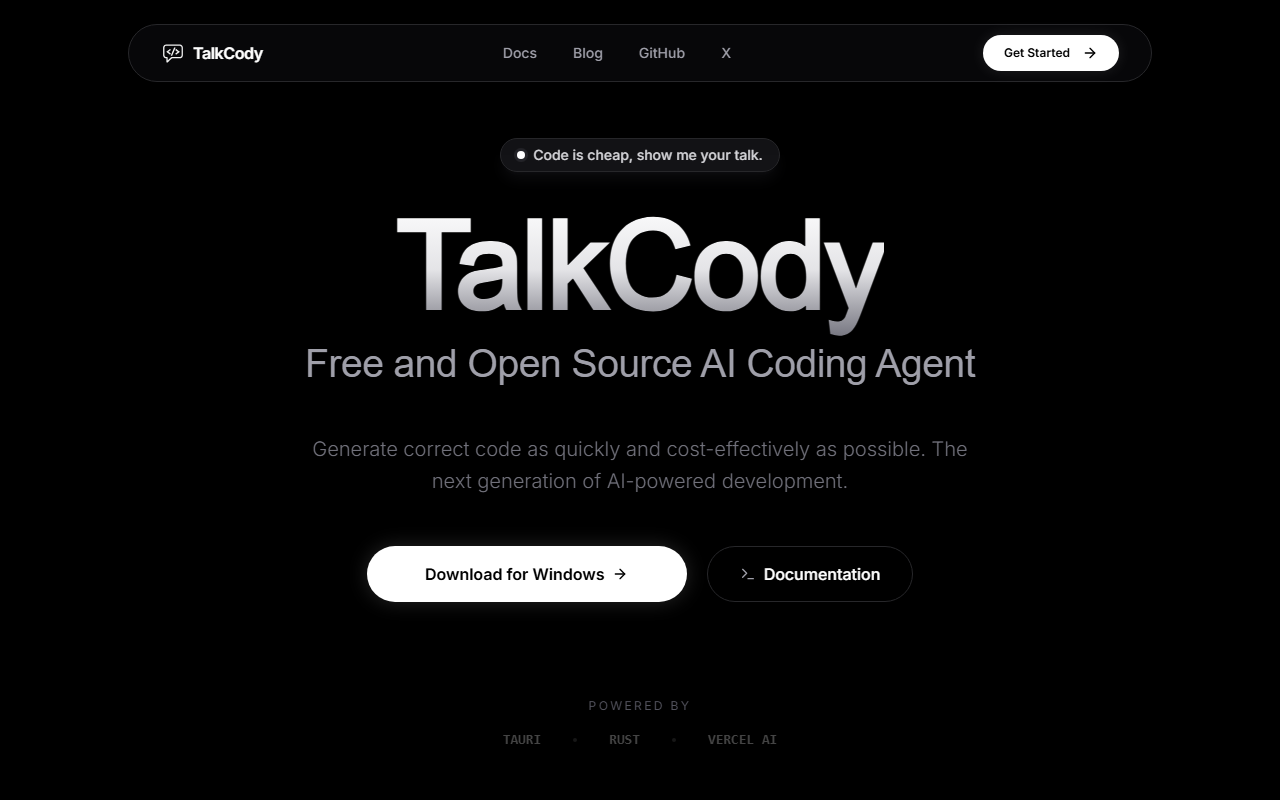
Upon visiting talkcody.com, I immediately noticed the clean, no-nonsense design that speaks directly to developers. The hero section proudly declares 'Code is cheap, show me your talk' and introduces TalkCody as a free and open-source AI coding agent. The site is uncluttered, with clear calls to action: 'Get Started', 'Download', and a link to documentation. The landing page lists core benefits—blazing fast development, maximum flexibility, professional-grade features, and privacy you can trust—all backed by specific technical claims like Four-Level Parallelism and MCP Server support. As someone who has reviewed dozens of AI coding tools, this level of transparency is refreshing. The tool is built with Rust and Tauri for native performance, and it's available on GitHub under an open-source license.
Features and Technical Underpinnings
TalkCody positions itself as a next-generation AI coding agent that runs entirely on the developer's machine. Four-Level Parallelism means it can execute tasks at the project, agent, and tool levels simultaneously, which should drastically reduce wait times for large codebases. The agent supports any AI model from any provider—OpenAI, Anthropic, Google, or local models via Ollama or LM Studio. This eliminates vendor lock-in and lets users leverage existing subscriptions like ChatGPT Plus or GitHub Copilot. The page lists model names such as 'GPT-5.2', 'DeepSeek', 'Gemini 3', and 'Kimi K2'—some of which appear speculative, suggesting future roadmap rather than current support. Multimodal input (text, voice, images) is included, along with MCP Server support for extended tool connectivity. There's also an Agents & Skills Marketplace where the community can share workflows. All data is stored 100% locally, and the tool works completely offline when using local models. Pricing is not explicitly listed on the site, but the agent is free and open source; you only pay for API calls if you use cloud models.
Strengths and Honest Limitations
The biggest strength of TalkCody is its commitment to privacy and cost control. Unlike many competitors that require cloud subscriptions or upload your code, TalkCody runs everything locally by default. This is ideal for teams working with proprietary code or in air-gapped environments. The flexibility to use any model—and switch instantly—is a genuine differentiator. Additionally, the Rust/Tauri foundation promises excellent performance and low resource usage. However, there are real limitations. TalkCody is still relatively early-stage. The website lists model names that may not yet be available (e.g., 'GPT-5.2'), which could cause confusion. The documentation link was not deeply explored, but a quick check reveals it's mostly a README, lacking detailed tutorials. There is no web version or cloud sync—this is strictly a desktop application (Windows, macOS, Linux). For developers who prefer a lightweight browser extension or mobile coding, this won't fit. Also, while the agent marketplace sounds promising, it relies on community contributions, which may be sparse at launch.
Positioning and Final Verdict
In the crowded AI coding assistant market, TalkCody stands out by targeting developers who value openness, privacy, and control. Alternatives like Cursor and GitHub Copilot offer polished, cloud-first experiences but often come with monthly fees and data storage concerns. TalkCody is better suited for technical teams that can handle occasional setup complexity and want to avoid vendor lock-in. It is less ideal for beginners who prefer a 'just works' experience or require mobile/cloud access. After spending time with the site and reading through the GitHub repository, I believe TalkCody has genuine potential—especially for open-source enthusiasts and privacy-conscious professionals. The combination of parallelism, multi-model support, and local execution is compelling. I recommend giving it a try if you are a developer who values speed and autonomy over a hand-holding UI. Visit TalkCody at https://talkcody.com/ to explore it yourself.













Comments