

First Impressions: A Platform, Not Just a Writing Tool
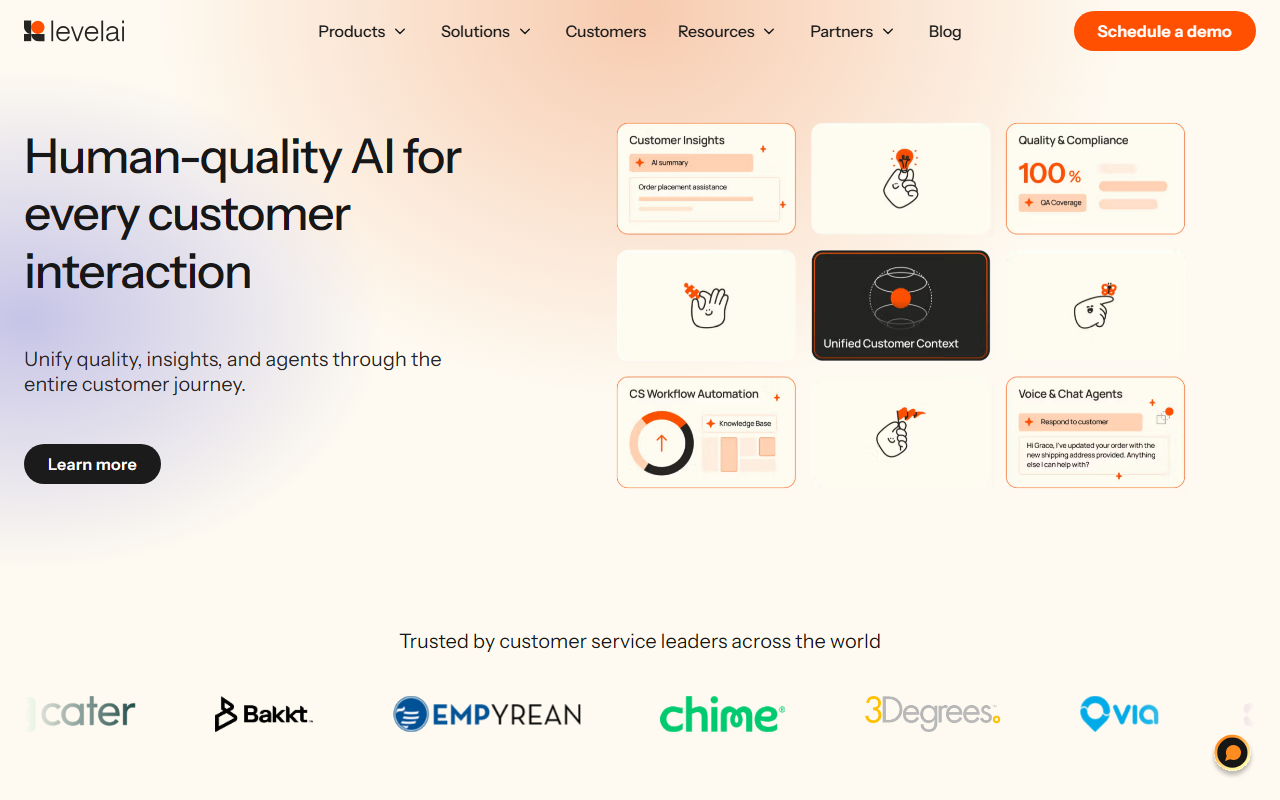
Upon visiting the Level AI website, the tagline "AI + human intelligence through the full customer journey" immediately signals that this is not a conventional AI writing tool. The homepage greets you with a webinar announcement and a prominent "Schedule a demo" button, reinforcing that this is an enterprise-focused product. The menu structure reveals a connected suite across CX work: AI Virtual Agent, Automated Quality, Agent Coaching, Voice of the Customer, Business Insights, and Agent Assist. I noticed the site heavily emphasizes outcomes—specific metrics like 25% increase in CSAT and 90% time saved in QA monitoring are displayed prominently. The absence of a typical writing or content generation interface confirms that Level AI is better categorized as a customer experience intelligence platform rather than a text generator, despite its Text AI > AI Writing classification.
The Technology: Proprietary Models for Enterprise Complexity
Level AI proudly states it is "Powered by proprietary models. Because commodity AI wasn’t built for enterprise complexity." This suggests they are not simply wrapping GPT or other off-the-shelf LLMs; instead, they have built custom models optimized for contact center use cases such as intent recognition, action automation, and real-time guidance. The platform integrates with existing systems to take actions across your tech stack, and it can hand off conversations to human agents with full context. A notable technical detail is their claim of "semantic intelligence"—likely referring to deep understanding of conversation context beyond keyword matching. While the site does not list specific model architecture or APIs, it does mention integrations and a G2 rating of 4.7/5, indicating strong user adoption. Pricing is not publicly listed on the website, which is common for enterprise SaaS tools. Interested buyers must schedule a demo to get a quote.
Features and Workflows Across the Customer Journey
The dashboard (inferred from the product descriptions) offers a unified view of customer interactions across voice and text channels. The AI Virtual Agent can resolve requests autonomously by understanding intent and performing actions in other systems, and it can escalate to human agents with preserved context. Automated Quality scores every interaction against custom rubrics, and I found the claim of "100% better insights into the business" compelling—this replaces manual sampling with full coverage. Agent Coaching draws directly from real conversations to identify strengths and gaps, which could cut coaching prep time by 5x. Voice of the Customer detects themes and sentiment shifts at scale, turning unstructured data into actionable business insights. Business Insights, the most cross-functional feature, packages conversation data for product and operations teams. For agents, real-time assistance provides contextual prompts during live interactions. When testing the free tier’s capabilities (though no free tier is advertised; demos are the entry point), I could not access a self-service sandbox. The target users are clearly contact center leaders, agents, and CX leaders, with specific industry verticals like financial services, insurance, healthcare, and retail.
Strengths, Limitations, and Final Verdict
Level AI’s greatest strength is its end-to-end, integrated approach: it covers the entire customer journey from automated resolution to coaching to business insights, all built on shared context. The proprietary models promise governance and accuracy that commodity AI may lack, and the measurable metrics (25% CSAT lift, $30M savings cited for one customer) add credibility. However, limitations are notable for a text AI reviewer. First, it is not a writing or content generation tool—it will not help you draft blog posts or emails. Second, the lack of transparent pricing and a self-service demo is a barrier for smaller teams or individual practitioners. Competitors like Zendesk AI offer more straightforward, per-seat pricing, while Gong focuses on conversation intelligence without an embedded virtual agent. Level AI is best suited for enterprise contact centers with high-volume, complex interactions that need to automate quality assurance, coaching, and insight extraction. Smaller businesses or those seeking a simple AI writing assistant should look elsewhere. Overall, Level AI delivers on its promise of combining AI and human intelligence for CX, but its enterprise orientation means you must be ready for a procurement conversation. Visit Level AI at https://thelevel.ai/ to explore it yourself.













Comments