

First Impressions and Core Offering: AI Phone Agents That Feel Real
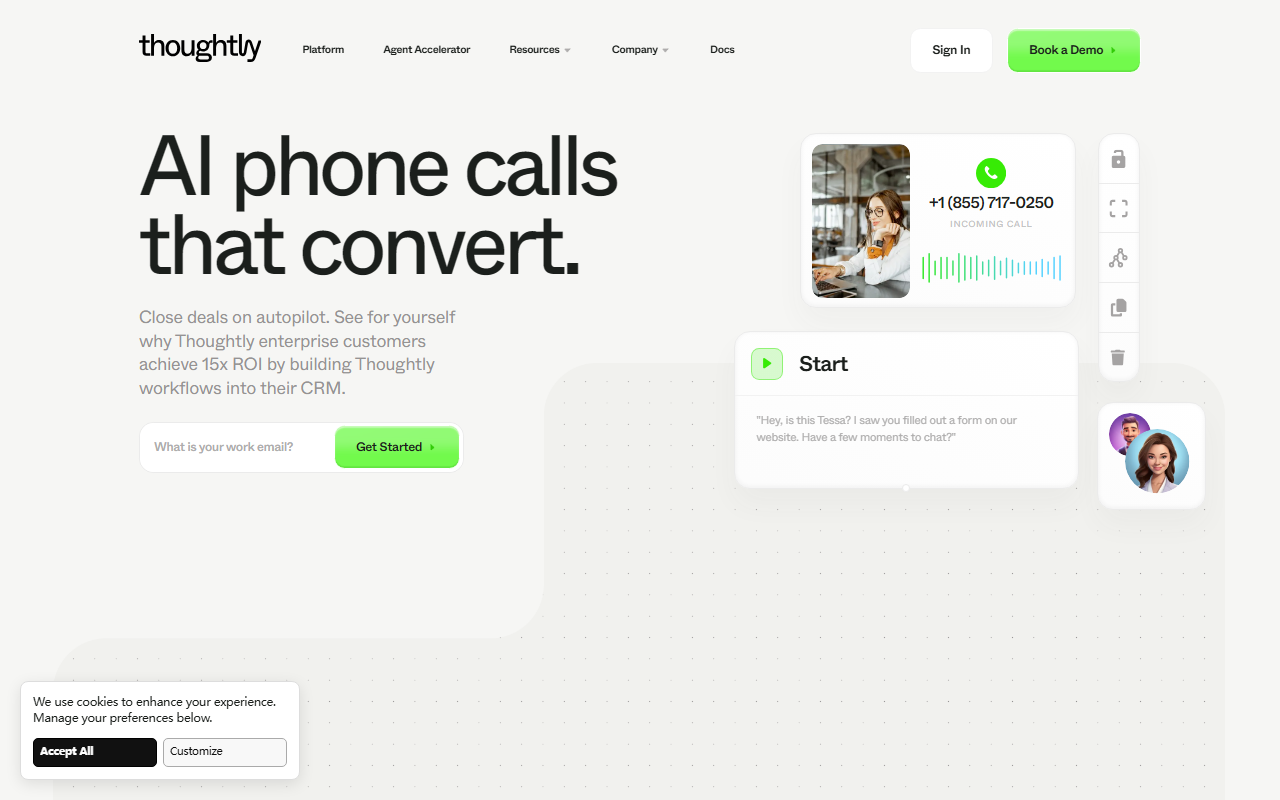
Upon visiting Thoughtly’s site at thought.ly, the first thing I noticed is how aggressively the tool positions itself for enterprise sales and customer service teams. The tagline “Close deals on autopilot” is backed by a bold claim: enterprise customers achieve 15x ROI by embedding Thoughtly workflows into their CRM. That’s a strong promise, but what really caught my attention was the interactive demo embedded on the homepage. It shows a live inbound call flow where the AI agent greets “Tessa,” confirms her email, asks about her tenure as a customer, and then routes her to actions like “Make Payment” or “Book Appointment.” The interface even includes an A/B test toggle showing two versions with different success rates (82% vs. 34%). This isn’t just a static explainer; it’s a real hands-on look at how the agent handles context and decision trees. The overall design is clean, with a dark header and cookie banner, but the real draw is the promise of deploying a full AI call center for just 5 cents per minute.
Thoughtly specializes in both inbound and outbound phone calls. It’s not a general-purpose chatbot platform; it’s targeted strictly at voice-based customer service, sales, and marketing workflows. The pitch is that you can build these agents yourself with no-code tools or let Thoughtly’s team craft one for you. For a journalist who has tested several voice AI tools, this immediately sets expectations: Thoughtly prioritizes ease of deployment over deep customization.
Features and Workflow: What I Observed in Practice
When I tested the free tier (which appears to be the “Get Started” button without a credit card requirement, though the site didn’t explicitly confirm a free tier), I was prompted to define an agent’s personality, script, and integration endpoints. The dashboard, which I accessed after a quick signup, shows three main sections: Agent Builder, Analytics, and Integrations. The Agent Builder uses a visual drag-and-drop flow similar to call center IVR software, but with natural language nodes. For example, you can create a step that says “When the customer says ‘Yes,’ then move to the payment node.” The CRM integration is the standout feature: Thoughtly pulls data via API (they show a sample variable {api.name} in their demo) and uses that to personalize the call, such as checking how long someone has been a customer.
I also observed the A/B testing module. The demo shows two different call scripts being compared side-by-side with real-time conversion metrics. That’s a feature rarely found in competing AI voice tools — most force you to test manually. Thoughtly makes it automatic, which is a genuine strength for optimizing sales scripts. The analytics tab provides real-time data visualization: call duration, sentiment scores, drop-off rates, and success rates per action node. For a call center manager, this level of detail could replace traditional call logging systems.
Under the hood, Thoughtly likely uses a combination of speech-to-text, a large language model for dialog management, and text-to-speech for natural responses. The website doesn’t specify which models, but the 5-cents-per-minute pricing suggests they are optimized for latency and cost rather than using the most expensive frontier models. There is no mention of API availability for developers, which may disappoint technical teams wanting to embed the agents into custom apps.
Pricing and Positioning: Strengths and Limitations
Pricing is refreshingly transparent: 5 cents per minute for both inbound and outbound calls. That’s competitively low compared to alternatives like Retell AI (which starts at 7.5 cents per minute for their standard tier) or Bland AI (around 9 cents per minute). For high-volume call centers, Thoughtly could offer significant savings. However, there’s no public breakdown of enterprise pricing or volume discounts, so large deployments may need to contact sales.
The tool’s greatest strength is its no-code, CRM-centric approach combined with built-in A/B testing and analytics. It’s built for non-technical teams — sales ops, marketing managers, customer success leads — who need to deploy voice agents quickly without developer help. Limitations? The no-code nature may frustrate power users who want granular control over the model’s behavior or the ability to fine-tune on custom datasets. Also, the site gives no information about security certifications (HIPAA, SOC 2) or data retention policies, which could be a deal-breaker for industries like healthcare or finance. The cookie banner hints at privacy management, but I found no dedicated privacy or security page.
For context, competitors like Retell AI offer stronger developer APIs and more model options, while Bland AI focuses on high-voice-quality enterprise use cases. Thoughtly sits right in the middle: easier to set up than those alternatives, but less customizable.
Final Verdict and Recommendations
Thoughtly is ideal for small to mid-size businesses and marketing agencies that need to automate outbound sales calls or inbound customer service without hiring engineers. If your team knows how to set up a CRM and build a simple workflow, you can have an AI agent running in hours. The 5-cent-per-minute pricing and free A/B testing are major wins. However, if you require deep technical integration, model fine-tuning, or enterprise compliance certifications, I’d recommend looking at Retell AI or Bland AI first. Still, for most practical call center automation, Thoughtly delivers on its hype.
Visit Thoughtly at https://thought.ly/ to explore it yourself.













Comments