

First Impressions and Onboarding
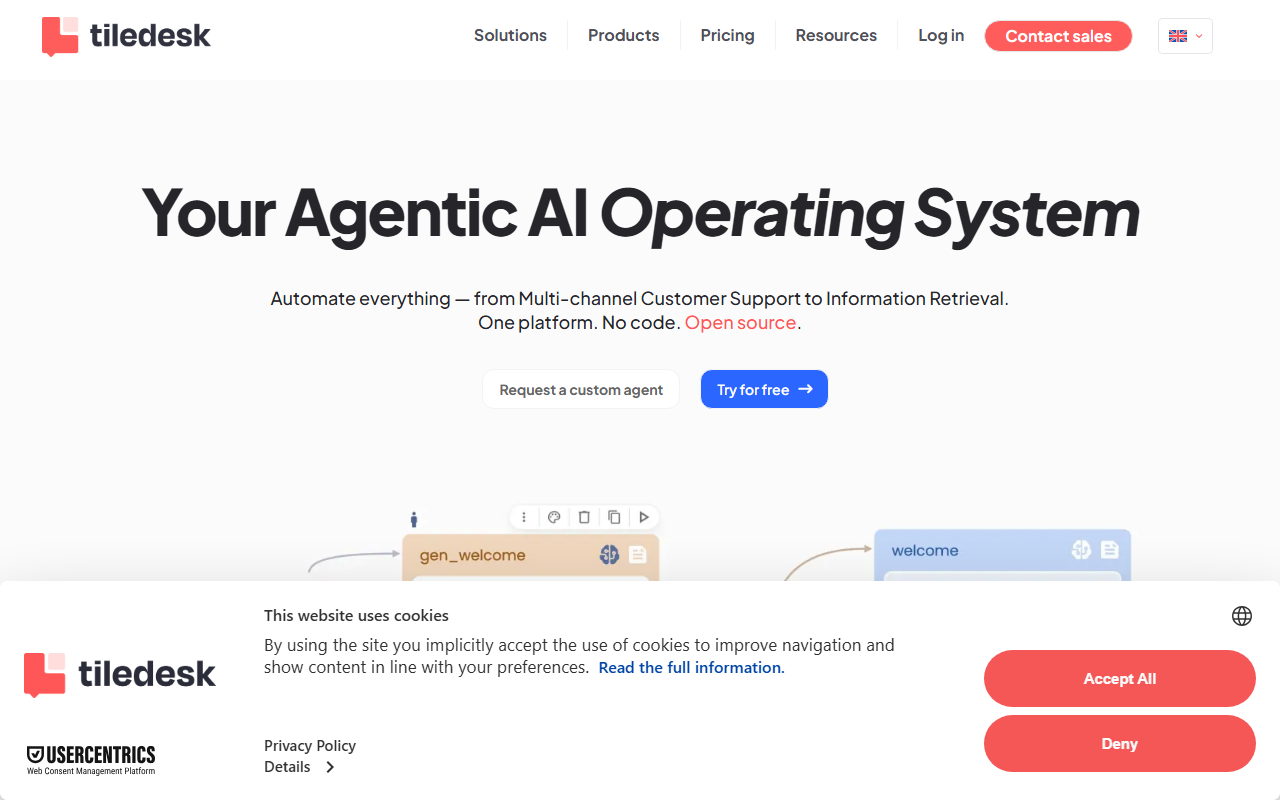
When I visited the Tiledesk website, the headline immediately set expectations: "Your Agentic AI Operating System." The landing page is clean, with a prominent "Try for free" button and a demo scheduling option. The dashboard—once I signed up via the 14-day free trial (no credit card required)—feels modern and well-organized. The left-hand menu exposes "Converse," "Automate," "Scheduling," and "Email" modules, each offering visual builders. Onboarding took less than five minutes; I was guided to create my first conversational agent by selecting a channel (web chat, WhatsApp) and connecting a test knowledge base. The no-code claim holds up: I could drag-and-drop conversation nodes without writing a single line of code. However, advanced users will appreciate the API and MCP support for deeper customization.
Core Features and Workflows
Tiledesk splits its capabilities into two primary modes: Converse for real-time conversational scenarios and Automate for batch processing. Under Converse, I designed a customer support flow that used a visual tree to handle FAQs, escalate to a human when needed, and pull order status from an API. The knowledge base module—called "Intelligent Knowledge Management & Search"—ingests documents and uses agentic RAG to retrieve and generate answers. What sets it apart is the Self-learning feature: the AI listens to every conversation, extracts new information, and automatically updates the knowledge base. I tested this by feeding a few mock customer queries; the knowledge base expanded without manual intervention. For automation, I set up an API endpoint, chained prompts, and triggered a Slack notification—all through the UI. Scheduling works by connecting Google Calendar, collecting availability from users, and booking appointments automatically. The email integration reads inbound emails, builds a historical timeline, and drafts replies based on past interactions.
Use Cases and Integration Ecosystem
Tiledesk shines in multi-channel customer support. I deployed an agent to WhatsApp in minutes using the built-in WhatsApp Business API connector. The platform also integrates with Shopify for e-commerce—displaying product catalogs, managing carts, and answering product questions. For enterprise use, the open-source nature means you can self-host, avoiding vendor lock-in. The AI agents can handle complex workflows: they can retrieve order data via API, escalate tickets with full context, and even send proactive outbound messages (appointment reminders, order updates). Competitors like Intercom or Zendesk offer similar conversational AI but are closed-source and often more expensive. Tiledesk positions itself as a flexible alternative, especially for teams that want full control over their data and AI logic.
Pricing and Final Verdict
Pricing is not publicly listed on the website. The site offers a 14-day free trial with no credit card required, but to get exact costs you must contact sales or request a custom agent. This lack of transparency may frustrate small teams or solo users. During my test, I also noticed that building complex automation logic still requires an understanding of prompt engineering and API design—so it’s not entirely code-free for advanced scenarios. Strengths include the open-source license, self-learning knowledge base, and multi-channel deployment. Limitations are the opaque pricing and a learning curve for non-technical users when configuring API-driven automations. I recommend Tiledesk for medium-to-large enterprises that need a customizable, data-sovereign AI operating system for customer operations and want to avoid subscription lock-in. Smaller teams should start with the free trial to gauge whether the complexity fits their needs. Who should look elsewhere: absolute beginners who want a plug-and-play chatbot like Tidio or purely text-based AI chatbots with transparent flat pricing. Who should try it: teams already using open-source tools and needing an orchestration layer for multi-agent, multi-channel AI workflows. Visit Tiledesk at https://tiledesk.com/ to explore it yourself.













Comments