

First Impressions and Platform Overview
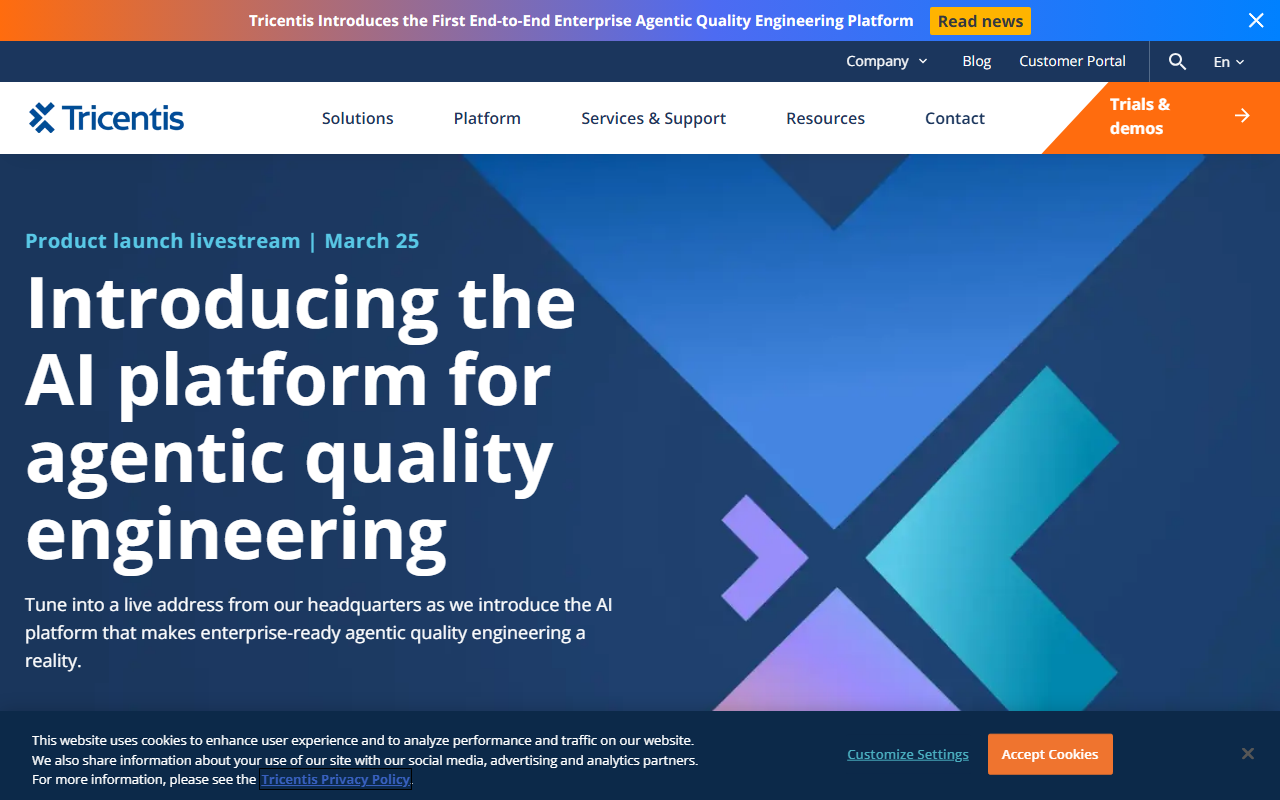
Upon visiting the Tricentis website, I was immediately struck by the emphasis on their new “Agentic Quality Engineering Platform.” The homepage prominently features the ability to “orchestrate agentic testing across your entire enterprise from a single platform.” The layout is clean, with a strong focus on AI-driven capabilities and integration with major enterprise systems like SAP, Salesforce, and Oracle. The dashboard imagery suggests a centralized control pane where AI agents can be managed, workflows defined, and policies enforced. The site also highlights their recognition as a Leader in the 2025 Gartner Magic Quadrant for AI-Augmented Software Testing Tools and the 2025 Forrester Wave for Autonomous Testing Platforms, lending immediate credibility.
Core Capabilities and AI Integration
Tricentis positions itself as more than just a test automation tool—it’s a full “agentic” platform covering the entire software development lifecycle. The AI Workspace serves as the control plane, allowing teams to operate and govern multiple AI agents. I explored the five main modules: Agentic test automation (generates resilient tests from natural language), Agentic test management (context-aware test creation and maintenance), Agentic performance testing (continuous validation with AI-driven design/analysis), and Agentic quality intelligence (blocking untested code, running only relevant tests). A key technical detail: the platform uses agentic AI agents that can interact via MCPs and APIs, as noted by a testimonial from Wolters Kluwer’s VP of Quality Engineering. This suggests a sophisticated orchestration layer that can even coordinate developer agents, not just testing agents.
Pricing and Target Audience
Pricing is not publicly listed on the website. Given the enterprise nature of the platform—supporting SAP, Salesforce, Oracle, and large-scale deployments—it’s safe to assume a subscription model with likely significant cost. This tool is best suited for large enterprises with complex, multi-technology environments and dedicated QA teams looking to adopt AI-driven workflows at scale. It is less appropriate for startups, small teams, or projects with simple testing needs, as the learning curve and investment may be prohibitive. Competitors include traditional tools like Selenium and Micro Focus UFT, as well as newer AI-driven platforms such as Testim and Functionize. However, Tricentis differentiates itself with its holistic agentic approach and deep enterprise integrations.
Strengths, Limitations, and Final Verdict
A genuine strength is the unified AI orchestration: instead of piecemeal AI features, Tricentis provides a single control plane to manage testing agents across the SDLC, with built-in governance and approval gates. The platform’s ability to handle complex ERP systems like SAP is a clear differentiator for many large organizations. However, a real limitation is the lack of transparency around pricing and the likely complexity of initial setup. Without a free tier or trial (none mentioned on the site), teams cannot easily evaluate the tool. Additionally, the heavy focus on AI agents may be overwhelming for teams still mastering traditional test automation. For whom is this tool? Enterprise QA leaders seeking to innovate at the speed of AI while maintaining risk control. For everyone else, consider starting with simpler, more accessible tools. Visit Tricentis at https://tricentis.com/ to explore it yourself.










Comments