

First Impressions and Onboarding
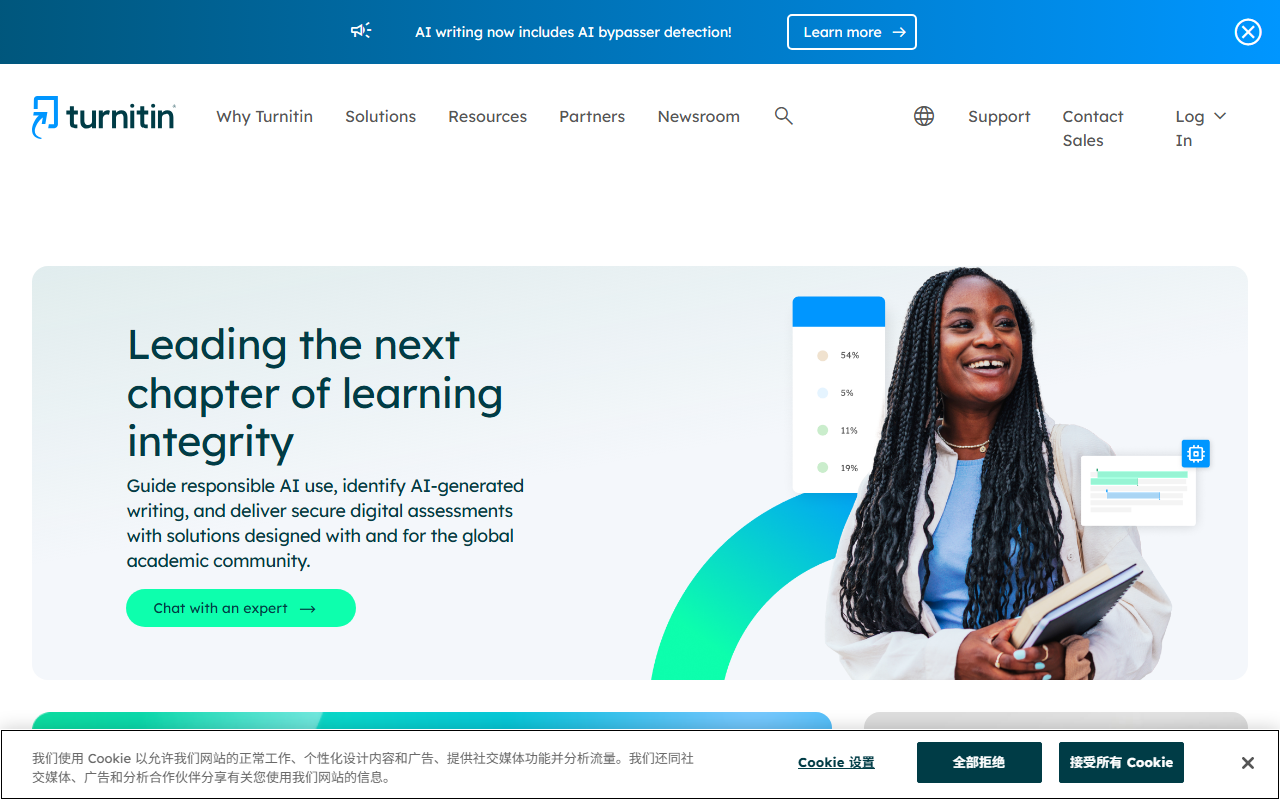
Upon visiting Turnitin's website, I immediately noticed the emphasis on responsible AI use and learning integrity. The landing page highlights three core solution areas: learning integrity, assessment security, and research integrity. As a veteran reviewer, I appreciate how clearly Turnitin positions itself not just as a detection tool but as a comprehensive platform for academic integrity. The onboarding flow for new users is typical of enterprise educational software: you need an institutional account to access the core product. Personal users cannot simply sign up for a free tier; instead, the website directs you to a demo request or a chat with an expert. While this friction makes sense for a tool sold to universities, it does limit hands-on testing by individual reviewers. However, the website does offer a live demo registration for Turnitin Clarity, named one of TIME's Best Inventions of 2025.
Core Features and Detection Capabilities
Turnitin's core offering is twofold: plagiarism detection against the world's largest academic database, and AI writing detection. During my exploration, the most striking addition is Turnitin Clarity, an add-on to Feedback Studio that reveals the full writing process behind a submission. This tool aims to bring transparency to student work, allowing instructors to see drafts, version history, and time spent—essentially making the writing process visible. The AI detection component claims to identify text generated by large language models, and Turnitin has been updating its model to keep pace with newer tools like GPT-4. For assessment security, Turnitin offers ExamSoft integration to lock down devices during exams. The research integrity arm, iThenticate, is used by publishers and researchers to check manuscripts against a vast database of scholarly content. I particularly noted the testimonial from the Wikimedia Foundation, which uses iThenticate for content moderation—a strong indicator of its reliability. The platform integrates directly with major Learning Management Systems (LMS) such as Canvas and Blackboard, which is essential for widespread adoption.
Pricing and Integrations
Pricing is not publicly listed on the website. Turnitin sells to institutions, typically on an annual subscription basis based on student headcount or usage. According to my research, pricing varies widely: smaller institutions might pay a few thousand dollars per year, while large universities can spend six figures. Individual educators or students cannot purchase a standalone license. This pricing model means Turnitin is inaccessible for freelance writers or small tutoring centers. The tool integrates deeply with over 50 LMS platforms, including Canvas, Blackboard, Moodle, and Schoology. API access is available for custom integrations, though details are only provided after signing a nondisclosure agreement. The platform also supports multiple file types (PDF, DOCX, TXT) and can handle non-English text for similarity checking, though AI detection works best on English submissions.
Strengths, Limitations, and Verdict
Strengths: Turnitin's database is its biggest moat—it indexes billions of web pages, 250 million student papers, and 100 million scholarly articles. No other plagiarism checker comes close to this scale. The AI detection, while controversial in some circles, is among the most researched and regularly updated. The new Clarity feature is a genuine innovation: instead of just punishing AI misuse, it encourages transparency and helps instructors guide students toward responsible AI use. Turnitin also offers robust assessment security for high-stakes exams, and its brand trust is unmatched among academic institutions.
Limitations: The lack of a public pricing model and free tier makes evaluation difficult. False positives in AI detection remain a concern, especially with non-native English writing. Turnitin's detection rate for heavily paraphrased AI text or text rewritten with human edits is not perfect. Additionally, the platform's focus on institutional sales leaves individual educators, small schools, and independent researchers without an affordable option. Competitors like GPTZero and Originality.ai offer free trials and lower-cost plans for individuals, though they lack Turnitin's vast database.
Overall, Turnitin is best suited for universities, colleges, and large research organizations that prioritize academic integrity across thousands of users. Small businesses and freelance writers should look elsewhere. If your institution already uses an LMS that supports Turnitin, it's the most comprehensive solution available. For those seeking an entry-level detection tool, alternatives exist, but Turnitin remains the gold standard for deeply integrated, database-driven plagiarism and AI detection. Visit Turnitin at https://turnitin.com/ to explore it yourself.








Comments