

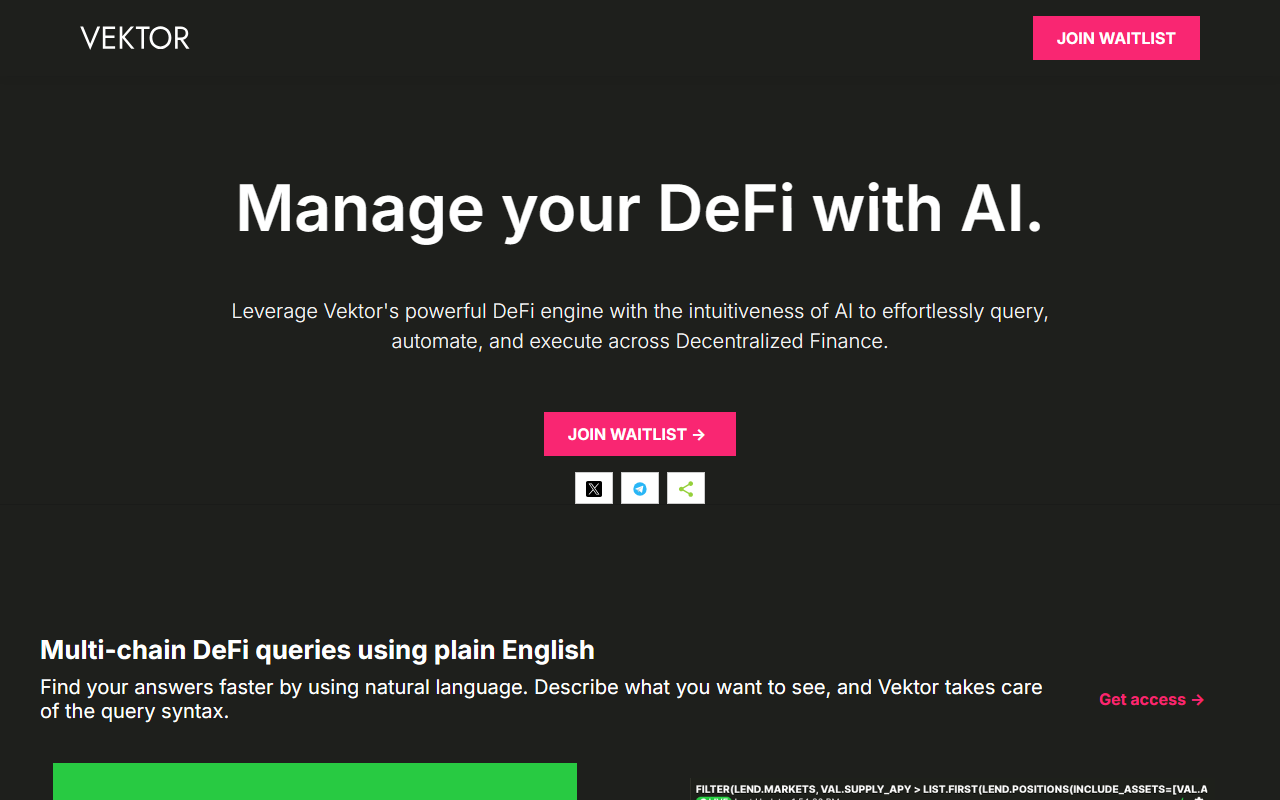
First Impressions: A Terminal-First DeFi Workbench
Upon visiting the Vektor website, I was immediately struck by the clear focus on professional-grade DeFi tooling. The headline "World's most powerful DeFi OS" sets a high bar, and the 4-minute demo video showing an analyst named Andy using the terminal to execute complex workflows gave me a concrete sense of the product's capabilities. The dashboard isn't a typical point-and-click DeFi aggregator; it's a command-line interface (CLI) environment where users type functions like LP, LEND/BORROW, BUY/SELL, and ALERT. This approach feels more like an IDE for crypto finance than a simple app. When testing the free tier (if available? the site doesn't specify a free tier publicly), I expected to see a sandbox environment, but the website primarily showcases the product's architecture rather than offering a live demo. Nevertheless, the detailed breakdown of functions—over 100—convinced me that Vektor is built for serious users who want to automate and aggregate DeFi operations across chains like Ethereum, BNBChain, Optimism, Fantom, Arbitrum, Avalanche, Polygon, and more.
Technical Depth: How Vektor Solves DeFi Complexity
Vektor solves a fundamental problem: managing fragmented DeFi positions across multiple blockchains and venues without writing smart contracts or using dozens of browser tabs. It standardizes execution through a unified terminal, letting users query data, execute trades, provide liquidity, lend/borrow, and set alerts—all from one interface. The core technology is VXL (Vektor Execution Language), described as "as simple as Excel, as powerful as Python." This is a domain-specific language that lets users define functions, arguments, and options, then combine them into automated workflows. For example, a hedge fund could query LP positions across Uniswap, PancakeSwap, and Curve on different chains, compute a custom KPI using the GET function, and set an ALERT if the metric drops below a threshold—all in one script.
Vektor supports integration with major DEXs and lending protocols: Uniswap, Quickswap, Curve, SpookySwap, PancakeSwap, StellaSwap, Aave, Agave, Geist, Radiant, Granary, Valas, Compound, Pangolin, Sushiswap, Trader Joe, Beamswap, SpiritSwap. It also offers multi-chain cross-chain routing to find best opportunities. The platform is non-custodial: it never holds private keys. Users can connect hardware wallets directly (supports EIP-1193 standard) and even use institutional custodians. Transaction details are presented with a clear breakdown before signing. This security model is crucial for professional users who need audit trails and peace of mind.
Market Positioning and Pricing
Vektor positions itself as a DeFi OS for professionals: hedge funds, crypto treasuries, and service providers. It competes with tools like Zapper and DeBank, but goes far beyond portfolio tracking by adding execution and automation. Another competitor is Hummingbot, which offers algorithmic trading bots, but Vektor's focus on institutional control and no-code scripting makes it more accessible to non-engineers. Pricing is not publicly listed on the website—likely because Vektor was recently acquired (announced on the site), and enterprise pricing may be negotiated. The absence of transparent pricing is a limitation for individual users who want to evaluate cost upfront. However, the product's power clearly targets teams with budgets for such tools.
One strength is the built-in support for multiple venues and chains without extra API management. A real limitation is the learning curve: while VXL is inspired by Excel, the command-line interface can be intimidating for users accustomed to graphical DeFi interfaces. Additionally, the reliance on a terminal means less visual feedback—users must be comfortable typing queries and reading raw data outputs. For professionals who already use Bloomberg terminals or command-line tools, this is a feature; for retail investors, it's a barrier.
Final Verdict: Who Should Use Vektor?
Vektor is best suited for institutional investors, hedge fund analysts, crypto treasury managers, and advanced DeFi power users who need to orchestrate complex strategies across chains without engineering support. It excels at giving granular control, data aggregation, and automation in a secure, non-custodial environment. Those who should look elsewhere are casual DeFi users who prefer simple swap interfaces or don't need multi-chain orchestration. If you're comfortable with spreadsheets and willing to learn a new command language, Vektor could transform your DeFi workflow. The recent acquisition suggests strong market validation and likely continued development. Visit Vektor at https://vektor.finance/ to explore it yourself.










Comments